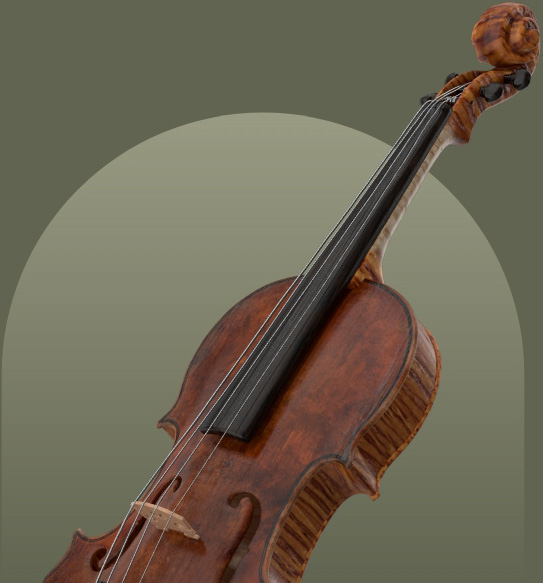
Mirecourt School
Jean Aldric
Mirecourt, worked 1726–1730
Jean Aldric was a French luthier and dealer, active primarily in Paris from 1788 until after 1840, though some sources suggest an earlier period in Mirecourt. He was renowned for crafting instruments modelled after Cremonese originals, particularly Stradivari, using a distinctive red varnish and producing instruments with fine tone. He was also highly skilled in converting old violas into modern violins and was a significant dealer, notably being one of the first Parisian violin makers to engage with the famous connoisseur Luigi Tarisio. His nephew, Aubry, later succeeded him in his workshop.
Maker Overview
Life
Sources contain conflicting information regarding Jean Aldric's working period and location. in The Brompton's Book of Violin & Bow Makers, Jean Aldric worked circa 1726-1730 in Mirecourt, France. However, other prominent sources, such as Willibald Leo Lütgendorff's Die Geigen- und Lautenmacher vom Mittelalter bis zur Gegenwart and Cecie Stainer's A Dictionary of Violin Makers, place his activity primarily in Paris from 1788 until after 1840. Stainer notes he worked in Paris from 1788-1840, while Lütgendorff states he settled in Paris around 1788 and died after 1843. He was a skilled representative of the French school, working after the Stradivari model. Jean Aldric was also particularly known as a dealer in Cremonese instruments, and in The Violin, he was one of the earliest French makers to deal with Luigi Tarisio, the famous Italian connoisseur. Lütgendorff further specifies that he was the first Parisian violin maker to establish contact with the collecting genius Tarisio. His business successor was his nephew, Aubry.
Characteristics
- Modeling
- Jean Aldric's instruments were modelled after Cremonese originals, specifically the Stradivari pattern.
- Varnish
- He generally used a red varnish of good quality, which Stainer describes as rich red. Lütgendorff notes that he mostly used red varnish, though sometimes it was too thick.
- Output
- His output was small.
- Tone
- His instruments were known for their fine tone.
- Conversion Skill
- He was particularly skilled at converting old violas into modern violins, and constructed altos from old Italian viols with great cleverness.
- Repairs
- He carefully repaired old instruments.
Influence and legacy
- School: Jean Aldric was a skilled representative of the French school of violin making.
- Peer Comparison: Lütgendorff notes that his work sometimes approached the quality of Nicolas Lupot.
- Museum Holdings: A violin made by Jean Aldric is preserved in the Museum of the Paris Conservatorium (No. 27).
- Succession: His nephew, Aubry, succeeded him in his business.
Biographies
The overview above is drawn from the following published accounts. Read them in the original:
John Dilworth+
ALDRIC, Jean Worked circa. 1726-1730 Mirecourt France. Instruments modelled after Cremonese originals. Small output.
Willibald Leo Lütgendorff+
Er liess sich um 1788 in Paris nieder und starb nach 1843. Ein geschickter Vertreter der französ. Schule, der nach dem Strad.-Modell arbeitete und manchmal selbst N. Lupot nahekam. Er verwendete meist rothen, nur manchmal zu dicken Lack und war besonders dafür bekannt, dass er alte Violen in moderne Geigen trefflich umzubauen verstand, die er dann wohl auch als Originale alter Meister verkauft haben wird. Als Händler hatte er besondere Bedeutung und er war auch der erste Pariser Geigenbauer, der mit dem Sammelgenie Tarisio in Verbindung trat. Er wohnte zuerst in der Rue des Arcis No. 16 und seit dem Anfang des 19. Jahrh. Rue de Seine St. Germain No. 71 (»pres celle de Bussy«). Sein Geschäftsnachfolger war sein Neffe Aubry. Er verwendete sowohl geschriebene, als gedruckte Zettel. Eine Violine von ihm befindet sich im Museum des Pariser Conservatoriums (No. 27).
George Hart+
Copied Stradivari with average ability. He was, perhaps, better known as a dealer in Cremonese instruments. He was one of the earliest French makers who dealt with Luigi Tarisio, the famous Italian connoisseur. He used generally a red varnish of good quality.
Cecie Stainer+
Worked in Paris, 1788-1840. Was well known for the excellent instruments he made, on the Stradivari pattern, of fine tone, with rich red varnish. He also constructed altos from old Italian viols with great cleverness and carefully repaired old instruments. An early violoncello of his is dated 1788. In another violoncello was the label, “Fait par Aldric, luthier, rue des Arcis, 16, Paris, 1792.” Later he moved to 71, rue de Seine, Saint-Germain, where, in 1840, his nephew Aubry succeeded him.
Sell your instrument with Amati
Get started by uploading photos of your instrument for our experts to review.
Sell your instrument with Amati
Get started by uploading photos of your instrument for our experts to review.