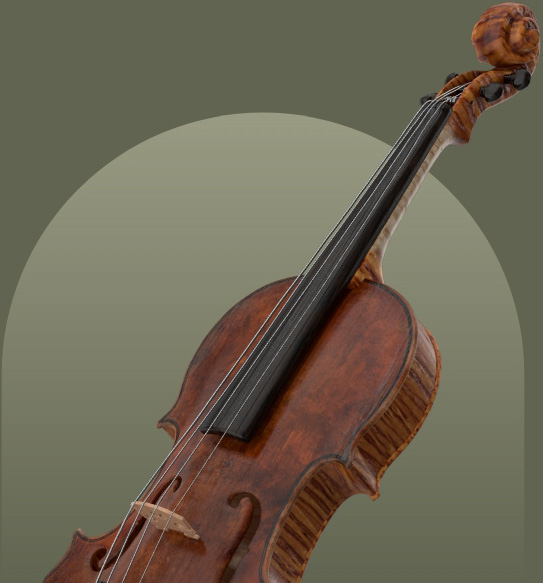
Anton (II) Sprenger
1833–1900
Anton (II) Sprenger (1833-1900) was a notable luthier born in Mittenwald, who established his workshop in Stuttgart in 1870 and was later appointed luthier to the court. He was recognized for his accurately made violins and cellos, often based on Stradivari and Guarneri patterns, and praised for their noble tone. Sprenger utilized both oil and spirit varnishes, including amber, with a distinctive golden-red tint. He was an innovator, credited with the invention of the Tonschraube (sound screw) and the Paganini-Kinnhalter (Paganini chinrest), and also worked on producing quintenreine Saiten (strings perfect in fifths). His training involved various masters, including G. Tiefenbrunner and Anton Hornsteiner, and he undertook further studies across Europe. His legacy includes numerous exhibition medals, honorary diplomas, and a violin preserved in the Museum of Cologne. His son, Adolf Sprenger, continued his business after his retirement in 1897.
Maker Overview
Life
Anton (II) SPRENGER (1833-1900) was born in Mittenwald, with sources providing conflicting birth years of 1833 and 1834. He died in 1900 in Stuttgart, Germany. Sprenger established himself independently in Biberach before moving to Ulm, and then relocated his business to Stuttgart in 1870, where he took over the business of M. Maur. He was later appointed luthier to the court. Anton (II) Sprenger retired in 1897, and his son, Adolf Sprenger, succeeded him in the business.
Characteristics
- Models
- Anton (II) Sprenger primarily focused on constructing new violins and cellos based on Stradivari and Guarneri patterns.
- Varnish
- He utilized both oil and spirit varnishes, with a noted golden-red tint. Willibald Leo Lütgendorff also mentions the use of amber varnish.
- Workmanship
- His instruments were accurately made and praised for their noble tone and clean workmanship.
- Innovations
- Sprenger developed several innovations, including an internal adjustable longitudinal supporting tube, though this was ultimately unsuccessful. He also invented the well-known Tonschraube (sound screw), which consists of a sound post running through the instrument from the neck to the scroll, artificially increasing the natural tension of the strings. This device was intended to distribute vibrations more evenly throughout the instrument's body and significantly improve poor, tonally weak instruments. Furthermore, Sprenger invented the so-called Paganini-Kinnhalter (Paganini chinrest) and worked on producing strings that were perfect in fifths (quintenreine Saiten).
- Violin in the Museum of Cologne labelled: Anton Sprenger
fecit Stuttgart, anno 1881John Dilworth
Influence and legacy
- Teachers: Sources contain conflicting information regarding his early training. John Dilworth states he was a pupil of G. Tiefenbrunner. Willibald Leo Lütgendorff also identifies him as a student of Gg. Tiefenbrunner. Cecie Stainer, however, notes he was a pupil of Anton Hornsteiner in Mittenwald and later worked under Tiefenbrunner of Munich, as well as Kindl and Fischer in Vienna.
- Further Training: For additional training, he traveled to Augsburg, Passau, Linz, and Vienna.
- Succession: His son, Adolf Sprenger, succeeded him in the business in 1897.
- Recognition: Anton (II) Sprenger received numerous exhibition medals and honorary diplomas.
- Museum Holdings: A violin made by him in 1881 is preserved in the Museum of Cologne.
Biographies
The overview above is drawn from the following published accounts. Read them in the original:
John Dilworth+
Anton (II) Born 1833 Mittenwald, died 1900 Stuttgart Germany. Pupil of G. Tiefenbrunner. Established independently in Stuttgart from 1873, taking over the business of M. Maur. Appointed luthier to the court. Retired 1897. Succeeded by his son Adolf Sprenger, above. Stradivari and Guarneri models, accurately made. Both oil and spirit varnishes noted; golden-red tint. Several novel but ultimately unsuccessful innovations, including an internal adjustable longitudinal supporting tube. Violin in the Museum of Cologne labelled: Anton Sprenger / fecit Stuttgart, anno 1881
Cecie Stainer+
b. 1834, Mittenwald. Was there a pupil of Anton Hornsteiner, later worked under Tiefenbrunner of Münich, and Kindl and also Fischer in Vienna. In 1870 he settled at Stuttgart at 23, Hospitalstrasse. He made violins and violoncellos on the Stradivari and Guarneri patterns, using oil varnish of good quality. Died 1900.
Willibald Leo Lütgendorff+
Schüler von Gg. Tiefenbrunner, ging zu seiner weiteren Ausbildung nach Augsburg, Passau, Linz und Wien, machte sich zunächst in Biberach selbstständig, zog dann nach Ulm und verlegte 1870 sein Geschäft nach Stuttgart, wo er Nachfolger Martin Baur’s und später Hofinstrumentenmacher wurde. Er befasste sich vorzugsweise mit dem Neubau von Geigen und Violoncelli nach Stradivari und Guarneri und verwendete Bernstein-, Öl- und auch Spirituslack. Seinen Instrumenten wird edler Ton und saubere Arbeit nachgerühmt; er besaß zahlreiche Ausstellungsmedaillen und Ehrendiplome und ist der Erfinder der bekannten Tonschraube. Diese besteht aus einem Klangstabe, der vom Hals bis zum Köpfchen durch das Instrument geführt wird und die natürliche Spannung der Saiten künstlich erhöht. Die Vibration wird dem Körper des Instruments gleichmässiger mitgetheilt, und schlechte, tonarme Instrumente können durch die Tonschraube ganz entschieden verbessert werden. Sprenger erfand ferner den sogen. Paganini-Kinnhalter und beschäftigte sich mit der Herstellung quintenreiner Saiten. Im Jahre 1897 übergab er sein Geschäft seinem Sohne.
Sell your instrument with Amati
Get started by uploading photos of your instrument for our experts to review.
Sell your instrument with Amati
Get started by uploading photos of your instrument for our experts to review.