
Robert Thompson
worked 1743–1770
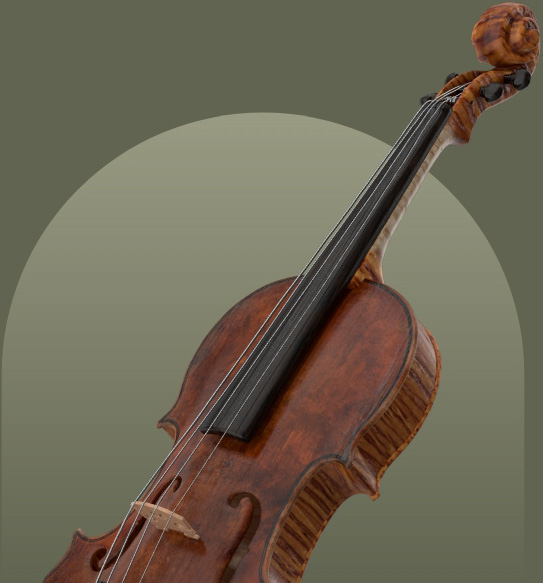
Robert Thompson was a London-based violin maker active from approximately 1743 to 1770, known for producing instruments on the Stainer model.
Auction price history
Highest auction price
| Type | Details | Sold | Price |
|---|---|---|---|
| Viola | 38.5 cm 1750 | July 2003 | £1,589 |
| Cello | 17-- | March 1993 | £10,120 |
| Cello | 1750 c. | June 1983 | £1,728 |
| Cello | 1764 | April 1983 | £4,620 |
Maker Overview
Life
Robert Thompson (circa 1743-1770) worked in London, UK, and was the brother of Peter Thompson.
Characteristics
- Model
- Instruments were made on the Stainer pattern, a common practice among his contemporaries in England, and Willibald Leo Lütgendorff.
- Varnish
- John Dilworth describes the varnish as a 'dull grey-brown', while Henri Poidras mentions 'yellow varnish'.
- Workmanship
- John Dilworth characterizes the standard as 'mediocre' in Stainer imitations, whereas William Meredith Morris describes it as 'Good average work', and Willibald Leo Lütgendorff states 'Seine Arbeit ist gut' (His work is good).
- Robert Thompson at the Bass-Violin in
Paul’s Ally, St. Paul’s Churchyard
London 1749John Dilworth - Robert Thompson
fecit, London, 1743John Dilworth - Robert Thompson
no 8 Lombard StreetJohn Dilworth
Influence and legacy
- Mentorship: John Dilworth suggests that Robert and his brother Peter were probably pupils of Daniel Wright.
- Tradition: They continued in a similar standard of Stainer imitations, following the tradition of their probable teacher.
- Family Continuity: Cecie Stainer reports that Robert Thompson was succeeded by his sons, Charles and Samuel, who worked from about 1775 to 1785.
- Collaborations: Willibald Leo Lütgendorff notes that around 1764, he operated his business jointly with one of his sons, likely Charles.
- Later Generations: Samuel and Peter Thompson, instrument makers, were also mentioned in the musical directory of 1794 in St. Paul's Churchyard.
Biographies
The overview above is drawn from the following published accounts. Read them in the original:
John Dilworth+
THOMPSON, Robert Worked circa. 1743-1770 London UK. Brother of Peter Thompson, above. Succeeded to the business of Daniel Wright: formerly the workshop of Barak Norman at the sign of the ‘Bass Violin’ (or the ‘Bass Viol)’ near the Chapter House on the north side of St. Paul’s Churchyard. This was in opposition to his brother Peter’s shop at the west side of the churchyard. Robert moved to 8 Lombard Street (also referred to as Sherborne Lane) in 1770. The brothers were probably pupils of Wright and continued in a similar mediocre standard of Stainer imitations with dull grey-brown varnish. Robert is the only one of the family whose signature has been found inside an instrument, suggesting that he was an actual maker rather than an entrepreneur. Signature inside a cello labelled and sold by John Simpson: ‘Robert Thompson, London 1745’. Printed label: Robert Thompson at the Bass-Violin in / Paul’s Ally, St. Paul’s Churchyard / London 1749 Robert Thompson / fecit, London, 1743 Robert Thompson / no 8 Lombard Street [BVMA]
Cecie Stainer+
A maker in London, at the sign of the “Bass-Violin,” in St. Paul’s Churchyard, about 1749-64. His instruments were made on the Stainer pattern. He was succeeded by his sons, Charles and Samuel, who worked about 1775-85. Labels; ” Robert Thompson att the Bass-Violin in Paul’s ally. St- Paul’s Churchyard, London, 1749,” and ” Made by Thompson and Son at the Bass-Violin, the west end of St- Paul’s Churchyard, London, 1764.” The printed label (two were dated 1775 and 1785) is, ” Made and sold by Chas. and Saml. Thompson in St. Paul’s Churchyard ” In the musical directory of 1794 were also mentioned Samuel and Peter Thompson, instrument makers in St. Paul’s Churchyard.
William Meredith Morris+
He worked at the sign of the ” Bass-violin,” in St. Paul’s Churchyard. Good average work on the Stainer model.
Willibald Leo Lütgendorff+
Seine Arbeit ist gut; er arbeitete, wie seine meisten Zeitgenossen in England, nach dem Stainer-Modell. Um 1764 betrieb er sein Geschäft mit einem seiner Sohne gemeinschaftlich, wohl mit Charles, der der älteste gewesen zu sein scheint.
Henri Poidras+
London 1745. Stainer model. Yellow varnish.
Sell your instrument with Amati
Get started by uploading photos of your instrument for our experts to review.
Sell your instrument with Amati
Get started by uploading photos of your instrument for our experts to review.
Family
Peter (I) Thompson Brother