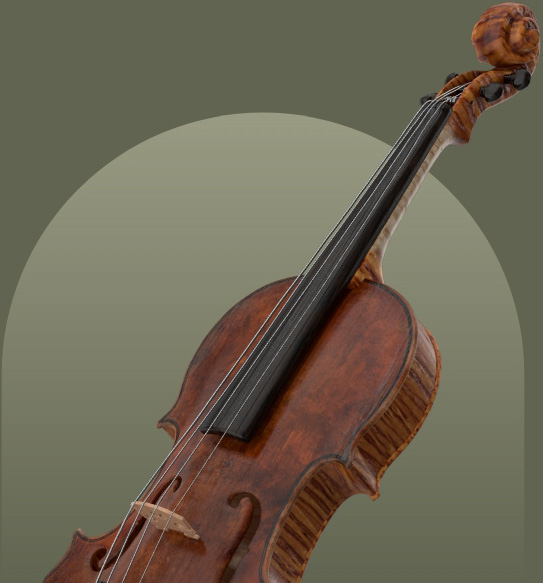
Giovanni Maria Valenzano
Rome, Valencia
Giovanni Maria Valenzano was an Italian luthier active from 1770 until after 1827, born in Asti. He is recognized as a significant, though somewhat underestimated, figure of the early 19th century. Valenzano was notable for being among the first to explore the Guarneri del Gesù model as an alternative to Stradivari, possibly influenced by his connection to Niccolò Paganini. His career involved extensive travel, with documented periods of work in Asti, Padua, Valenza, Barcelona, Montpellier, Marseille, Nice, Genoa, Rome, and Trieste. Sources also mention his work in Naples. His craftsmanship, while sometimes described as unrefined in early stages, evolved to produce instruments with a fine Stradivari-derived form, Amati-like models, and influences from the Milanese and Neapolitan schools. He used fine wood and applied a distinctive golden-yellow or pinkish-orange varnish.
Auction Price History
Highest auction price
10 results
| Type | Details | Auction house | Sold | Price |
|---|---|---|---|---|
| Violin | 35.6 cm 18th C. (head later) Attributed to | — | November 2011 | £3,571 |
| Violin | 35.3 cm 1800 c. Ascribed to | — | October 2011 | £3,600 |
| Violin | 35.2 cm Valenza, 1821 | — | March 2011 | £22,800 |
| Violin | 35.3 cm 19th C. Attributed to | — | March 2009 | £9,375 |
| Violin | 35.5 cm | — | March 2009 | £3,125 |
| Violin | 35.7 cm Ascribed to | — | October 2007 | £8,565 |
| Violin | Rome, 1820 c. Probably by | — | May 2005 | £7,200 |
| Violin | 1826 | — | June 1990 | £35,200 |
| Violin | 1794 | — | June 1990 | £16,500 |
| Violin | 1810-25 | — | May 1981 | £9,350 |
No results match those filters.
Maker Overview
Life
Giovanni Maria Valenzano (b. Asti, d. after 1827 Trieste Italy) was an active luthier from 1770, initially in Asti. in The Brompton's Book of Violin & Bow Makers, he is considered a significant and somewhat underestimated luthier of the early 19th century. Dilworth notes that Valenzano was one of the first violin makers to explore the Guarneri del Gesù form and model as an alternative to the established Stradivari pattern, a development possibly influenced by his links with Niccolò Paganini, whose origins and early life were in the same region.
Characteristics
- Model & Form
- Valenzano's work generally shows a well-judged approach on a fine Stradivari-derived form, though he was also one of the first to explore the Guarneri del Gesù model. Karel Jalovec notes that his instruments are designed on the model of Amati, provided with moderate arching. Willibald Leo Lütgendorff states that his model fluctuates between that of the Milanese and Neapolitan schools.
- Workmanship
- Early work is described by John Dilworth as unrefined and somewhat reminiscent of Testore instruments, featuring small finial circles to the soundholes. Even his best work is not highly finished, with a distinctive feature being knife marks fanning out from the purfling points in each corner. Jalovec, however, describes his instruments as carefully finished and endowed with a good tone. Lütgendorff characterizes his work as 'handwerksmässig' (craftsmanlike).
- Scroll
- The scroll shows influence of the Genoa school, featuring a straight pegbox and a small upright volute.
- Copies
- He produced some Guadagnini copies, as well as rare instruments with strong del Gesù features in the soundholes, scroll, and arching.
- Materials & Varnish
- Jalovec notes that he used fine wood. The varnish is typically golden-yellow or a slightly pinkish orange, similar to that used by Spanish makers. Jalovec also mentions a good yellow or brown-yellow varnish.
- Revisum et Correctum da me
Joanne Valenzano
anno 1796John Dilworth - Joannes Valentianus
Pédémontanus 1798John Dilworth - Johannes Maria Valenzano
in Padova 1800John Dilworth - Joannes Maria Valenzano
Astensis in Valentia fecit 1804John Dilworth - Johannes Valenzano
in Barcelona 1809John Dilworth - Johannes Valenzano, Astensis
Nicea, fecit Domini 1815John Dilworth - Johannes Valenzano, Astensis
Genova, fecit 1818John Dilworth - Joannes Maria Valenzano
Astensis fecit Romae 1825John Dilworth - Johannes Valenzano,
Trieste 18..John Dilworth
Influence and legacy
- Mentorship & Schools: His scroll work shows influence from the Genoa school. His models were also influenced by the Milanese and Neapolitan schools.
- Innovation: Valenzano was notable for being one of the first violin makers to explore the Guarneri del Gesù form and model as an alternative to the established Stradivari pattern.
- Associations: His links with Niccolò Paganini, whose origins were in the same region, may have influenced his exploration of the Guarneri del Gesù model.
- Reputation: John Dilworth describes Giovanni Maria Valenzano as a significant and somewhat underestimated luthier of the early 19th century.
- Contemporary Recognition: Niccolò Paganini remarked in 1827 that Valenzano was 'doing very well' in Trieste.
Biographies
The overview above is drawn from the following published accounts. Read them in the original:
John Dilworth+
VALENZANO, Giovanni Maria b. Asti, d. after 1827 Trieste Italy. Active in Asti from 1770. Significant and somewhat underestimated luthier of the early 19th century. One of the first violin makers to explore the Guarneri del Gesù form and model as an alternative to the established Stradivari pattern, thanks to his links with Paganini whose origins and early life were in the same region. According to reported labels Valenzano worked first in Padua (Veneto), subsequently moving around north east Italy and the Mediterranean coast. In 1804 he is found in ‘Valentia’ or Valenza (Piedmont); possibly the origin of his family name. His birthplace of Asti is c.40 km from Valenza and in early labels he calls himself ‘Piedmontese’. Established from 1809 in Barcelona, Spain and from 1813 in Montpellier, Marseille, and from 1815 in Nice, France. Thereafter returned to Italy, working in Genoa 1818, Rome c.1825, and finally Trieste. (His presence there was remarked upon by Paganini in 1827 with the comment that he was doing very well). Work generally well judged on a fine Stradivari-derived form, though early work unrefined and a little reminiscent of Testore instruments with small finial circles to the soundholes. The scroll shows influence of the Genoa school, with straight pegbox and a small upright volute. Even the best work is not highly finished : a distinctive feature is the knife marks fanning out from the purfling points in each corner. Some Guadagnini copies, as well as rare instruments with strong del Gesù features in the soundholes, scroll, and arching. Varnish golden-yellow or a slightly pinkish orange, similar to that used by Spanish makers. Revisum et Correctum da me / Joanne Valenzano / anno 1796 Joannes Valentianus / Pédémontanus 1798 Johannes Maria Valenzano / in Padova 1800 Joannes Maria Valenzano / Astensis in Valentia fecit 1804 Johannes Valenzano / in Barcelona 1809 Johannes Valenzano, Astensis / Nicea, fecit Domini 1815 Johannes Valenzano, Astensis / Genova, fecit 1818 Joannes Maria Valenzano / Astensis fecit Romae 1825 Johannes Valenzano, / Trieste 18.. [De Courcy]
Willibald Leo Lütgendorff+
Er stammte aus Asti und soll (nach Valdrighi 3268) auch in Neapel, nach Anderen in Padua gearbeitet haben. Seine Arbeit ist handwerksmässig, und sein Modell schwankt zwischen dem der Mailänder und dem der Neapolitaner Schule.
Karel Jalovec+
Valencia, Rome, Trieste, 1771 — 1825. He came from Asti, worked in Naples and Padua after the fashion of the Milanese and Neapolitan schools. His instruments are designed on the model of Amati, provided with moderate arching, carefully finished and endowed with a good tone. He used fine wood, and applied a good yellow or brown-yellow varnish. Price 20 — 25.000 Kc.
Sell your instrument with Amati
Get started by uploading photos of your instrument for our experts to review.
Sell your instrument with Amati
Get started by uploading photos of your instrument for our experts to review.