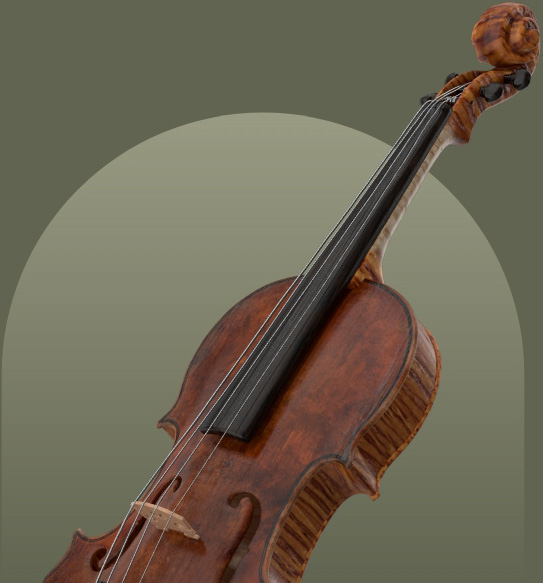
Preston School
James Worden
Preston, 1839–1910
James Worden (1839-1910) was a distinguished English luthier, organ builder, and pianoforte-maker from Preston. Born in Leyland, he received training in cabinetmaking and organ building before establishing his workshop at 83 Friargate Gate. Worden produced approximately fifty violins, along with a tenor, a 'cello, and a guitar. His instruments, known for their excellent workmanship and sweet, velvet-like tone, often followed Stradivari or Maggini models, utilizing well-chosen woods and distinctive design elements like hybrid sound-holes and gracefully carved scrolls. He also played a significant role in Preston's musical community, founding and conducting several societies. His instruments are identifiable by labels featuring dedications to saints and the motto 'Princeps Pacis'.
Auction price history
Highest auction price
5 results
| Type | Details | Auction house | Sold | Price |
|---|---|---|---|---|
| Violin | 25.8 cm Preston, 1899 | — | June 2011 | £384 |
| Violin | 36.5 cm Preston, 1894 (restorations) | — | December 2009 | £432 |
| Violin | 1893 | — | November 2003 | £235 |
| Violin | 1904 | — | November 1989 | £198 |
| Violin | 1904 | — | April 1985 | £176 |
No results match those filters.
Maker Overview
Life
James WORDEN (1839-1910) was born at Leyland on August 25, 1839, the son of George and Ann Worden. His father was a descendant of the Wordens of old Worden Hall, and his mother was a descendant of the Plessingtons of the Dimples, an old Lancashire family, whose lineage includes the Rev. J. Plessington, the last British Roman Catholic martyr executed in 1678. Mr. Worden received a liberal elementary education at the school of the Christian Brothers in Preston. He married Miss Mary Anne Stirzaker in 1868 at the church of St. Joseph, Preston. He served an apprenticeship in cabinetmaking before going to Mr. Francis Booth of Wakefield in 1870 to learn organ building, and later worked for the firm of Messrs. Gray & Davidson. He was a practical pianoforte-maker, organ builder, and violin-maker, maintaining a workshop at 83 Friargate Gate in Preston. He led a very active musical career throughout his life.
Characteristics
- Output
- James Worden produced approximately fifty violins, one tenor, one 'cello, and one guitar.
- Models
- He made instruments on different models, mostly following Stradivari, but sometimes using an adopted model of his own based on the lines of Maggini. John Dilworth also mentions Personal, Stradivari, and Guarneri-derived models. Henri Poidras states his bow instruments have no definite model.
- Workmanship
- His workmanship is described as excellent by William Meredith Morris, with Henri Poidras noting good workmanship, and John Dilworth characterizing it as neatly worked.
- Materials
- The wood used was well chosen for its acoustic properties and generally handsome in appearance. One notable instrument features a Panormo back cut from a partly worked block, discarded by Vincenzo Panormo due to a few worm-holes, which is believed to be from the famous billiard table and exhibits magnificent wood with beautiful cloud-like coruscations and a broad, vivid flame.
- Design Elements
- The sound-holes in his original instruments are a hybrid between those of Stradivari and Joseph Guarneri. The scroll is beautifully carved and exceedingly graceful, though William Meredith Morris suggests it is too slender for the giant model, lacking the boldness and massiveness desired for such an instrument. The button is not of the usual modern British type, being somewhat smaller and more elongated.
- Varnish
- He used Whitelaw's varnish in various colours, as well as Walton's. John Dilworth describes it as commercial oil varnish in various shades.
- Tone
- The tone of his instruments is beautifully sweet and velvet-like. The fiddle with the Panormo back is noted for its round, clear, and penetrating tone.
- Labels
- His instruments bear labels with dedications to different saints and the motto 'Princeps Pacis'. An example label reads: 'James Worden, Maker / Preston, 1900 / Sub titulo St. Caecelia'.
- James Worden, Maker
Preston, 1900
Sub titulo St. CaeceliaJohn Dilworth
Influence and legacy
- Apprenticeship: James Worden served an apprenticeship in cabinetmaking.
- Organ Building Training: He learned the trade of organ building from Mr. Francis Booth of Wakefield and later from the firm of Messrs. Gray & Davidson.
- Musical Societies: In 1883, he founded the Preston Harmonic Society, which he continued to conduct. In 1884, he was appointed conductor of the Preston Orpheonic Male Voice Choir, leading them to take second prize at the Inventions Exhibition in London in 1885, following performances at the Liverpool Eisteddfod in 1884 and the Liverpool Exhibition in 1886. He was also associated with the Preston Choral Society, appreciating his collaboration with its conductor, Signor Luigi Resegari.
- Instrument Dedications: Each instrument he finished was dedicated to and placed under the protection of a well-known saint.
- Motto: His instruments often feature the motto 'Princeps Pacis', which is part of the coat of arms of the Borough of Preston, The Paschal Lamb.
Biographies
The overview above is drawn from the following published accounts. Read them in the original:
John Dilworth+
WORDEN, James Born 1839, died 1910 Preston, Lancashire UK. Musician, cabinet maker, organ builder, and violin maker. Personal, Stradivari, and Guarneri-derived models. Neatly worked. Commercial oil varnish in various shades. About 50 instruments completed. Labels with dedications to different saints and the motto ‘Princeps Pacis’. James Worden, Maker / Preston, 1900 / Sub titulo St. Caecelia
William Meredith Morris+
He was born at Leyland, Aug. 25, 1839, and is the son of George and Ann Worden. The father was a descendant of the Wordens of old Worden Hall, and the mother a descendant of the Plessingtons, of the Dimples, an old Lancashire family. The mother’s family gave the Roman Catholics their last British martyr, to wit the Rev, J. Plessington, who was executed in the year 1678. Mr. Worden received a liberal elementary education at the school of the Christian Brothers, at Preston. He was married in the year 1868, to Miss Mary Anne Stirzaker, at the church of St. Joseph, Preston. He served an apprenticeship at the trade of cabinetmaking. In the year 1870 he went to Mr, Francis Booth, of Wakefield, to learn the trade of organ building, and later to the firm of Messrs. Gray & Davidson. He is a practical pianoforte-maker and organ builder, as well as violin-maker, and his workshop at 83 Friargate Gate, is well known in and around Preston. He has made up to date fifty violins, one tenor, one ‘cello, and one guitar. He makes on different models, mostly on that of Stradivari, but sometimes on an adopted model of his own, based on the lines of Maggini. The workmanship is excellent. The wood is well chosen for its acoustic properties, and is generally handsome in appearance. The sound-holes in the instruments, made on original lines, are a hybrid between those of Strad and Joseph. The scroll is beautifully carved and exceedingly graceful per se but when viewed as a part of the whole, it impresses the mind with a sense of longing after the bold and the massive. It is too slender for this giant model. The button is not of the usual modern British type, but is somewhat smaller and more elongated. One of Mr. Worden’s instruments has a Panormo back cut from a partly worked block, which was discarded by the noted Vincenzo owing to a few worm-holes. There is ample evidence that it is a block out of the famous billiard table. It is magnificent wood, with beautiful cloud- like coruscations, and a broad, vivid flame. This fiddle is on the Strad lines, well-made and full of character. Mr. Worden uses Whitelaw’s varnish in the various colours, and also Walton’s. The tone is beautifully sweet and velvet-like. The Panormo back fiddle has a round, clear, and penetrating tone. This maker has led a very active musical career. In 1883 he founded the Preston Harmonic Society, which society still exists and is conducted by its founder. In 1884 he was appointed conductor of the Preston Orpheonic Male Voice Choir, and he led them at the Liverpool Eisteddfod in that year; at the Inventions, London, in 1885, where they took the second prize ; and at the Liverpool Exhibition in 1886. He has also, up to within a recent date, been associated with all the work of the Preston Choral Society, and looks back with much pleasure to his association with its wholly admirable conductor, Signor Luigi Resegari. The Paschal Lamb, with the motto Princeps Pads, is the coat of arms of the Borough of Preston. Each instrument as it is finished is dedicated to, and put under the protection of, some well-known saint.
Henri Poidras+
Preston circa 1839-1910. Known as a piano, organ and string instrument maker. His bow instruments have no definite model, but they are esteemed for their good workmanship.
Sell your instrument with Amati
Get started by uploading photos of your instrument for our experts to review.
Sell your instrument with Amati
Get started by uploading photos of your instrument for our experts to review.