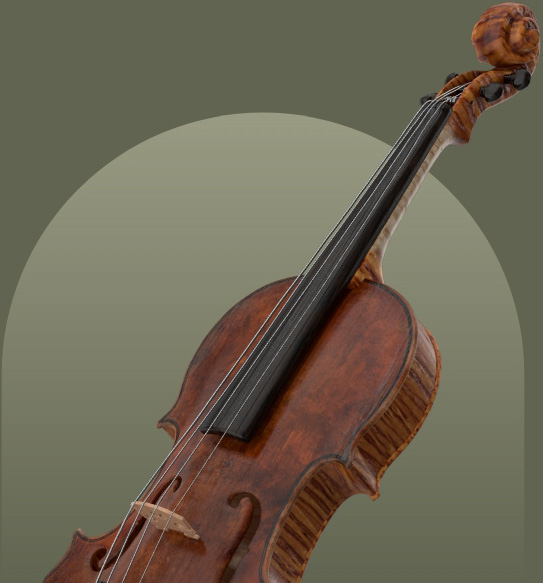
Thomas Zach
1812–1892
Thomas Zach (1812-1892) was a highly regarded luthier born in Malé Zínany, Czech Republic, who trained in Prague with J. B. Dvorak and A. Sitt. He established his career in Budapest, succeeding J. B. Schweitzer's business, before moving through Subotica, Pécs, and Bucharest, where he served as luthier to Prince Sturdza. He ultimately settled in Vienna in 1869, building a strong reputation for his sophisticated instruments, particularly those modeled after Stradivari and Guarneri. Zach was recognized with a first prize and the Progress Medal in 1873 for a Guarneri-modeled string quartet and was known for his distinctive golden-brown to dark red-brown varnish and an innovative tailpiece design.
Auction price history
Highest auction price
| Type | Details | Auction house | Sold | Price |
|---|---|---|---|---|
| Violin | 1887 | — | May 2001 | £2,815 |
No results match those filters.
Maker Overview
Life
Thomas Zach (1812-1892) was born in 1812 in Malé Zínany, Czech Republic, and passed away in 1892 in Vienna, Austria., he was originally a miller's apprentice and only began learning violin making later in life. He trained with J. B. Dvorak and A. Sitt in Prague. He then moved to Budapest, where he worked for many years with J. B. Schweitzer, eventually succeeding him in his business in 1857. Lütgendorff notes that his natural talent and serious dedication allowed him to mature into a particularly capable master. After leading his workshop for 15 years, he sold the business to J. Schunda in 1862 and, for a period, started a coffee house, an activity that ultimately did not satisfy him. He subsequently moved to Subotica, Croatia, in 1863, then to Pécs, Hungary, in 1864, and Bucharest, Romania, in 1865. In Bucharest, he was appointed luthier to Prince Sturdza, supplying the court with a significant number of instruments. In 1869, he made his final move to Vienna, where he quickly established a very high reputation and employed several assistants, including A. Ferenczy, B. Szepessy, E. Bartek, and P. Pilat. Sources contain conflicting information regarding his birth year, with John Dilworth stating 1812, while one of his labels from 1886 indicates 'geBorn 1829'.
Characteristics
- Workmanship
- Thomas Zach produced very sophisticated work, primarily on Stradivari and Guarneri models.
- Varnish
- His instruments feature a clear, transparent golden-brown to dark red-brown shaded varnish, noted for its rich texture and consistency.
- Innovation
- At the Vienna World Exhibition in 1873, he received the Progress Medal for a string quartet modeled after Guarneri. Lütgendorff describes an innovation on his tailpieces, where strings were guided through four tubes corresponding to their position and fastened by knotting, intended to regularize vibration. Lütgendorff also notes that something similar had been attempted by Spohr.
- Thomas Zach
Magini fecit Pestini 1858John Dilworth - Thomas Zach fecit
ad for A.S. Viennae 1869John Dilworth - Thomas Zach k.k. priv.
Geigenmacher geBorn 1829John Dilworth - T Z
Gemach in Wien 1886John Dilworth
Influence and legacy
- Training: Thomas Zach received his training in violin making from J. B. Dvorak and A. Sitt in Prague.
- Mentorship: He worked for many years under J. B. Schweitzer in Budapest, eventually taking over his business.
- Awards: In 1873, he was awarded the first prize for a quartet of instruments of Guarneri modelling, and at the Vienna World Exhibition in the same year, he received the Progress Medal for a Guarneri-modeled string quartet, which was declared the best.
- Reputation: After settling in Vienna in 1869, he developed and sustained a very high reputation, quickly gaining renown and prestige.
Biographies
The overview above is drawn from the following published accounts. Read them in the original:
John Dilworth+
ZACH, Thomas Born 1812 Malé Zínany Czech Republic, died 1892 Vienna Austria. Trained with J. B. Dvorak and A. Sitt in Prague. Worked in Budapest with J. B. Schweitzer, succeeding to his business in 1857. He sold the shop to Schunda 1862, moving to Subotica, Croatia, 1863, Pécs, Hungary 1864 and Bucharest, Romania 1865. There he was appointed luthier to Prince Sturdza supplying the court with a large number of instruments. In 1869 he made his final move to Vienna, where he develop and sustained a very high reputation. Employed several assistants there, including A. Ferenczy, B. Szepessy, E. Bartek and P. Pilat. Awarded first prize for quartet of instruments of Guarneri modelling 1873. Very sophisticated work on Stradivari and Guarneri models. Clear transparent golden-brown to dark red-brown shaded varnish of rich texture and consistency. Thomas Zach / Magini fecit Pestini 1858 Thomas Zach fecit / ad for A.S. Viennae 1869 Thomas Zach k.k. priv. / Geigenmacher geBorn 1829 T Z / Gemach in Wien 1886 [Benedek]
Willibald Leo Lütgendorff+
Er war ursprünglich Müllergeselle, und er lernte erst in reiferen Jahren das Geigenmachen bei J. B. Dvo?ák und Sitt in Prag. Er kam dann zu Joh. B. Schweitzer nach Budapest, bei dem er viele Jahre thätig war, und dessen Nachfolger er später wurde. Natürliche Veranlagung und ernstes Streben liessen ihn zu einem besonders tüchtigen Meister heranreifen. Nachdem er 15 Jahre seiner Werkstatt vorgestanden, verkaufte er diese an J. Schunda und fing eine Kaffeewirthschaft an. Diese Thätigkeit befriedigte ihn aber doch nicht; nachdem er von 1863—1864 in Szabadka, von 1864—1865 in Fünfkirchen, von 1865—1872 in Bukarest gelebt hatte, siedelte er nach Wien über und kam auch hier bald zu Ruf und Ansehen. Auf der Wiener Weltausstellung 1873 erhielt er die Fortschrittsmedaille für ein Streichquartett nach Guarneri, das unbestritten als das beste erklärt wurde. Eine Neuerung fand sich am Saitenhalter, wo die Saiten durch vier der Saitenlage entsprechende Röhrchen geführt und durch Knüpfen befestigt wurden, was die Vibration regelmässiger machen sollte. (Etwas Ähnliches hat übrigens schon Spohr versucht.) Verheirathet war er mit Marie Swoboda aus Plánic.
Henri Poidras+
Vienna 1812-1892. Good make.
Sell your instrument with Amati
Get started by uploading photos of your instrument for our experts to review.
Sell your instrument with Amati
Get started by uploading photos of your instrument for our experts to review.