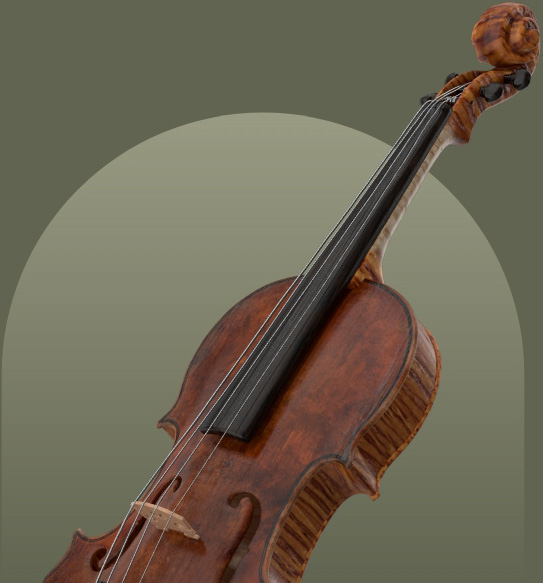
Nicola Bergonzi
Cremona, 1754–1832
Nicola Bergonzi (1754-1832) was a Cremonese luthier whose parentage is disputed among historical sources, with some citing Zosimo Bergonzi and others Michel Angelo Bergonzi as his father. Active from at least 1777, he developed a clean, well-proportioned style, though his instruments are often noted for their heavy outline, cramped scrolls, and thin, cold-looking varnish. He made a significant number of violins and was influential on his contemporary, Storioni. Bergonzi retired from violin making around 1796, later becoming a cloth merchant. His labelled instruments, which include violins, violas, and double basses, are rare.
Auction Price History
Highest auction price
2 results
| Type | Details | Auction house | Sold | Price |
|---|---|---|---|---|
| Violin | Labelled Joannes Baptista Guadagnini ..., head by Giovanni Battista Guadagnini, Parma 1760 c. Lot 128 | Tarisio | March 2025 | £127,595est. $ 90,000-120,000 |
| Violin | 1780 c. (replaced scroll) | — | October 2003 | £58,705 |
No results match those filters.
Maker Overview
Life
Nicola Bergonzi (1754-1832) was born in Cremona, Italy. Sources contain conflicting information regarding his parentage; John Dilworth identifies him as the eldest son of Zosimo Bergonzi, while Cecie Stainer and George Hart state he was the eldest son of Michel Angelo Bergonzi. His earliest known work is dated 1777, though he was likely active earlier. Cecie Stainer notes his period of activity in Cremona as approximately 1755-1782. It is not clear from whom he learned violin making, as his father, Zosimo, was barely active as a luthier. Nicola Bergonzi was more motivated than his father and, from fairly crude beginnings, developed a clean style of work. He was highly influential in the work of Storioni, who was his close neighbor, and the two may have been partners and collaborators in the last decades of the 18th century. He appears to have retired from violin making in 1796 and was registered in Cremona as a cloth merchant by 1804. His labelled work is rare.
Characteristics
- Workmanship
- Nicola Bergonzi's work is described by John Dilworth as a clean style, well-proportioned and neatly finished, though sometimes a little stiff in outline and heavy. Cecie Stainer notes that his instruments show a great falling off, but his work is often highly finished, yet wanting in character. George Hart similarly states that his workmanship was very good, often highly finished, but lacking character. Willibald Leo Lütgendorff observed that his instruments were inferior in tone and workmanship compared to his father's.
- Model and Form
- His instruments were made on a similar model to that of his father.
- Wood Selection
- George Hart notes that he selected wood of a close nature and hard appearance. Cecie Stainer describes the wood as often too close-grained. Willibald Leo Lütgendorff also commented that the wood was not well chosen.
- Varnish
- The varnish is frequently criticized; John Dilworth notes it lacked the fine varnish of earlier Cremonese makers. Cecie Stainer describes it as poor and thin. George Hart states it was thin and cold-looking, not equal to that of Carlo Bergonzi. Willibald Leo Lütgendorff described the varnish as thin and having little fire.
- Scroll
- The scroll is often described as cramped by Cecie Stainer and George Hart, with Hart adding it was scarcely of the Cremonese type. Willibald Leo Lütgendorff also found the scroll to be unbeautiful (unschön).
- Production
- He made a great number of violins.
- Moulds
- , some of the moulds of Antonio Stradivari were lent to Michel Angelo Bergonzi and were subsequently used by Nicola, which accounts for the varied form of their instruments.
- Nicolaus Bergonzi
Cremonensis faciebat
Anno 17..John Dilworth
Influence and legacy
- Mentorship: It is not clear from whom Nicola Bergonzi learned violin making, as his father, Zosimo, was barely active as a luthier.
- Influence on Contemporaries: He was highly influential in the work of Storioni, who was his close neighbor, and they may have been partners and collaborators in the late 18th century.
Biographies
The overview above is drawn from the following published accounts. Read them in the original:
John Dilworth+
BERGONZI, Nicola Born 1754, died 1832 Cremona Italy. Eldest son of Zosimo Bergonzi, below. Earliest known work dated 1777, but probably active earlier. It is not clear from whom he learned, as his father Zosimo was barely active as a luthier. Nicola was more motivated, however, and from fairly crude beginnings mastered a clean style of work, well proportioned and neatly finished, if a little stiff in outline, heavy, and lacking the fine varnish of earlier Cremonese makers. He was certainly highly influential in the work of Storioni, who was his close neighbour. The two may in fact have been partners and collaborators in the last decades of the 18th century. He seems to have retired from violin making in 1796 and was registered in Cremona as a cloth merchant in 1804. His labelled work is rare, and includes small sized children’s violins, some violas, and double basses, but, as far as is known, no cellos. Nicolaus Bergonzi / Cremonensis faciebat / Anno 17.. [Gindin]
George Hart+
Son of [Michel Angelo Bergonzi]. He made a great number of Violins of similar form to those of his father. The wood which he selected was of a close nature and hard appearance. The varnish is not equal to that of Carlo; it is thin and cold-looking. The workmanship is very good, being often highly finished; but yet wanting in character. The scroll is cramped, and scarcely of the Cremonese type. Lancetti mentions a Tenor by this maker, dated 1781. In the correspondence which passed between the grandson of Antonio Stradivari and the agents of Count Cozio (which is given in these pages), reference is made to some of the moulds of the great maker being in the keeping of — Bergonzi, they having been lent to him, the writer saying that he would obtain them and put them with the other patterns, which appears to have been done; These moulds were doubtless lent to Michel Angelo Bergonzi, and were used by Niccolo as well as his father, and accounts for the form of their instruments being varied.
Cecie Stainer+
Eldest son of Michel Angelo. Worked in Cremona about 1755-82. His instruments show a great falling off; made on a similar model to that of his father; his work is often highly finished but is wanting in character; the scroll is cramped, the wood often too close-grained, the varnish poor and thin.
He made a great number of violins.
Willibald Leo Lütgendorff+
Ältester Sohn von Michel Angiolo B., der das väterliche Geschäft übernahm
und fortsetzte. Er baute viele Instrumente,
die im Patron denen seines Vaters
ähnlich sind, ihnen aber im Ton und in
der Arbeit sehr nachstehen. Der Lack
ist dünn und hat wenig Feuer, das Holz
nicht gut gewählt und die Schnecke unschön.
Sell your instrument with Amati
Get started by uploading photos of your instrument for our experts to review.
Sell your instrument with Amati
Get started by uploading photos of your instrument for our experts to review.