
Brussels School
Caspar Borbon
Brussels, worked 1673–1705
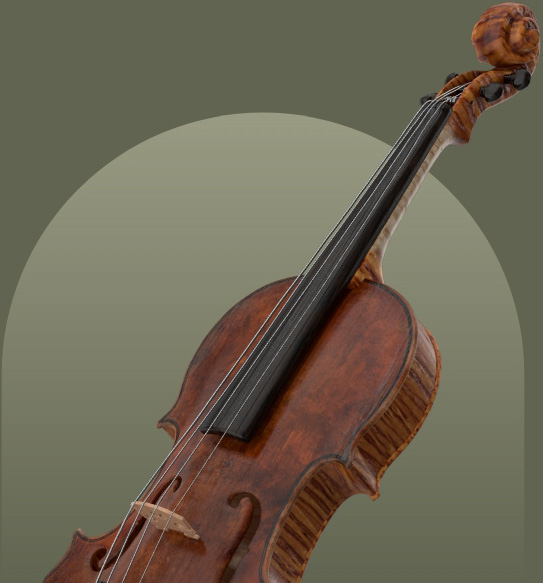
Caspar Borbon (circa 1673-1705) was an important maker of the early Flemish school, working in Brussels, Belgium. He was noted as a "reparatteur des instruments" by 1673 and later also used the name Bourbon. His craftsmanship was fine, characterized by a rich, well-textured varnish, full arching, prominent soundholes, and a distinctive scroll. Borbon produced a range of instruments including violins, violas, cellos, pochettes, viols, and double-basses, showing influence from Gasparo da Salò. Several of his instruments, such as violins from 1694 and 1698, a 1692 viola, and a 1682 cello in the Brussels Music Museum, are known to be extant.
Maker Overview
Life
Caspar Borbon (circa 1673-1705) worked in Brussels, Belgium, and is recognized as an interesting and important maker of the early Flemish school., he was already listed in the court chapel's records as a "reparatteur des instruments" in 1673 and was likely the son of Peter Borbon. From 1701, he also began to write his name as Bourbon.
Characteristics
- Influence
- His work was apparently influenced by Gasparo da Salò, a characteristic noted by John Dilworth, Willibald Leo Lütgendorff, and Cecie Stainer.
- Craftsmanship
- Borbon exhibited fine craftsmanship and finish, with his work betraying a skilled hand.
- Varnish
- He utilized a rich, well-textured varnish that appeared in various shades, including deep orange-red, as well as yellow or red.
- Arching
- Instruments typically featured a very full, rounded arch.
- Soundholes
- His soundholes were prominent, wide-set, and curving, often described as widely opened or perpendicular.
- Scroll
- The volute of the scroll on his instruments had a wide second turn.
- Instruments
- He made violins, violas, cellos, pochettes, and viols, and Cecie Stainer also mentions double-basses.
Influence and legacy
- Stylistic Influence: Caspar Borbon's work shows a clear influence from Gasparo da Salò, as noted by multiple historians including John Dilworth, Willibald Leo Lütgendorff, and Cecie Stainer.
- Extant Instruments: Two violins dated 1694 and 1698 are known to be extant. A very fine viola from 1692 is also recorded in original condition.
- Museum Holdings: A cello from 1682 made by Borbon is preserved in the Brussels Music Museum.
- Exhibitions: An alto, described as curiously made with yellow varnish, was exhibited in Paris in 1878.
Biographies
The overview above is drawn from the following published accounts. Read them in the original:
John Dilworth+
BORBON, Gaspar Worked circa. 1673-1705 Brussels Belgium. Interesting and important maker of the early Flemish school. Work apparently influenced by Gasparo da Salò. Fine craftsmanship and finish. Rich well-textured varnish of various shades up to deep orange-red, usually with very full rounded arch and prominent, wide-set curving soundholes. Volute of scroll has wide second turn. Two violins extant dated 1694 and 1698. Viola labelled: Gaspar Borbon, 1689, tot Bruessel. Cello in the Brussels Music Museum: Gaspar Borbon tot Brussel, 1682 Also a very fine viola of 1692 in original condition. A pochette and viol are also recorded.
Cecie Stainer+
Worked in Brussels. A viola of his is dated 1692. He made violins, altos, and double-basses, after the pattern of Gasparo da Salo, with perpendicular sound-holes, widely opened. An alto, curiously made, with yellow varnish, was exhibited at Paris, 1878.
Willibald Leo Lütgendorff+
Er wird in der Liste der Hofcapelle von 1673 bereits als »reparatteur des
instruments« aufgeführt und war wahrscheinlich ein Sohn Peter Borbon’s. Seit
1701 schreibt er seinen Namen auch Bourbon. Seine Arbeit erinnert ein wenig an
den Stil Caspar da Salò’s, die F-Löcher sind weit geöffnet, im Übrigen verrathen
sie eine geschickte Hand; auch der gelbe oder rothe Lack ist nicht gerade
schlecht.
Sell your instrument with Amati
Get started by uploading photos of your instrument for our experts to review.
Sell your instrument with Amati
Get started by uploading photos of your instrument for our experts to review.
Working in Brussels at the same time
Jean De Maseneer worked 1680–1720
Jordaens Palsterman worked 1648–1698