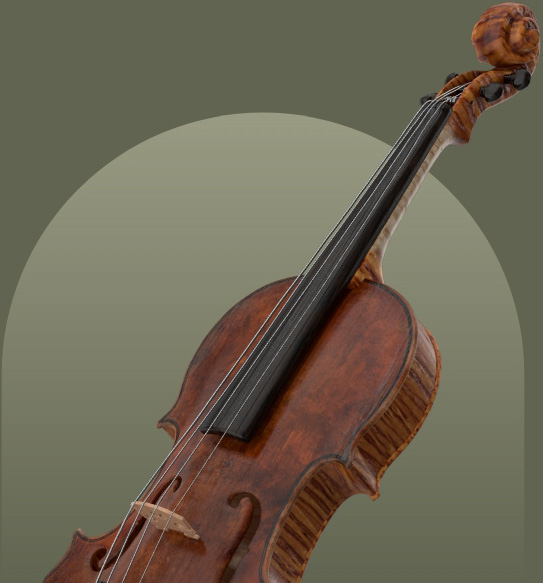
Richard (I) Duke
London, 1718–1783
Richard (I) Duke (1718-1783) was a prominent 18th-century London luthier, entrepreneur, and shopkeeper, whose career spanned from his first workshop in Lamb’s Conduit Passage by 1743 to later locations in Red Lyon Street and Great Turnstile, Holborn. He enjoyed royal patronage and diversified his business to include sheet music publishing. Duke employed several skilled workers, with John Betts eventually succeeding him through his daughter Anne. His craftsmanship, though variable, produced instruments primarily in the Stainer style, alongside notable copies of Amati and rare 'long pattern' Stradivari models. His violins and tenors were particularly esteemed for their round, ringing tone and often featured a distinctive yellow or red-brown varnish. Despite his genuine skill, Duke's reputation suffered significantly from widespread counterfeiting, with his name and brand frequently applied to inferior instruments. His legacy includes a substantial number of genuine instruments, many of which remain in private collections, and a lasting influence on British violin making.
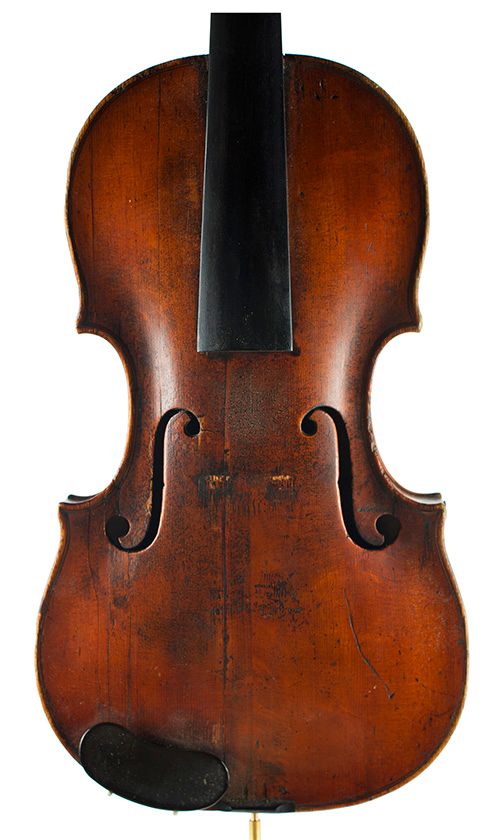


Auction Price History
Highest auction price
40 results
| Type | Details | Auction house | Sold | Price |
|---|---|---|---|---|
| Violin | 35.5 cm Attributed to | — | June 2011 | £2,400 |
| Violin | 36.4 cm Possibly by | — | December 2010 | £960 |
| Cello | 74.0 cm | — | December 2010 | £18,000 |
| Violin | 35.5 cm London, 1770 c. | — | March 2010 | £15,000 |
| Violin | 35.4 cm 1760 c. | — | December 2009 | £782 |
| Viola | 37.6 cm London, 1760 c. (restorations) | — | June 2009 | £1,560 |
| Violin | 35.6 cm London, 1750 c. | — | March 2008 | £5,520 |
| Violin | 35.6 cm 1758 Attributed to | — | July 2007 | £4,320 |
| Violin | London, 1767 | — | October 2006 | £3,474 |
| Violin | London, 1764 | — | July 2005 | £2,400 |
| Violin | London, 1760 c. | — | April 2005 | £3,008 |
| Viola | 38.9 cm London, 1760 | — | November 2004 | £3,840 |
| Violin | Attributed to | — | May 2004 | £2,091 |
| Violin | 7/8 Size. original neck (repairs) | — | February 2004 | £977 |
| Violin | 1760 c. | — | October 2003 | £1,696 |
| Violin | 17-- | — | March 2001 | £1,012 |
| Viola | 37.8 cm 17-- | — | November 1998 | £2,185 |
| Violin | 17-- | — | November 1998 | £2,990 |
| Violin | — | November 1998 | £901 | |
| Violin | 1756 | — | October 1998 | £2,530 |
| Viola | 37.8 cm 17-- | — | November 1997 | £1,150 |
| Viola | 37.5 cm 17-- | — | May 1997 | £1,800 |
| Violin | 1756 | — | May 1997 | £3,600 |
| Violin | 1761 | — | March 1997 | £2,645 |
| Violin | 17-- | — | March 1996 | £4,025 |
| Violin | 17-- | — | November 1995 | £3,680 |
| Violin | 17-- | — | November 1995 | £920 |
| Violin | 1760 | — | November 1995 | £4,025 |
| Violin | 1763 | — | October 1995 | £1,380 |
| Violin | 1760 | — | August 1995 | £1,092 |
| Violin | 1760 | — | November 1994 | £1,867 |
| Violin | 17-- | — | October 1994 | £1,265 |
| Violin | 17-- | — | June 1994 | £4,025 |
| Violin | 1761 | — | November 1993 | £2,300 |
| Viola | 40.8 cm 17-- | — | October 1993 | £1,150 |
| Violin | 1756 3/4 Size | — | November 1991 | £2,420 |
| Cello | 1760 c. | — | March 1990 | £1,760 |
| Viola | 37.8 cm 17-- | — | November 1988 | £1,980 |
| Viola | 37.8 cm 17-- | — | June 1988 | £1,870 |
| Viola | 37.9 cm 1750-99 | — | October 1982 | £1,165 |
No results match those filters.
Maker Overview
Life
Richard (I) Duke (1718-1783), born in 1718 and active until his death in 1783 in London, UK, stands as a definitive and prolific maker, entrepreneur, and shopkeeper of 18th-century London. His entry into the craft may have been influenced by Daniel Wright, a luthier in Holborn who apprenticed John Johnson. There is also an extant label from 'William Duke / Holborn Bars / London 1727', suggesting a possible familial connection, perhaps to his father. Duke's workshop was first established in Lamb’s Conduit Passage by 1743. By 1757, he had relocated to ‘Red Lyon Street near Graye’s Inn Passage’, and by 1760, his business was situated at Great Turnstile, Holborn. He enjoyed significant patronage, including from the Dukes of Cumberland and Gloucester. His entrepreneurial ventures extended beyond instrument making; he advertised a wide range of musical instruments and services, and in 1760, he collaborated with Henry Thorowgood in publishing sheet music. Duke employed numerous workers, including John Carter, Ned Betts, Isaac Nayler, William Napier, and John Vogler. The most significant of his employees was John Betts, who eventually took over the business from Duke’s daughter, Anne.
Characteristics
- Models
- Richard Duke's output encompassed a variety of forms, predominantly adhering to the then-current London style influenced by Stainer. However, he also produced instruments clearly modeled on Amati, and rare examples followed a 'long pattern' Stradivari violin, representing a very early exploration of this model., he made excellent copies of Stradivari and Amati instruments, though his Stainer copies were considered not quite as good. Willibald Leo Lütgendorff states that Duke also used his own model, which resonated with the Stainer style, characterized by a high arch and a long pattern.
- Workmanship and Materials
- Workmanship varied across his instruments. The cheapest examples featured a dull, thin brown varnish, while others displayed a vibrant red-brown coating. Cecie Stainer observed that his violins and violoncellos were of a rather long pattern, very arched, with a yellow varnish, and possessed a very good tone. Lütgendorff highlighted his careful work and choice of wood, resulting in a soft and appealing tone. George Hart considered his Amati copies scarcely surpassed, with varnish, work, and material of the best description, though his Stainer copies were less successful. William Meredith Morris noted that his workmanship was consistently fine, whether copying Amati or Stainer, and that he was more deeply imbued with the German (Stainer) spirit than the Italian.
- Varnish
- Varnish quality varied. Dilworth mentions dull thin brown and vibrant red-brown. Stainer notes a yellow varnish. Lütgendorff describes his yellow varnish as less successful, sometimes applied over a walnut stain. Morris characterizes Duke's varnish as elastic, soft, and transparent, possessing an aristocratic refinement, though it lacked 'unction'. A fine violin sold in 1898 featured a light mellow-brown varnish.
- Instrument Types
- While violins were common, violas and cellos are very rare, and a few round-backed double basses are also recorded. Cecie Stainer noted that some of his tenors were slightly short in length but very broad, designed to achieve a large, deep tone, with good results, though the two lower strings might be more powerful. William Meredith Morris observed that his violoncellos were never in such demand as his violins and tenors and are seldom seen today.
- Tone Characteristics
- William Meredith Morris describes the tone of Duke's instruments, whether Italian or German in character, as round, ringing, and ravishing. He differentiates it from Stainer's tone and from Banks's, which was more subdued, mellow, and sweet, noting that Duke's tone was brighter and had more vibrato.
- Scroll Carving
- In the very finest examples of his work, the carving of the scroll was considered superior to that of makers like Banks.
- There is also a label extant stating ‘William Duke
Holborn Bars
London 1727’ which may be the work of his father. Richard’s workshop was first established in Lamb’s Conduit Passage by 1743John Dilworth - Richard Duke, Maker
Holborn, London. Anno 1768John Dilworth - Richard Duke, Maker
near opposite Great Turn-Stile
Holborn. LondonJohn Dilworth
Influence and legacy
- Early Training: Richard Duke may have been initiated into the business by Daniel Wright, a luthier working in Holborn.
- Pupils: had three known pupils: his son Richard, John Betts, and Edward Betts.
- Stylistic Influences: Duke's work was heavily influenced by the Stainer model, which was popular in London at the time, and he also successfully copied Amati instruments. Rare instances show an early exploration of the 'long pattern' Stradivari model.
- Reputation and Counterfeiting: Richard Duke's brand has been unfortunately ill-used by commercial operations to upgrade many inferior instruments, which has harmed his reputation. Cecie Stainer, Lütgendorff, and George Hart all emphasize that his name was frequently applied to poor specimens, and his labels were often forged, making authentication crucial. Hart states that no maker, with the exception of the great Cremonese artists, has been so persistently counterfeited. William Meredith Morris considers Duke the most sincerely flattered maker of the British classical school due to the widespread imitation.
- Business Succession: His business was eventually taken over by John Betts, who acquired it from Duke’s daughter, Anne, as detailed by John Dilworth.
- Patronage: Duke enjoyed the patronage of notable figures, including the Dukes of Cumberland and Gloucester.
- Enduring Presence: William Meredith Morris strongly believes that more genuine 'Dukes' exist than 'Banks' and 'Forsters' combined, though they are often found in the attics of county mansions rather than dealers' shops. He cites examples like the 'Cresselly Duke', a beautiful Stainer-model violin that had been in the Portsmouth family since 1768.
- Market Value: Fine specimens of Duke's work rarely enter the market but fetch a fair price when they do. For instance, a fine violin by Duke with choice wood, light mellow-brown varnish, and beautiful tone was sold by Messrs. Hart in 1898 for £35, considered worth double the money at the time.
Biographies
The overview above is drawn from the following published accounts. Read them in the original:
John Dilworth+
DUKE, Richard (I) Born 1718, died 1783 London UK. A prolific maker, entrepreneur, and shopkeeper, Duke is one of the definitive makers of 18th century London. Unfortunately his brand has been ill-used by commercial operations to upgrade many inferior instruments which has done harm to his reputation. He may have been initiated into the business by Daniel Wright who worked in Holborn and gave an apprenticeship to John Johnson. There is also a label extant stating ‘William Duke / Holborn Bars / London 1727’ which may be the work of his father. Richard’s workshop was first established in Lamb’s Conduit Passage by 1743. In 1757 he could be found at ‘Red Lyon Street near Graye’s Inn Passage’ and in 1760 at Great Turnstile, Holborn. He enjoyed the patronage of the Dukes of Cumberland and Gloucester, and advertised all sorts of musical instruments and services, venturing into the publishing of sheet music with Henry Thorowgood in 1760. He employed many workers, including John Carter, Ned Betts, Isaac Nayler, William Napier, and John Vogler; but the most important was John Betts who took over the business from Duke’s daughter Anne. His output covers a variety of forms, mostly in the then-current London style of Stainer, but some are obviously modelled on Amati, and rare examples follow a ‘long pattern’ Stradivari violin; a very early exploration of this model. Workmanship is variable. The cheapest instruments carry a very dull thin brown varnish, but others have a vibrant red-brown coating. Violas and cellos are very rare, and a few round-backed double basses are also recorded. Most are branded: ‘Duke. London’; this brand is widely imitated on cheap Saxon instruments. Genuine examples usually carry a pencilled signature on the inner surface of the front. Printed labels: Richard Duke / Londini. fecit 1760 Richard Duke, Maker / Holborn, London. Anno 1768 Richard Duke, Maker / near opposite Great Turn-Stile / Holborn. London
George Hart+
The name of this maker has long been a household word with English Violinists, both amateur and professional. Who has not got a friend who is the fortunate owner of a veritable ” Duke?” The fame of His Majesty Antonio Stradivari himself is not greater than that of Richard Duke in the eyes of many a Fiddle fancier. From his earliest fiddling days the name of Duke became familiar to him; he has heard more of him than of Stradivari, whom he somehow confuses with Cremona. He fondly imagines that Cremona was a celebrated maker, and Stradivari something else; inquires, and becomes more confused, and returns again to ” Duke,” with whom he is thoroughly at home. Many excellent judges have wondered how it came to pass that Richard Duke should have been so highly valued, there being, in their estimation, so little amongst his remains worthy of the reputation he gained. The truth is, that no maker, with the exception of the great Cremonese artists, has been so persistently counterfeited. The name of Duke has been stamped upon every wretched nondescript, until judges who had not the opportunity of seeing the genuine article mistook the copies for the original, and hence the confusion. When, however, a really fine specimen of Duke is once seen, it is not likely to be forgotten. As copies of Amati such instruments are scarcely surpassed, varnish, work, and material being of the best description. The copies of Stainer were not so successful.
William Meredith Morris+
Unfortunately there are no biographical particulars of this great man, and no evidence as to his character and personality other than that furnished by his remains. He worked on the Stainer and Amati models. Miss Stainer, in her “Dictionary of Violin-Makers,” says that he also made copies of Stradivari, but I have never seen any of these copies, nor heard of undoubtedly genuine ones. Counterfeit Strad modelled Dukes there are, I have not the least doubt, as there are counterfeit “nobody” Dukes by the hundred. It has been said that ” imitation is the sincerest form of flattery,” if so, Duke is the most sincerely flattered maker of the British classical school. His fame was greater in the eighteenth century than was that of even Banks. The reason for this is not far to seek ; he made the best copies of Stainer that were ever produced in this country, and as Stainer was the ruling idol, the instruments which most truly approached his lines would naturally have the pre-eminence. In this way Duke got his laurels. And once a name is made it requires but the exercise of a little discretion to keep it up. The Duke cult was in its heyday when Banks and Forster were turning out their best Amati copies. Richard’s bias was towards the German model, and he did not copy the Italian model as often nor as felicitously as he might have done. The sound-holes are faithful to the original in the Stainer copies, and they are strongly reminiscent of the same prototype in the Amati copies. Not that he put inferior work into the latter, as Banks was doing when copying Stainer ; on the other hand, his workmanship is always fine, whether copying Amati or Stainer ; but he drank more deeply of the German spirit than he did of the Italian. In the opinion of connoisseurs of to-day the Amati copies may be the more valuable, but there is not the slightest doubt that Duke and his patrons did not share the same view. His patrons were mostly rich people and county families. I am familiar with seventeen Duke violins and tenors which are now in the possession of English and Welsh county families, and have at different times examined and tried several of them. The pedigree of the majority of these can be traced back to the time of purchase. One of the most noted of them is the ” Cresselly Duke,” a beautiful violin on the Stainer model. It was the property of the late S. P. Allen, Esq., of Cresselly, who came into the possession of it through his wife, the daughter of the fourth Earl of Portsmouth. The fiddle had been in the Portsmouth family since the days of the second Earl, who purchased it himself of Duke in the year 1768. Mr. Fleming expresses the belief that genuine Duke instruments are extremely rare. I am strongly of the opinion that there are more genuine ” Dukes ” in existence than there are “Banks” and “Forsters” put together, but they are not to be found in dealers’ shops. They are fossilizing in dust heaps in the garrets of county mansions. There were hundreds of fine amateur players amongst the gentlefolk of those days, when the facilities for attending music-halls, opera-houses, &:c., were so few and far between. The finest specimens of Duke are not a whit inferior to those of Banks, except as regards model and varnish, and in one particular, at least, they are even superior, viz. in the carving of the scroll, but this remark applies only to the very finest of them, Duke was a busy man, and he did not always have the time at his command to do his best. Banks and Forster worked more at leisure, and the former of the two was helping to create the taste for better things, which always has a modifying effect upon the relation between supply and demand. I do not understand how it has come to be said that Duke’s Stainer copies are not quite so good as his Amati copies. I submit that they are as good per se, and better as copies. Duke was too thoroughly imbued with Stainer ideas to admit of his making instruments in the true Italian spirit. There is no perceptible difference in the tone, be the work Italian or German in character. It is a round, ringing, ravishing tone in either case. It has not the remotest affinity with the tone of Stainer, nor is it like the tone of Banks, which is more subdued, mellow, and sweet. The tone of Duke as compared with that of Banks is brighter and has more vibrato in it. Tone nuances are very hard to analyse in words, but easily differentiated by the cultivated ear.
Duke’s varnish is elastic, soft, and transparent, but it lacks unction. There is an air of aristocratic refinement about it which is quite unmistakable, but we long for one sweet blush of the emotions. If I were asked to give an imaginary pen picture of Duke, I should describe him as a well-built man, broad-browed, keen-eyed, dignified and reserved in bearing, with a very correct but cold taste in matters artistic. That is the sort of man I see in my mind’s eye hard at work beside the bench shaping those chaste, sober, broad-chested tenors. Fine specimens of Duke rarely come into the market ; when they do, they fetch a fair price. One of the finest violins which I have seen of his make was sold by the Messrs. Hart in the year 1898 for £35. It had choice wood, light mellow-brown varnish, and a beautiful tone. The instrument was in perfect preservation, and, as prices go, worth double the money. Photographs of this violin are reproduced here. As far as is known Duke had only three pupils, his son Richard, John Betts, and Edward Betts. His violoncellos were never in such demand as his violins and tenors, and they are seldom to be seen nowadays. He often branded his instruments under the button ” Duke, London.” Labels : —
(1) RICHARD DUKE, LONDINI, FECIT 1760
(2) RICHARD DUKE, MAKER, HOLBORN, LONDON, ANNO 1768
Both of these were usually written in ink. His printed label ran : —
(3) RICHARD DUKE, MAKER, NEAR OPPOSITE GREAT TURN-STILE, HOLBORN, LONDON
Cecie Stainer+
A maker in London about 1750-80. He made excellent copies of Stradivari and Amati instruments, and not quite such good ones of Stainer. Genuine instruments of his are very fine, but unfortunately his name was often made use of in extremely poor specimens.
His violins and violoncellos were of rather a long pattern, very arched, with yellow varnish, their tone was very good; some of his tenors are a little short in length but very broad, so as to obtain a large deep tone; the result is good, although the two lower strings might be more powerful.
Labels: ” Richard Duke, Londini, fecit 1760″; similar ones dated 1767 and 1769 ;
” Richard Duke, maker, Holborn, London, anno 1768 ” ; another dated 1777. These two labels were generally written in ink.
He also used a printed label: ” Richard Duke, maker, near opposite Great Turn-Stile, Holbourn, London.”
Willibald Leo Lütgendorff+
Einer der besten englischen Geigenmacher, der auch ein eigenes Modell,
das an das Stainer’sche anklingt, verwendete. Die Wölbung ist hoch, das Patron
länglich, Holz und Arbeit sehr sorgfältig und der Ton weich und ansprechend.
Weniger geglückt erscheint sein gelber Lack, der manchmal über einer Art
Walnussbeize aufgetragen ist. Bei den grösseren Violen ersetzt er gern in
der Breite, was er an Lange verkürzt. Auch als Copist hat er sich mehrfach
mit Erfolg versucht. Seine Copien nach Stradivari und Amati sind recht gut,
weniger genau dagegen die nach Stainer, zu denen ihm wahrscheinlich kein
Original vorgelegen hat. Echte Geigen von ihm sind selten zu haben, doch
wurde er leider von Stümpern häufig nachgeahmt und seine Zettel gefälscht,
so dass Instrumente, die seinen Namen tragen, erst eingehend auf ihre Echtheit
hin geprüft werden müssen. Ausser seinen bald geschriebenen, bald gedruckten
Zetteln gebrauchte er auch einen Brandstempel mit seinem Namen, dem manchmal
noch »London« hinzugefügt wurde. Wenn Vidal die Arbeit Richard Duke’s
Sell your instrument with Amati
Get started by uploading photos of your instrument for our experts to review.
Sell your instrument with Amati
Get started by uploading photos of your instrument for our experts to review.