
Regensburg School
Andreas Engleder
Regensburg, 1810–1861
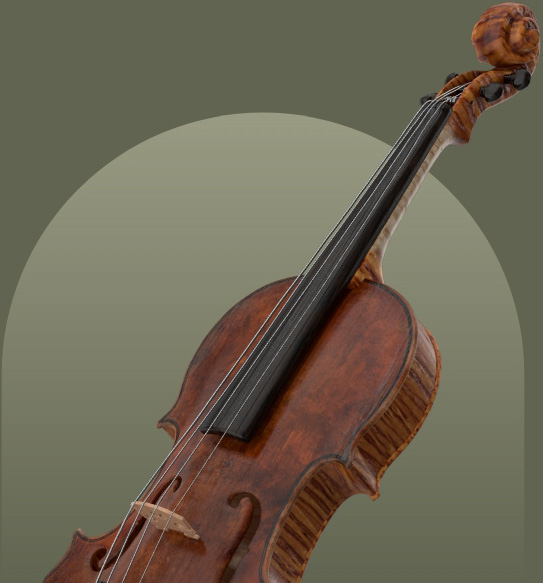
Andreas Engleder (1810-1861) was a celebrated violin maker from the Munich school, renowned for his fine workmanship on classical models. A pupil of his uncle Joseph Fischer and J. C. Vauchel, he held the prestigious title of violin maker to the court in Munich. Willibald Leo Lütgendorff described him as "one of the best violin makers in Munich" and "probably the most sought-after repairer in Bavaria." Engleder also ventured into innovative instrument design, exhibiting a quintet of instruments with a unique pear-shaped outline in 1854, for which he received medals. While these experimental designs produced a brilliant treble, the bass response was considerably weaker. His work consistently featured splendid wood and impeccable craftsmanship, ensuring his instruments remain highly sought-after today.
Maker Overview
Life
Andreas Engleder (1810-1861) was born in 1810 in Grossberg, Regensburg, and died in 1861 in Munich, Germany (John Dilworth, The Brompton’s Book of Violin & Bow Makers). He was the nephew of Joseph Fischer in Regensburg and also received training from J. C. Vauchel (Dilworth, Lütgendorff). Engleder served as violin maker to the court in Munich, a prestigious appointment (Dilworth, Stainer). Willibald Leo Lütgendorff, in Die Geigen- und Lautenmacher vom Mittelalter bis zur Gegenwart, recognized him as one of Munich's finest violin makers during the mid-19th century and likely Bavaria's most sought-after repairer at the time. He exhibited a quintet of instruments in 1854, for which he was awarded medals (Dilworth, Stainer, Lütgendorff). His instruments bear the label "Andreas Engleder / fecit Monachii, 18.." (Dilworth).
Characteristics
- Innovation
- Andreas Engleder showcased a quintet of instruments with a distinctive pear-shaped outline in 1854 (Dilworth). Willibald Leo Lütgendorff, citing Prof. Dr. Schafhäutl, describes this innovative design: "With his string quintet, the artist attempted a new form. The upper bouts of the violin were almost obliquely truncated, so that they transitioned smoothly into the waist without corners; the ends of the lower bouts had also fallen away; on the other hand, these lower bouts were enlarged almost in the same proportion as the upper bouts were reduced in area, so that a pear-shaped outline was created." This experimentation, notably, built upon earlier efforts such as Schubert's 1803 proposal for a guitar-shaped violin, which Galbusera executed in Milan in 1813. However, Engleder's modification yielded only a one-sided success, as "against the brilliantly sounding treble, the bass fell off immensely" [gegen den brillant klingenden Diskant fiel der Bass ungemein ab] (Lütgendorff, quoting Schafhäutl).
- Materials
- His work is characterized by the use of "prachtvolles Holz" [splendid wood] (Lütgendorff).
- Methods
- Engleder was known for his "fine workmanship on classical models" (Dilworth) and "tadellose Arbeit" [impeccable work] (Lütgendorff). Cecie Stainer, in A Dictionary of Violin Makers, also highlights his "beautiful workmanship."
- Andreas Engleder
fecit Monachii, 18..John Dilworth
Influence and legacy
- Training and Mentorship: Engleder's foundational training under his uncle Joseph Fischer in Regensburg and J. C. Vauchel significantly influenced his craftsmanship (Dilworth, Lütgendorff).
- Schools/Tradition: As a leading figure, Engleder profoundly shaped and elevated the reputation of the Munich school of violin making (Dilworth).
- Notable Associations: His prestigious appointment as violin maker to the Munich court not only highlighted his skill but also provided a platform for wider influence (Dilworth, Stainer).
- Modern Recognition: Andreas Engleder's lasting legacy includes his recognition as one of the finest makers of the Munich school, ensuring his place in violin-making history (Dilworth). His instruments are described as "very worthwhile and sought-after" (Dilworth). The medals awarded for his exhibited works in 1854 attest to the high regard for his contributions during his lifetime and contribute to his enduring legacy (Stainer, Lütgendorff). Cecie Stainer noted him for his "great experience and good work."
Biographies
The overview above is drawn from the following published accounts. Read them in the original:
John Dilworth+
ENGLEDER, Andreas Born 1810 Grossberg, Regensburg, died 1861 Munich Germany. Pupil of his uncle Joseph Fischer in Regensburg, and of J. C. Vauchel. Violin maker to the court in Munich. Exhibited a quintet of instruments on an eccentric pear-shaped outline 1854. Recognised as one of the best makers of the Munich school. Fine workmanship on classical models, very worthwhile and sought-after. Andreas Engleder / fecit Monachii, 18..
Cecie Stainer+
Was maker to the Court at Münich. In 1854 he exhibited there a quintet of instruments made on a new pattern of his own ; they were of beautiful workmanship, and of full excellent tone ; he was awarded medals. He was well known for his great experience and good work.
Willibald Leo Lütgendorff+
Er stammt aus Grossberg bei Regensburg und war Schüler von Fischer in
Regensburg, dessen Neffe er war, und von Vauchel. Er war einer der besten Geigenmacher Münchens um die Mitte des 19. Jahrhunderts und damals wohl der gesuchteste Reparateur Bayerns. Über seine Versuche, neue Formen für den Geigenbauzu finden, schreibt u. A. Prof. Dr. Schafhäutl: »Bei seinem Saitenquintett
versuchte der Künstler eine neue Form. Die obern Backen der Violine waren
beinahe schräg abgestutzt, so dass sie ohne Ecken ganz leicht in die Brust übergingen;
auch die Enden der Unterbacken waren weggefallen; dagegen waren
diese Unterbacken beinahe in eben dem Verhältnisse vergrössert, als die obern
Backen in Fläche vermindert wurden, so dass ein birnenähnlicher Umriss entstand.
Schubert schlug im Jahre 1803 die Guitarrenform für die Geige vor, Galbusera in
Mailand führte 1813 diesen Vorschlag aus, Engleder veränderte nun auch das Verhältniss
der Backen. Er erzielte nur einen einseitigen Erfolg, denn gegen den brillant klingenden Diskant fiel der Bass ungemein ab.« Prachtvolles Holz, tadellose Arbeit. 1854 Medaille.
Sell your instrument with Amati
Get started by uploading photos of your instrument for our experts to review.
Sell your instrument with Amati
Get started by uploading photos of your instrument for our experts to review.
Working in Regensburg at the same time
Georg Foster worked 1820–1830
Josef Engleder 1815–1860