
Scotland School
James Gilchrist
Glasgow, Rothesay, 1832–1894
James Gilchrist (1832-1894) was a Scottish scientific instrument maker and engineer who became a notable amateur violin maker in Glasgow from around 1880. Known for his innovative and mathematically driven approach to instrument construction, he applied his engineering background to calculate precise measurements for his instruments, even crafting his own tools. While some sources, like William Meredith Morris, noted a lack of individuality and poor tone quality in his work, others, such as Willibald Leo Lütgendorff, praised his profound knowledge and dexterity, leading to him being called the 'Scottish Stradivarius'. John Dilworth describes his instruments as finely made, Stradivari-derived models with variable varnish and distinctive detailing. He produced between 86 and 100 stringed instruments, and his work, though not leading to financial wealth, was valued during his lifetime, with collections held by figures like Professor J. Bell Pettigrew.
Auction price history
Highest auction price
| Type | Details | Sold | Price |
|---|---|---|---|
| Violin | 35.6 cm Glasgow, 1883 | December 2011 | £960 |
| Violin | 1889 | November 1997 | £667 |
| Violin | 1889 | April 1993 | £782 |
| Violin | 1892 | September 1992 | £495 |
| Violin | 1892 | March 1992 | £825 |
| Violin | 1890 | June 1989 | £440 |
| Violin | 1893 | November 1988 | £550 |
| Violin | 1883 | November 1988 | £1,012 |
Maker Overview
Life
James Gilchrist (1832-1894) was born in Rothesay, Scotland, in 1832 and passed away in Glasgow, Scotland, in 1894. He was initially trained as a scientific instrument maker and engineer, beginning his career as a metalworker and mechanic, crafting the finest scientific instruments., he lived in Glasgow from 1850 and became active as an amateur maker of stringed instruments from around 1880. Willibald Leo Lütgendorff notes that Gilchrist turned to violin making relatively late, around 1880, but with such zeal and enthusiasm that his admirers soon dubbed him the 'Scottish Stradivarius'. Dilworth states that Gilchrist was professionally established at 109 Hope Street, later moving to 29 Stanley Street. William Meredith Morris describes him as an amateur maker who, by trade, was a philosophical instrument maker. Sources contain conflicting information regarding the total number of instruments produced; Morris and Lütgendorff state he made eighty-six stringed instruments of every description (Violinen, Violen, und Violoncelli), while Dilworth indicates no more than 100 instruments are known.
Characteristics
- Workmanship
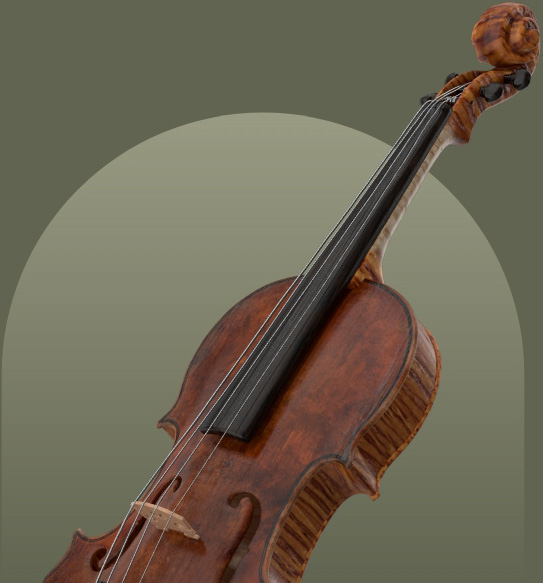
- William Meredith Morris observed that Gilchrist's workmanship was 'very fair' but that the work as a whole 'lacks individuality, and the tone is of a poor quality'. In contrast, Willibald Leo Lütgendorff highlights Gilchrist's profound knowledge and extraordinary manual dexterity. John Dilworth describes his instruments as 'finely made Stradivari-derived model with very flat arch'.
- Innovation
- Lütgendorff notes that Gilchrist used excellent wood and calculated the thickness ratios of the top and back according to his own mathematical principles, establishing 50 measurements to achieve a correct and precise division of the top concerning the bass bar, soundpost, and bridge. He paid attention to every detail, even lining the peg holes of the scroll according to his own system. He also crafted his own tools, improving existing ones and inventing new ones.
- Design Characteristics
- Dilworth points out 'several mannerisms and affectations in the detailing, some whimsical and inconsistent, some with certain practical advantages'.
- Varnish
- Dilworth states that Gilchrist's varnish was 'variable; some thin textured, others with thicker oil covering'.
- James Gilchrist no..
Glasgow 1886John Dilworth
Influence and legacy
- Training: James Gilchrist was trained as a scientific instrument maker and engineer, a background that significantly informed his approach to violin making.
- Methodology: His work was characterized by a highly analytical and mathematical approach, applying principles derived from his engineering and scientific instrument-making expertise to the construction of musical instruments.
- Reputation: Willibald Leo Lütgendorff reports that Gilchrist's violins were highly valued during his lifetime, and he received 3000 Marks for a quartet. He was known as the 'Scottish Stradivarius' by his admirers.
- Collectors: Professor J. Bell Pettigrew, for whom Gilchrist also constructed models for his studies on bird flight, possessed a collection of Gilchrist's violins.
- Labels: Examples of his labels include 'JAMES GILCHRIST, GLASGOW, 1892' as cited by William Meredith Morris, and 'James Gilchrist no.. / Glasgow 1886 [Rattray]'.
- Financial Standing: Despite his skill and reputation, Lütgendorff recounts that Gilchrist never accumulated wealth, with his wife reportedly saying, 'Machen kann er Alles — nur kein Geld' (He can make anything — except money).
Biographies
The overview above is drawn from the following published accounts. Read them in the original:
John Dilworth+
GILCHRIST, James Born 1832 Rothesay, Scotland, died 1894 Glasgow, Scotland UK. Trained as a scientific instrument maker and engineer. Living in Glasgow from 1850, active as an amateur maker from 1880. Established professionally at 109 Hope Street; later at 29 Stanley Street. No more than 100 instruments known. Finely made Stradivari-derived model with very flat arch, but several mannerisms and affectations in the detailing, some whimsical and inconsistent, some with certain practical advantages. Varnish also variable; some thin textured, others with thicker oil covering. James Gilchrist no.. / Glasgow 1886 [Rattray]
William Meredith Morris+
An amateur maker, who was by trade a philosophical instrument maker. He made eighty-six stringed instruments of every description. The workmanship is very fair, but the work as a whole lacks individuality, and the tone is of a poor quality. Label : —
JAMES GILCHRIST, GLASGOW, 1892
Willibald Leo Lütgendorff+
Er begann seine Laufbahn als Metallarbeiter und Mechaniker und fertigte
alle Arten der feinsten wissenschaftlichen Instrumente an. Mit einem gründlichen
Wissen verband er eine ausserordentliche Handgeschicklichkeit, ausserdem
besass er eine prächtige Tenorstimme und ein feines Gehör. Erst spät, um
1880, wandte er sich dem Geigenbau zu, aber dann mit solchem Eifer und
solcher Begeisterung, dass er es bald dahin brachte, dass ihm seine Verehrer
den Namen des »schottischen Stradivarius« gaben. Er verwendete ausgezeichnetes
Holz und berechnete die Stärkenverhältnisse von Decke und Boden nach seinen
eigenen mathematischen Grundsätzen und stellte 50 Ausmessungen fest, um
eine richtige und genaue Eintheilung der Decke in Bezug auf Bassbalken,
Stimme und Steg zu erzielen. Er gab auf alle Kleinigkeiten Acht und fütterte
sogar die Wirbellöcher der Schnecke nach einem eigenen System. Er machte
im Ganzen 86 Violinen, Violen und Violoncelli undliess keine fremde Hand
an seine Arbeit kommen, sogar die Werkzeuge, mit denen er arbeitete, fertigte
er sich selbst an und verbesserte die gebräuchlichen und erfand neue dazu.
Seine Geigen wurden schon zu seinen Lebzeiten hoch bewerthet und er erhielt
für ein Quartett 3000 Mark. Professor J. Bell Pettigrew, dem er auch die
Modelle zu dessen Untersuchungen des Vogelflugs construirt hatte, besitzt eine
Sammlung von Gilchrist’scher Geigen. Trotz alledem ist er zu keinem Vermögen
gekommen, und seine Frau pflegte zu sagen: »Machen kann er Alles — nur kein Geld.« Er war ein durchaus origineller Mann und ein erfinderischer Kopf, wie man wenige kennt.
Sell your instrument with Amati
Get started by uploading photos of your instrument for our experts to review.
Sell your instrument with Amati
Get started by uploading photos of your instrument for our experts to review.
Working in Glasgow at the same time
Alexander Brown worked 1845–1864
Alexander Mccallum worked 1880–1890
Archibald Morrison 1820–1895
G. And Son Panton worked 1883
George Duncan b. 1855
Hugh Wyatt Cooper 1848–1912
James Gorrie worked 1880–1902
James William Briggs 1855–1935