
Mittenwald School
Mathias (II) Hornsteiner
Mittenwald, c.1760–1803
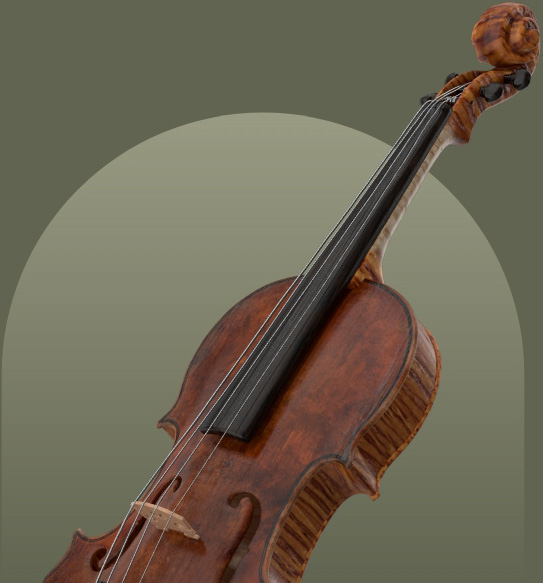
Known as ‘Dax’. Most distinguished maker of the family. Cremonese influenced modelling, with Tyrolean archings of medium height. Soundholes of both Stainer and Stradivari styles. Materials of variable quality. Thin varnish in several shades from pale golden-yellow to dark red-brown. Violas and cello\u{2026} — John Dilworth

Instruments

Auction price history
Highest auction price
| Type | Details | Sold | Price |
|---|---|---|---|
| Cello | 78.5 cm Mittenwald, Late 18th C. | October 2009 | £2,160 |
| Violin | 35.7 cm Mittenwald, 1785 | June 2007 | £3,848 |
| Violin | 35.5 cm Mittenwald, 1806 | February 2007 | £3,840 |
| Violin | 35.9 cm Mittenwald, 1795 c. | November 2006 | £2,160 |
| Violin | 35.5 cm Mittenwald, 1780 c. [Probably by] | July 2006 | £1,800 |
| Violin | Mittenwald, 19th C. [Possibly by] | February 2005 | £361 |
| Cello | 1800 | May 2003 | £661 |
| Violin | 1802 | November 1997 | £3,062 |
| Viola | 38.6 cm 1781 | November 1988 | £1,870 |
| Viola | 38.6 cm 1786 | April 1987 | £1,650 |
| Violin | 1800 c. | April 1985 | £1,650 |
| Violin | 1781 | June 1984 | £1,620 |
Biographies
The overview above is drawn from the following published accounts. Read them in the original:
John Dilworth+
HORNSTEINER, Mathias (II) Born circa. 1760, died 1803 Mittenwald Germany. Known as ‘Dax’. Most distinguished maker of the family. Cremonese influenced modelling, with Tyrolean archings of medium height. Soundholes of both Stainer and Stradivari styles. Materials of variable quality. Thin varnish in several shades from pale golden-yellow to dark red-brown. Violas and cellos on classical models also notable. Matthias Hornsteiner / der Geigenmacher in Mittenwald 1770
Cecie Stainer+
A maker in Mittenwald about 1770-1800. His instruments were better made than those of Joseph Hornsteiner.
Willibald Leo Lütgendorff+
Der beste aus der Familie Hornsteiner. Schone zierliche Geigen, schönes, feinjähriges Deckenholz, rother oder gelbbrauner Lack, gute Klotz-Schule. Seine beste Zeit ist 1765—1795.
Sell your instrument with Amati
Get started by uploading photos of your instrument for our experts to review.
Sell your instrument with Amati
Get started by uploading photos of your instrument for our experts to review.
Working in Mittenwald at the same time
(Boller) Anton (I) Poller b. 1766
(Boller) Korbinian Poller worked 1770–1790
(Johann) Ulrich Poller worked 1775–1790
Aegidius Klotz 1733–1805
Alois Mathias Fichtl 1764–1810
Andreas Feyrer worked 1789
Andreas Hornsteiner worked 1786–1810
Andres Forgues worked 1774