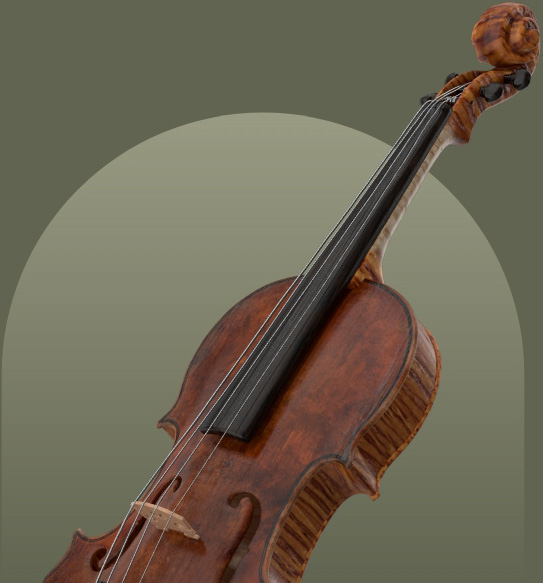
Gabriel Lembock
Budapest, Vienna, 1814–1892
Gabriel Lembock was a prominent Austrian luthier born in Budapest in 1814, who later settled in Vienna. He was a pupil of Peter Teufelsdorfer and J. B. Schweitzer, and became the son-in-law and successor to Anton Fischer (I). Lembock was known for his prolific output, particularly his copies of classical models, especially those of Guarneri del Gesù, and his skill in repairing old instruments. He received awards at Munich in 1854 and London in 1862, and was appointed luthier to the Imperial Court and the conservatoire. His workshop, which he retired from in 1875, was eventually taken over by Carl Haudek in 1893.
Auction Price History
Highest auction price
11 results
| Type | Details | Auction house | Sold | Price |
|---|---|---|---|---|
| Viola | Labelled Kais. Königl. Hof-Instrumentmacher, Gabriel Lemböck, Besitzer aller Weltausstellungs- ... Lot 45 | Tarisio | October 2024 | £9,865est. € 10.000-15.000 |
| Violin | 36.0 cm Vienna, 1858, after "Guarneri" | — | March 2011 | £37,250 |
| Violin | 36.0 cm 1857 | — | November 2008 | £6,985 |
| Violin | Vienna, 1855 | — | November 2005 | £11,448 |
| Violin | 1860 | — | March 1997 | £2,990 |
| Violin | 1857 | — | June 1995 | £5,980 |
| Violin | 1859 | — | April 1993 | £5,980 |
| Violin | 1878 | — | September 1987 | £3,740 |
| Violin | 18-- | — | March 1986 | £1,404 |
| Violin | 1848 | — | November 1985 | £1,296 |
| Violin | 1857 | — | October 1982 | £776 |
No results match those filters.
Maker Overview
Life
Gabriel Lembock (1814-1892) was born in 1814 in Ofen, Budapest, Hungary, and passed away in 1892 in Vienna, Austria. According to The Brompton's Book of Violin & Bow Makers by John Dilworth, he worked as a journeyman from 1840 and eventually settled in Vienna with Anton Fischer (I), whose son-in-law and successor he became. Sources contain conflicting information regarding the establishment of his own workshop; Die Geigen- und Lautenmacher vom Mittelalter bis zur Gegenwart by Willibald Leo Lütgendorff and A Dictionary of Violin Makers by Cecie Stainer state he opened his own workshop in 1840 in Canovastrasse, while Dilworth indicates he took over the shop of Bernhard Stoss in 1855. He was appointed luthier to the court in 1863 and given similar responsibilities at the conservatoire in 1871. Around 1862, he also supplied his instruments to Ede Remenyi in Budapest. After 1875, he retired from the workshop, which was continued by his apprentices. The shop was finally taken over by Carl Haudek in 1893.
Characteristics
- Models
- Lembock made copies of most classical models, but was particularly known for those of the Guarneri del Gesù violin that belonged to Paganini. He also worked after other masters.
- Varnish
- His varnish was of a glassy consistency and appeared in various shades.
- Output
- He was a prolific violin maker; his violas are described as rather small and rarely encountered, and few cellos are recorded.
- Repairs
- He was celebrated for his skill in repairing old instruments.
- Experiments
- He made various interesting experiments, including building violins with cedarwood tops, which were said to have a very soft tone.
- Tone
- The tone of his violins was consistently good.
- Gabriel Lemböck
Vienna Anno 1846John Dilworth - Gabriel Lemböck in Wien
anno 1867John Dilworth - Kais. Königl. Hof- Instrumentenmacher
Gabriel Lemböck
Bestes aller Weltausstellungen-medaillen
Wien, 1873.
I., Canovagasse Nr 4. Gabrielis Lemböck
Vienna Anno 1846John Dilworth - Gabriel Lemböck fecit secundum
Josephi Guarneri Cremonensis ori-
ginale ex Nicolai Paganini Concer-
tuosa Violina.
Viennae Anno 1852John Dilworth - I.H.S. Gabriel Lemböck
K.K. Hof-Instrumentenmacher. 1863John Dilworth
Influence and legacy
- Training: He was a pupil of Peter Teufelsdorfer and J. B. Schweitzer.
- Mentorship: He worked as a journeyman with Anton Fischer (I) in Vienna, later becoming his son-in-law and successor.
- Apprentices: His workshop was continued by apprentices including Josef Sollner, Karl Hermann Voigt, Alexander Ferenczy, and August Setzer.
- Awards: He was awarded prizes at Munich in 1854 and London in 1862.
- Appointments: He was appointed luthier to the court in 1863 and to the conservatoire in 1871.
- Succession: His business was succeeded by Carl Haudek in 1893, who had worked with Lembock.
Biographies
The overview above is drawn from the following published accounts. Read them in the original:
John Dilworth+
LEMBÖCK, Gabriel Born 1814 Ofen, Budapest Hungary, died 1892 Vienna Austria Pupil of Peter Teufelsdorfer and J. B. Schweitzer. From 1840 he worked as a journeyman, and finally settled in Vienna with Anton Fischer (I), whose son-in-law and successor he became. In 1855 he took over the shop of Bernhard Stoss and was appointed luthier to the court 1863 and given similar responsibilities at the conservatoire 1871. Awarded prizes at Munich 1854 and London 1862. Around 1862 he was also supplying his instruments to Ede Remenyi in Budapest. After 1875 he retired from the workshop, which was continued by apprentices, including Josef Sollner, Karl Hermann Voigt, Alexander Ferenczy, and August Setzer. The shop was finally taken over by Carl Haudek in 1893. Lembock made copies of most classical models, but is particularly known for those of the Guarneri del Gesù violin that belonged to Paganini. Varnish of a glassy consistency in various shades. Prolific violin maker; violas are rather small and rarely encountered. Few cellos recorded. Branded with two separate stamps in several places: ‘G’ ‘L’ . Printed labels: Gabriel Lemböck / Vienna Anno 1846 Gabriel Lemböck in Wien / anno 1867 Kais. Königl. Hof- Instrumentenmacher / Gabriel Lemböck / Bestes aller Weltausstellungen-medaillen / Wien, 1873. / I., Canovagasse Nr 4. Gabrielis Lemböck / Vienna Anno 1846 Gabriel Lemböck fecit secundum / Josephi Guarneri Cremonensis ori- / ginale ex Nicolai Paganini Concer- / tuosa Violina. / Viennae Anno 1852. I.H.S. Gabriel Lemböck / K.K. Hof-Instrumentenmacher. 1863 [Benedek]
Cecie Stainer+
b. Oct. 16, 1814, Budapest; d. March 27, 1892. Pupil of J. B. Schweizer in Budapest, then worked with Fischer in Vienna. In 1840 he started a business there in Canovastrasse. Was appointed Instrument maker to the Imperial Court.
He was celebrated for his skill in repairing old instruments. He exhibited two violins, very good copies of Guarneri, at Münich, 1854. A quartet of instruments, exhibited in London, 1862, were also made after the Italian pattern, and were admired for the beauty and fulness of their tone. Carl Haudek, who had worked with Lembock, until the death of the latter, succeeded to the business.
Willibald Leo Lütgendorff+
Schüler von J. B. Schweitzer, nach Anderen von Peter Teufelsdorfer, kam
als Gehilfe zu Fischer nach Wien, dessen Schwiegersohn und Nachfolger er
wurde, und eröffnete im Jahre 1840 seine eigene Werkstatt in der Canovagasse.
Er gehört zu den Geigenmachern, die mit Recht als Künstler bezeichnet werden,
und war ebenso geschickt, neue Geigen zu machen, als alte auszubessern. Er arbeitete meist nach Guarneri, aber auch nach anderen Meistern; der Ton seiner
Geigen ist immer gut, nur der Lack nicht hervorragend. Er machte auch
allerlei interessante Versuche und baute u. A. Geigen mit Cedernholzdecken,
deren Ton recht weich gewesen sein soll. Er besass viele Medaillen und war
Hof-Geigenmacher. Sein Nachfolger ist Haudek.
Sell your instrument with Amati
Get started by uploading photos of your instrument for our experts to review.
Sell your instrument with Amati
Get started by uploading photos of your instrument for our experts to review.