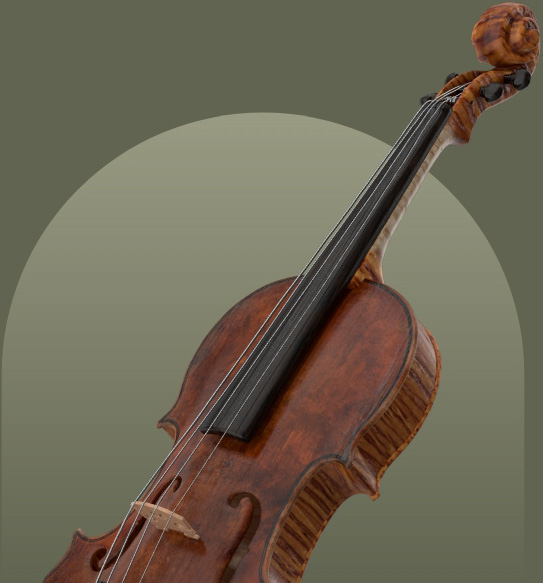
Nicolas Lupot
Orleans, Paris, Stuttgart, 1758–1824
Nicolas Lupot (1758-1824) was a preeminent French violin maker, renowned as the "French Stradivari" for his mastery in creating instruments in the classical style of Antonio Stradivari. Born in Stuttgart and trained by his father, Lupot established his influential workshop in Paris in the late 18th century, eventually becoming the city's leading maker. He was distinguished by his precise craftsmanship, sophisticated varnish (though sometimes applied thickly), and a commitment to faithful copies of Stradivari's work, presented without artificial aging. Lupot played a significant role in the French School of violin making, collaborating on "La Chélonomie," the first important book in French on the subject, and training notable apprentices like Charles François Gand. His career was marked by prestigious appointments as luthier to the King and the Conservatoire, and his instruments are found in significant collections, including the Ashmolean Museum. Lupot's dedication to quality and his impactful contributions cemented his legacy as a master craftsman whose works continue to be highly valued.
Auction Price History
Highest auction price
37 results
| Type | Details | Auction house | Sold | Price |
|---|---|---|---|---|
| Violin | Ex Sydney Manowitz and Oscar Lampe, labelled Nicolas Lupot luthier rue Croix, des petits-Champs à ... Lot 102 | Tarisio | October 2024 | £192,000est. £ 120,000-180,000 |
| Violin | Labelled Nicolas Lupot Luthier rue Croix des petits-Champs, à Paris, l'an 1820, branded N... à Paris Lot 113 | Tarisio | February 2024 | £191,592est. € 200.000-300.000 |
| Violin | 35.6 cm Paris, 1799 | — | June 2011 | £176,000 |
| Violin | 35.6 cm France, 19th C. | — | October 2010 | £10,000 |
| Violin | 36.1 cm Paris, 1804 | — | June 2010 | £80,777 |
| Violin | 35.6 cm Ascribed to | — | April 2010 | £14,926 |
| Violin | 35.8 cm Paris, 1798 | — | March 2010 | £91,250 |
| Cello | 75.0 cm Orléans, 1972/1973 c. | — | December 2009 | £139,273 |
| Violin | 35.8 cm Orleans, 1790 c. Attributed to | — | June 2009 | £10,500 |
| Violin | 35.8 cm Paris, 1801 | — | November 2008 | £62,864 |
| Violin | 36.1 cm Ascribed to | — | March 2008 | £22,100 |
| Violin | 36.0 cm Orleans, 1775 | — | April 2007 | £18,195 |
| Violin | 36.1 cm 1785 Attributed to | — | May 2006 | £3,161 |
| Violin | 35.9 cm Orléans, 1785 | — | February 2006 | £18,000 |
| Violin | Paris, 1820 c. | — | June 2005 | £10,867 |
| Violin | Paris, 1796 | — | October 2004 | £56,704 |
| Cello | Orleans, 1793 | — | July 2004 | £106,400 |
| Violin | 1783 | — | June 2002 | £22,864 |
| Violin | 1798 | — | May 2002 | £54,683 |
| Violin | 1794 | — | June 2000 | £24,044 |
| Violin | 1790 | — | June 1999 | £17,250 |
| Violin | 1820 | — | November 1998 | £62,000 |
| Violin | 1809 | — | November 1998 | £80,700 |
| Violin | 1798 | — | June 1993 | £52,800 |
| Violin | 1805 | — | June 1992 | £22,000 |
| Violin | 1800 c. | — | June 1990 | £30,800 |
| Violin | 1811 | — | March 1990 | £44,000 |
| Violin | 1805 (scroll later) | — | November 1989 | £23,100 |
| Violin | 1805 | — | November 1988 | £72,600 |
| Violin | 1813 | — | November 1988 | £50,600 |
| Violin | 1805 | — | June 1985 | £30,800 |
| Violin | 182- | — | November 1983 | £8,583 |
| Violin | 1793 | — | October 1982 | £9,706 |
| Violin | 1777 | — | January 1981 | £3,422 |
| Violin | 1789 | — | March 1980 | £5,378 |
| Violin | 18-- | — | March 1980 | £17,111 |
| Violin | 1803 | — | March 1980 | £7,333 |
No results match those filters.
Maker Overview
Life
Nicolas Lupot (1758-1824) was born in Stuttgart, Germany, in 1758 and died in Paris, France, on August 13, 1824 (Brompton's, Stainer). He was the son and pupil of François Lupot (I) in Stuttgart and was active from around 1770 (Brompton's). He moved with his father to Orleans in 1768 (Stainer) or 1770 (Hart), and his earliest known works from Orleans are dated 1776 (Lütgendorff).
Characteristics
- Innovation
- Nicolas Lupot made instruments "far above anything produced up to that time by French makers" by combining theory and practice to an extraordinary degree. George Hart notes that Lupot "scorned all those mischievous maturing processes common to the majority of French copyists" and "never desired that his copy should pass with the unwary as the original; it left his hands wholly unsophisticated," always varnishing the copy completely and letting time do its work of wear.
- Methods
- He was known for his precise work in the classical style of Stradivari (Brompton's). He carefully studied the work of Italian makers, especially Antonio Stradivari (Stainer), aiming to produce exact imitations of Stradivari violins (Stainer). George Hart states that Stradivari was Lupot's "idol," and "every feature of Lupot's instruments was clearly a matter of study with him," with "every portion of his work contributing to the harmonious whole." Hart further asserts that Lupot was "untouched in his own day, and his productions have never been approached since." It is said, that "every instrument that left his workshop was entirely made by his own hands." Willibald Leo Lütgendorff noted that Lupot worked after Stradivari "ohne ihn sklavisch zu copiren" [without slavishly copying him].
- Technical Characteristics
- Most of his work is in a large Stradivari model (Brompton's). His instruments are distinguished by "slightly exaggerated purfling mitres" and a "rich shaded deep red-brown varnish of slightly hard consistency" (Brompton's). His early work from Stuttgart reflected Germanic origins, being "rather stiff in form with narrow edges" (Brompton's). Cecie Stainer describes his varnish as "good quality, free from hardness," though often "too thick and heavy, especially on the violoncellos," and its color varies from yellow to dark red. George Hart further characterizes his varnish as "peculiar to him," "between the Italian and French," with its color varying "between light and dark red." Lütgendorff mentions that Lupot often applied varnish too thickly, which "im Alter leicht rissig wird" [easily cracks in old age], though this "nicht beeinträchtigt" [does not affect] the tone. Lupot also "nahm wiederholt Fischbein" [repeatedly used fishbone] for inlays (Lütgendorff). His instruments are also noted for a tone that is "round and telling, and free from roughness" (Hart).
- 1786 rue d’Illiers
à Orleans
N.Lupot fils luthier
fecit Nicolaus Lupot filius
fecit in Aurelianensis anno 1776John Dilworth - N. Lupot Fils, Luthier rue d’Illiers, à Orléans. L’An 1790John Dilworth
- Nicolas Lupot, Luthier rue de
Grammont; à Paris l’an 1798John Dilworth - Nicolas Lupot, Luthier rue Croix
des petits-Champs, à Paris, l’an 1815John Dilworth - N. Lupot Luthier de la Musique du Roi
et de l’Ecole Royale de Musique
Paris 1820John Dilworth
Influence and legacy
- Training and Mentorship: Nicolas Lupot was the son and pupil of François Lupot (I) (Brompton's). He was joined briefly by his father François (who died in 1805) and his brother François (II), who specialized in bow making (Brompton's). He took Charles François Gand as his apprentice in 1802, who later became his son-in-law and successor (Brompton's, Stainer). He also took Auguste Bernardel as an assistant (Brompton's). Cecie Stainer also lists Nicolas Eugène Gand among his distinguished pupils. The Bernardel family eventually joined the Gand family, forming a significant Paris atelier (Brompton's).
- Schools/Tradition: Nicolas Lupot "exercised a great influence on the French School of violin making" (Stainer). He is widely considered "the king of modern makers" (Hart) and has been termed the "French Stradivari" (Hart, Lütgendorff).
- Notable Associations: Lupot collaborated with Abbé Sibbire in writing "La Chélonomie," published in Paris in 1806, which was described as the first important book in French on violin making (Brompton's, Stainer). He was famed for his skillful repair of old Italian instruments (Stainer). The violinist Spohr played on one of Nicolas Lupot's violins during his concert tours (Stainer, Lütgendorff).
- Museum Collections: An example of a prize instrument made by Lupot, dated 1816 with gold leaf inscriptions, is now in the Ashmolean Museum, Oxford (Brompton's). In 1818, he restored the Andrea Amati violin of Charles IX, which is now housed in the Cremona Civic Museum (Brompton's).
- Famous Owners: The violinist Spohr used one of Lupot's violins for his concert tours; this instrument later passed into the possession of Matthai of Leipzig and then Ulrich (Stainer).
- Modern Recognition: Lupot's appointment as luthier to the Conservatoire required him to make instruments as prizes for students (Brompton's). George Hart writes that Lupot's works "will be more valued as time rolls on," and he is "the king of modern makers."
Biographies
The overview above is drawn from the following published accounts. Read them in the original:
John Dilworth+
LUPOT, Nicolas Born 1758 Stuttgart Germany, died 1824 Paris France. Son and pupil of François Lupot (I) in Stuttgart. Active from c.1770. Began supplying work to François Pique in Paris c.1792, before moving there himself in 1794. By 1810 established as the leading maker of the city, and possibly the whole of Europe, within his lifetime. His precise work in the classical style of Stradivari was highly influential, when most pre-revolutionary luthiers adhered to Amatisé or Stainer patterns. Early work from Stuttgart reflects his Germanic origins and traditions: rather stiff in form with narrow edges. His first workshop in Paris was at 24 rue de Gramont and labels with that address date from 1796. In 1802 he took as his apprentice Charles François Gand, who was to become his successor. He was joined briefly by his father François who died in 1805, and also his brother François (II) who specialised in bow making. He also took as an assistant Auguste Bernardel, whose family eventually joined that of Gand in forming a very significant Paris atelier. From 1806 he was established in rue de la Croix des Petits Champs. At this time he collaborated with Abbé Sibbire in the writing of La Chélonomie; the first important book in French on the subject of violin making. Appointed luthier to the Chapelle of the King and Emperor 1813, then luthier to King Louis XVIII 1816, and luthier to the conservatoire 1817. This last appointment required him to make instruments as prizes for the students; a surviving example with gold leaf inscriptions dated 1816 is now in the Ashmolean Museum, Oxford. In 1818 he carried out the restoration of the Andrea Amati violin of Charles IX, now in the Cremona Civic Museum. Most of his work is in a large Stradivari model, distinguished with slightly exaggerated purfling mitres and rich shaded deep red-brown varnish of slightly hard consistency. Early work branded on the back beneath the button: ‘Lupot Orléans’. 1786 rue d’Illiers / à Orleans / N.Lupot fils luthier / fecit Nicolaus Lupot filius / fecit in Aurelianensis anno 1776 N. Lupot Fils, Luthier rue d’Illiers, à Orléans. L’An 1790 Nicolas Lupot, Luthier rue de / Grammont; à Paris l’an 1798 Nicolas Lupot, Luthier rue Croix / des petits-Champs, à Paris, l’an 1815 N. Lupot Luthier de la Musique du Roi / et de l’Ecole Royale de Musique / Paris 1820
George Hart+
Son of François, born at Stuttgard in 1758, removed with his father to Orleans in 1770. He established himself in Paris his fame having reached that city some time before. The attention which he soon received from the musical world of Paris proved to him that his removal was advantageous. He had not long been in Paris before he was honoured with Nicolas Lupot, Luthier, rue Croix the patronage of des-petits-champs, a Paris, 1’an 1817 the Conservatory of Music, an honour which is attended with many benefits, the chief of which is the making of a Violin annually, to be awarded as a prize to the most successful student among the Violinists. By this arrangement the maker has an opportunity of exercising to the best advantage all the skill of which he is capable, as he is at once aware that the attention of the public is directed to the constructor of the prize as well as to the receiver, and that an immediate road to popularity is thus opened. Lupot’s appointment as maker to the Conservatoire was enjoyed by his successor, François Gand, and is still retained by the latter’s son, in conjunction with Bernadel. Nicolas Lupot may be justly termed the French Stradivari. He was an artist in every sense of the word. He regarded the works of Stradivari with the utmost veneration. While, however, he laboured unceasingly to imitate him, he scorned all those mischievous maturing processes common to the majority of French copyists ; he never desired that his copy should pass with the unwary as the original; it left his hands wholly unsophisticated. There is not an instance in which he did not varnish the copy all over, leaving time to do its work of wear, although by so doing he doubtless sacrificed much in his own time, inasmuch as all new Violins so varnished have a crude appearance, notwithstanding any amount of high finish expended upon them. What, however, Lupot lost in his own day has been awarded to his name a hundredfold since. He seldom occupied himself in copying Guarneri or Amati, although there are a few beautiful examples met with now and again in which he adopted these forms. Stradivari was his idol, and from the fact already mentioned, that he is very rarely found to have followed any other model than that of Stradivari, he would seem to have been aware of his own peculiar fitness for the the great master’s design. Every feature of Lupot’s instruments was clearly a matter of study with him. It cannot be said of him, as of most other makers, that certain points are good, while others are weak. Every portion of his work contributes to the harmonious whole. The outline is perfect; the soundhole is executed in a masterly manner; the model, purfling, and scroll of equal merit. He was untouched in his own day, and his productions have never Jbeen approached since. It may safely be said that Lupot is the king of modern makers, and his works will be more valued as time rolls on. The varnish of Lupot is peculiar to him. Its qualities are good, being free from hardness. Though it is not of the Italian type, neither is it of the kind usually met with on the Violins of his contemporaries: it may be described as a quality of varnish coming between the Italian and French. Its colour varies between light and dark red. Age has assisted in heightening its lustre, and although it will never rank with the varnish of Cremona, yet it will hold its own among the varnishes of modern times. It is said that many instruments having the name of Pique in them are the work of Lupot, and this misnomer is accounted for by the story that Pique purchased them in an unvarnished state, and varnished them with his preparation. Be this as it may, it is certain that the varnish of Pique could not serve to benefit such instruments ; on the contrary, it would reduce their value. The tone of Lupot’s instruments improves yearly. The quality is round and telling, and free from roughness. He died in Paris in 1824, aged 66, and was succeeded in his business by his son-in-law, François Gand.
Cecie Stainer+
Son of François Lupot (1736-1804); b. 1758, Stuttgart; d. Aug. 13, 1824, Paris. He was the most distinguished member of this family, and exercised a great influence on the French School of violin making ; he carefully studied the work of the Italian makers, especially of Antonio Stradivari, and finally combining theory and practice in an extraordinary degree, made instruments far above anything produced up to that time by French makers.
In 1768 he went with his father to Orleans, and there learnt his trade; in 1792, while still living there, Pique, the Parisian maker, who was already well known for his violins, made an arrangement with him, by which he was to supply a certain number of violins” in the white” (i.e. unvarnished), at the rate of 30 francs each, to Pique, who had not the time to make them himself. This was good pay, for later J. B. Vuillaume only gave 15 or 20 francs (12s. to 16s.) for violins in this state, and now the price is about 40 to 50 francs (£1 12s. to £2).
Nicolas went to Paris in 1794, but did not start his business in rue de Grammont till 1798; in 1806 he moved to rue Croix-des-petits-Champs, where he remained till his death; it was there that he produced his famous copies of Italian instruments. He did not attempt to be original, but worked until he could produce exact imitations of the great Stradivari violins ; a few copies of Guarneri and Amati are known ; they are very beautiful, but it was the Stradivari pattern that he was most successful with. The result of his large experience of the methods employed by Italian makers was incorporated in the Abbe Sibire’s work, entitled ” La Chelonomieou le parfait luthier,” published in Paris, 1806.
He made many violins, altos, and violoncellos, which now fetch high prices; his earlier violins, those dated Orleans, and the first part of his time in Paris, are worth £20 or more ; those made between 1804 and 1824, from £50 to ; £60 or more; his violoncellos are rarer, and a fine specimen is worth about £8o. Some quintets of instruments (2 violins, 2 altos, and 1 violoncello), which he endeavoured to make similar in appearance and tone, are now very rare, and fetch fancy prices.
It is said that every instrument that left his workshop was entirely made by his own hands ; he was a real artist, and every small detail was beautifully finished. He used different varnishes, the usual one with time becomes cracked and lumpy-looking, which though a defect does not affect the tone. It is of good quality, free from hardness, but often too thick and heavy, especially on the violoncellos. The colour varies from yellow to dark red; the tone is always very fine. Spohr used to play on one of Nicolas’ violins during his concert tours; this instrument passed into the possession of Matthai of Leipzig, and when he died into that of Ulrich.
Nicolas was also famed for the skilful manner in which he repaired old Italian instruments. He had several distinguished pupils—Aug Seb. P. Bernardel, Nicolas Eugene Gand, and Charles François Gand, his son-in-law and successor. In 1815 he was appointed maker to the King, and in 1816 maker to the Paris Conservatoire; this latter post involved making the violins and violoncellos given as prizes to the Conservatoire pupils. In 1820 he undertook to entirely replace the instruments of the royal orchestra with new ones of his own ; but his death cut short the work, which was completed by Ch. Fr. Gand.
Many instruments were signed with his autograph.
Willibald Leo Lütgendorff+
nach Orleans kam. Seine ältesten Arbeiten sind aus Orleans 1776 datirt. Um
1794 kam er nach Paris und wurde zunächst von Pique beschäftigt. Es ist
zweifellos, dass sein Verkehr mit diesem Meister sehr förderlich für ihn war;
bei seiner genialen Veranlagung machte er sehr rasche Fortschritte und konnte
im Jahre 1798 seine eigene Werkstatt in der Rue de Grammont eröffnen, die
er 1806 nach der Rue Croix-des-Petits-Champs verlegte. Er ist unbestritten
der grösste Meister der französischen Schule, und wenn man ihn den »französischen
Stradivari« nennt, so hat dies seine volle Berechtigung. Er war ein
gründlicher Kenner der Italiener — auf seinen Mittheilungen fussend schrieb
Abbé Sibire seine »Chélonomie« — und des von ihm über Alles geschätzten
Stradivari. N. Lupot arbeitete nach Stradivari, ohne ihn sklavisch zu copiren;
seine Arbeit ist in jeder Beziehung mustergiltig und von so classischer Vollendung,
dass sie nicht übertroffen werden kann. Sein Lack, den schon G. Hart
als den besten aus der nachitalienischen Periode bezeichnet, ist freilich nicht so
schön wie der der besten Cremoneser. Er trug ihn auch oft zu dick auf, was
zwar den Ton seiner Geigen nicht beeinträchtigt, aber weniger bestechend aussieht,
zumal dieser Lack im Alter leicht rissig wird. Zu den Einlagen nahm
er wiederholt Fischbein. Lupot galt schon bei Lebzeiten als ein grosser Meister;
seine Geigen wurden den besten Schülern des Conservatoriums als Preise gegeben;
1815 wurde er zum Geigenmacher der königlichen Capelle und 1816
zum Lieferanten der k. Musikschule ernannt. Er erhielt für seine Violinen
durchschnittlich 300 Frcs.; schon in den sechziger Jahren des 19. Jahrhunderts
wurden sie mit 1000 Frcs. und 1900 oft gerne mit 4000-5000 Frcs. bezahlt.
In Deutschland wurde er hauptsächlich durch Spohr berühmt, der, seit er eine
Geige von Lupot erworben, ausschliesslich auf dieser spielte. Lupot’s Nachfolger
war sein Schüler und Schwiegersohn Chr. Fr. Gand.
Sell your instrument with Amati
Get started by uploading photos of your instrument for our experts to review.
Sell your instrument with Amati
Get started by uploading photos of your instrument for our experts to review.