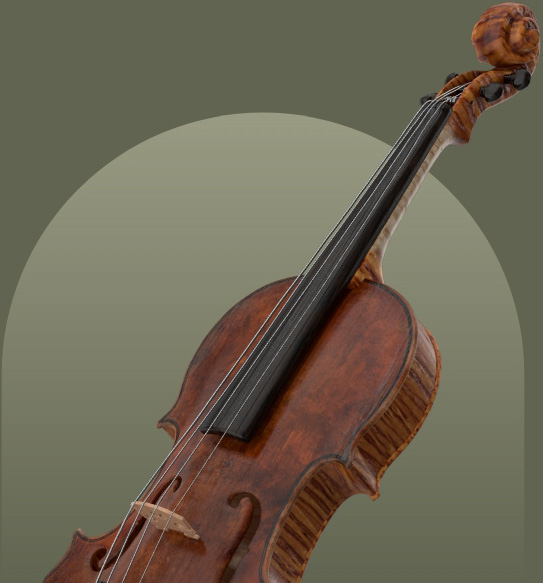
Joseph Merlin
1735–1803
Joseph Merlin (1735-1803) was a Belgian-born inventor and entrepreneur who worked in Paris and London. Known for his automatons and inventions like roller-skates and 'non-slip' pegs, he also produced musical instruments, primarily violins and a five-string cello, following the Stainer model. While his instruments were generally well-made and neatly worked, often featuring dull brown or red-brown spirit varnish, their tone quality was consistently described as poor. He operated workshops in various London locations, including New Street, Covent Garden, and Princes Street, Hanover Square.
Auction price history
Highest auction price
| Type | Details | Sold | Price |
|---|---|---|---|
| Cello | 1780 | November 1999 | £14,950 |
| Cello | 17-- | July 1992 | £7,150 |
| Cello | 1780 c. | June 1989 | £6,160 |
| Violin | 1778 | March 1989 | £1,980 |
| Violin | 1778 | November 1985 | £2,090 |
| Violin | 1785 | May 1981 | £253 |
Maker Overview
Life
Joseph Merlin (1735-1803) was an inventor and entrepreneur, born in Huys, Liège, Belgium, and later died in London, UK. in The Brompton's Book of Violin & Bow Makers, Merlin worked in Paris around 1750 before moving to London in 1760. In London, he received a commission to build a barrel-organ for the Princess of Wales and collaborated with a goldsmith in New Street, Covent Garden, near John Marshall's workshop. While few conventional musical instruments bear his label, he was primarily engaged in the design and manufacture of complex automatons. Merlin's most famous exploit involved a demonstration of his roller-skates, during which he danced while playing the violin, unfortunately colliding with a large mirror in Carlisle House, Soho Square, destroying both the mirror and his violin.
Characteristics
- Models
- Joseph Merlin followed the high Stainer model for his violins in A Dictionary of Violin Makers and Willibald Leo Lütgendorff in Die Geigen- und Lautenmacher vom Mittelalter bis zum Gegenwart.
- Instruments
- He produced violins and a five-string cello, which he described as a 'Pentachord,' made for Sir Edward Walpole.
- Workmanship
- His rare known works show signs of having been supplied by various London craftsmen of the time, and are described as neatly worked by John Dilworth. Cecie Stainer and William Meredith Morris also state his instruments were well made.
- Varnish
- The varnish on his instruments is described by John Dilworth as dull brown or red-brown spirit varnish. William Meredith Morris notes it as mostly dirty yellow or brown of an inferior quality.
- Tone Quality
- Sources consistently describe the tone of his instruments as not good, leaving much to be desired, or poor, and William Meredith Morris.
- Pegs
- Merlin invented and patented 'non-slip' pegs, which he added to at least one Stainer model violin dated 1776. His mechanical pegs for violins and violoncellos were at one time considered fashionable and in considerable use.
- Labels
- Willibald Leo Lütgendorff mentions he mostly used oval labels.
- Josephus Merlin
Cremonae Emulus
No. 106 Londini 1778
Improved
Queen Ann, No. 66, Street East
Portland ChapelJohn Dilworth
Influence and legacy
- Collaborations: Joseph Merlin worked with a goldsmith in New Street, Covent Garden, and his instruments show signs of having been supplied by various London craftsmen of the time, as detailed by John Dilworth.
Biographies
The overview above is drawn from the following published accounts. Read them in the original:
John Dilworth+
MERLIN, Joseph Born 1735 Huys, Liège Belgium, died 1803 London UK. Inventor and entrepreneur. Worked in Paris c.1750, moving to London 1760. There he was commissioned to build a barrel-organ for the Princess of Wales, and worked with a goldsmith in New Street, Covent Garden, close to the workshop of John Marshall. Few conventional musical instruments with his label but primarily engaged in the design and manufacture of complex automatons. One very ordinary London Stainer model violin bears his label dated 1776, but seems to have been ‘improved’ with the addition of his patent ‘non-slip’ pegs. More interesting is a five-string cello (‘Pentachord’ by his own description) made for Sir Edward Walpole. His rare known work show signs of having been supplied by various London craftsmen of the time, with dull brown or red-brown spirit varnish, but neatly worked. Merlin’s most famous exploit is his demonstration of another invention, roller-skates, on which he danced while playing the violin. Unfortunately the demonstration ended with him colliding with a large mirror in Carlisle House, Soho Square, destroying it and his violin. Cello branded beneath back button: ‘I. Merlin / London’. Printed and amended label: Josephus Merlin / Cremonae Emulus / No. 106 Londini 1778 / Improved / Queen Ann, No. 66, Street East / Portland Chapel
William Meredith Morris+
Stainer model, fairly well made, but possessing a poor tone. The varnish is mostly dirty yellow or brown of an inferior quality. His mechanical pegs for violins and violoncellos were at one time in considerable use. Label : —
JOSEPHUS MERLIN CREMONAE EMULUS. NO. 104. LONDINI, 1779. IMPROVED. 66 QUEEN ANN STREET EAST, PORTLAND CHAPEL
Cecie Stainer+
A maker in London, Princes Street, Hanover Square, in 1770-80. His violins and his mechanical pegs for violins and violoncellos were at one time very fashionable. He followed the high Stainer model, his instruments were well made, but the tone was not good.
Willibald Leo Lütgendorff+
Arbeitete nach dem Stainer-Modell und war seiner Zeit als genialer Erfinder von allerlei mechanischen Gegenständen berühmt. Er arbeitete gut, doch lässt der Ton
seiner Instrumente zu wünschen übrig Er verwendete meist ovale Zettel.
Sell your instrument with Amati
Get started by uploading photos of your instrument for our experts to review.
Sell your instrument with Amati
Get started by uploading photos of your instrument for our experts to review.