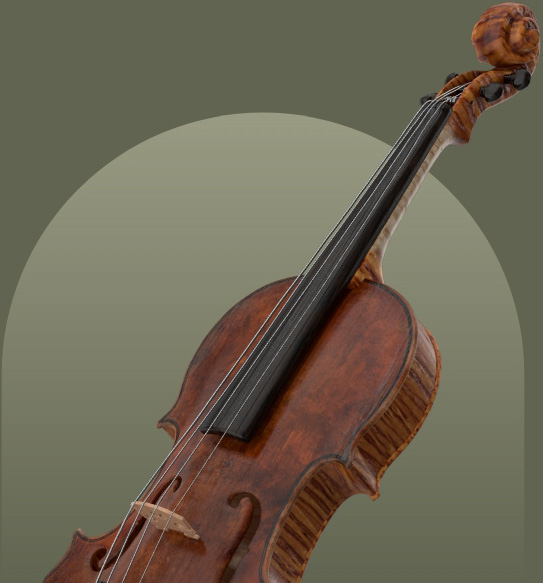
Morglato Morella
Mantua and Venice, worked 1545–1602
Morglato Morella was an influential maker of lutes, rebecs, and viols, active from approximately 1510 to 1602, working in Mantua and Venice. His viols were particularly famous and highly praised by contemporaries like S. Ang. Maffei. While few of his original instruments remain intact due to later modifications, his craftsmanship is noted for features such as double purfling and carved details, though some historical descriptions are considered unreliable. There is speculation that he may have been a pupil of Pietro Dardelli. Modern scholarship, particularly by Willibald Leo Lütgendorff, cautions that many instruments attributed to Morella in the current market are likely forgeries.
Maker Overview
Life
Morglato Morella (circa 1510-1602) was a notable maker of lutes, rebecs, and viols, whose career spanned from approximately 1510 to 1602, though sources contain conflicting information regarding his precise working dates. Cecie Stainer, in A Dictionary of Violin Makers, places his activity around 1510-1550, while John Dilworth, in The Brompton's Book of Violin & Bow Makers, suggests circa 1545-1602. He worked first in Mantua and later in Venice. George Hart, in The Violin, notes that M. Fetis, in his Biographie Universelle des Musiciens, stated Morella was famous for his viols and lutes, and S. Ang. Maffei, in his Annali di Mantova, highly praised Morella's instruments. Very few of his original instruments remain intact, as his viols were often repurposed for making smaller altos or violoncellos. John Dilworth mentions two labels attributed to Morella, one from Mantua and another from Venice, found in the Brussels Musical Instruments Museum (ex Snoeck) and P. De Wit's collection, but he considers both to be dubious. Dilworth also points out that Henley provides a detailed but unreliable description of Morella's work, including red-brown varnish, occasional double-purfling, and carved anthropomorphic heads. Willibald Leo Lütgendorff, in Die Geigen- und Lautenmacher vom Mittelalter bis zur Gegenwart, confirms that Morella was in Mantua around 1540 and in Venice by 1550, and notes that many works attributed to him in the trade are likely forgeries.
Characteristics
- Instrument Types
- Morglato Morella was known for crafting lutes, rebecs, and viols.
- Construction Details
- 's description, which John Dilworth deems unreliable, Morella's instruments sometimes featured double-purfling and were inlaid with carved anthropomorphic heads. Willibald Leo Lütgendorff also mentions a re-worked violin from the Snoeck collection (No. 507) that had double purfling and a jester's head on the pegbox.
- Varnish
- Henley described the varnish as red-brown, a detail also noted by Lütgendorff.
- Labels
- Two labels are quoted: "Morglato Morella / Mantuae 15.." and "Morglato Morella / fece in Venecia 1594", though John Dilworth considers their authenticity dubious.
- Morglato Morella
Mantuae 15..John Dilworth - Morglato Morella
fece in Venecia 1594John Dilworth
Influence and legacy
- Mentorship: There is speculation, cited by John Dilworth and Willibald Leo Lütgendorff, that Morglato Morella may have been a pupil of the lute maker Pietro Dardelli.
- Reputation: Morglato Morella's viols were highly renowned, a fame justified by the quality of the few surviving examples.
- Praise: S. Ang. Maffei, in his Annali di Mantova, offered high praise for the instruments made by Morella.
- Preservation Challenges: Many of his viols were later adapted into smaller altos or violoncellos, contributing to the scarcity of his original intact instruments.
- Forgeries: Willibald Leo Lütgendorff warns that many works attributed to Morella currently appearing in the trade are almost certainly forgeries.
Biographies
The overview above is drawn from the following published accounts. Read them in the original:
John Dilworth+
MORELLA, Morglato Worked circa. 1545-1602 Mantua & Venice Italy. Cited in most dictionaries, with speculation that he was the pupil of the lute maker Pietro Dardelli. Two labels are quoted from violins or fragments in the Brussels Musical Instruments Museum (ex Snoeck) with Mantua as origin, and from P. De Wit giving Venice, but both are dubious. Henley gives a detailed but unreliable description of red- brown varnish, sometimes double-purfled and inlaid with carved anthropomorphic heads. Morglato Morella / Mantuae 15.. Morglato Morella / fece in Venecia 1594
George Hart+
M. Fetis, in his ” Biographie Universelle des Musiciens,” states that he was famous for his Viols and Lutes. S. Ang. Maffei, in his “Annali di Mantova” (fol. 147), highly praises the instruments made by Morella.
Cecie Stainer+
A maker of lutes, rebecs, and viols about 1510-50, who worked first in Mantua, then in Venice. Very few of his instruments remain intact, as his viols were often utilised for making up altos or violoncellos of small size.
Willibald Leo Lütgendorff+
Vielleicht ein Schüler P. Dardelli’s. Seine Violen waren berühmt, und die wenigen von ihm erhaltenen Arbeiten rechtfertigen diesen Ruhm vollkommen. Um 1540 war er noch in Mantua (vgl. Bertolotti S. 35), 1550 aber in Venedig. Eine wahrscheinlich umgearbeitete Geige von ihm aus der Sammlung Snoeck (No. 507) hat doppelte Einlage, am Wirbelkasten ein Schalknarrenköpfchen und rothbraunen Lack. Die jetzt öfter im Handel vorkommenden Arbeiten von ihm sind wohl ausnahmslos Fälschungen.
Sell your instrument with Amati
Get started by uploading photos of your instrument for our experts to review.
Sell your instrument with Amati
Get started by uploading photos of your instrument for our experts to review.