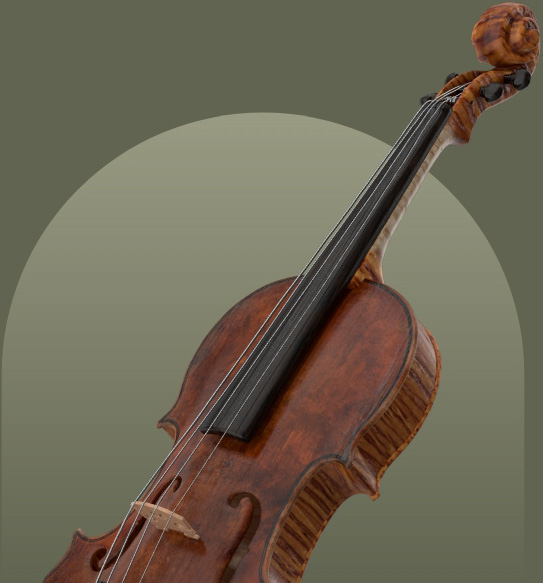
Mirecourt School
Joseph Nicolas
Mirecourt, 1796–1864
Joseph Nicolas (1796-1864) was a French luthier, the son and pupil of Didier Nicolas, whom he succeeded in 1816. He continued his father's style with little differentiation, producing instruments branded "J. Nicolas fils" that were known for their powerful tone and light varnish. He received a bronze medal in 1834 and notably crafted a double-sided violin in 1855. After his death, his workshop and branding stamps were sold to Derazey, leading to instruments bearing the Nicolas name but not made by him.
Auction price history
Highest auction price
5 results
| Type | Details | Auction house | Sold | Price |
|---|---|---|---|---|
| Viola | 38.2 cm Mirecourt, 1832 experimental | — | December 2010 | £466 |
| Violin | 36.4 cm Mirecourt, 1830 c. | — | June 2010 | £1,346 |
| Violin | 1850 c. | — | October 2003 | £1,357 |
| Violin | 1850 c. | — | October 1995 | £1,035 |
| Violin | 1840 c. | — | May 1986 | £330 |
No results match those filters.
Maker Overview
Life
Joseph Nicolas (1796-1864) was the son and pupil of Didier Nicolas, succeeding his father in 1816 and continuing his work with little perceptible differentiation, according to The Brompton's Book of Violin & Bow Makers by John Dilworth.
Characteristics
- Branding
- His instruments are branded "J. Nicolas fils".
- Workmanship
- He continued his father's work with little perceptible differentiation.
- Characteristics
- His violins are usually lightly varnished and are considered good orchestral instruments due to their powerful tone in Die Geigen- und Lautenmacher vom Mittelalter bis zur Gegenwart.
- Notable Instruments
- A fine cello by Joseph Nicolas is preserved in the museum of Hamburg.
- Unusual Creations
- In 1855, he constructed a violin that could be played on both back and front, featuring two finger-boards and two bridges, though its utility was not obvious.
Influence and legacy
- Mentorship: Joseph Nicolas was the son and pupil of Didier Nicolas.
- Succession: He succeeded his father in 1816.
- Artistic Goal: He strived to emulate his father.
- Awards: Joseph Nicolas was awarded a bronze medal in 1834.
- Posthumous Business: After his death, his widow sold the business and instrument stamps to Derazey of Mirecourt, leading to instruments being stamped with the Nicolas name but not made by him, as documented by Cecie Stainer.
- Museum Presence: A fine cello crafted by Joseph Nicolas is housed in the museum of Hamburg.
Biographies
The overview above is drawn from the following published accounts. Read them in the original:
John Dilworth+
Joseph Born 1796, died 1864. Son and pupil of Didier Nicolas, above. Succeeded his father in 1816 and continued his work with little perceptible differentiation. After his death J. Derazy purchased the rights to the triangular label ‘A la Ville de Cremonne’ used by Didier, and continued production. A fine cello by Joseph is in the museum of Hamburg. Branded: ‘J.Nicolas Fils’
George Hart+
Son of Didier, born 1796, died 1864.
Cecie Stainer+
Son of Didier Nicolas ; b. 1796, Mirecourt; d. 1864. Pupil and successor of his father. His instruments are branded “J. Nicolas fils.” He was awarded a bronze medal in 1834; in 1855 he constructed a violin which could be played on both back and front, being provided with two finger-boards, two bridges, &c.— the utility of this instrument is not obvious.
After his death his widow sold all the stock-in-trade to the maker Derazey, of Mirecourt; the two stamps with which Joseph and his father had branded their instruments were included; these were apparently made use of along with the other material by Derazey, consequently new instruments have since appeared not made by a Nicolas, although stamped with the name.
Willibald Leo Lütgendorff+
Sohn, Schüler , Mitarbeiter und Nachfolger von Didier Nicolas, dem er nachstrebte.
Seine Geigen tragen die Marke:
sind meist hell lackirt und gelten ihres kräftigen Tons wegen als gute Orchesterinstrumente. Nach seinem Tode verkaufte die Wittwe Geschäft und Firma an Derazey; in Folge dessen kann man viele Geigen, die lange nach dem Tode der
beiden Nicolas entstanden sind, mit ihren Stempeln versehen antreffen.
Sell your instrument with Amati
Get started by uploading photos of your instrument for our experts to review.
Sell your instrument with Amati
Get started by uploading photos of your instrument for our experts to review.