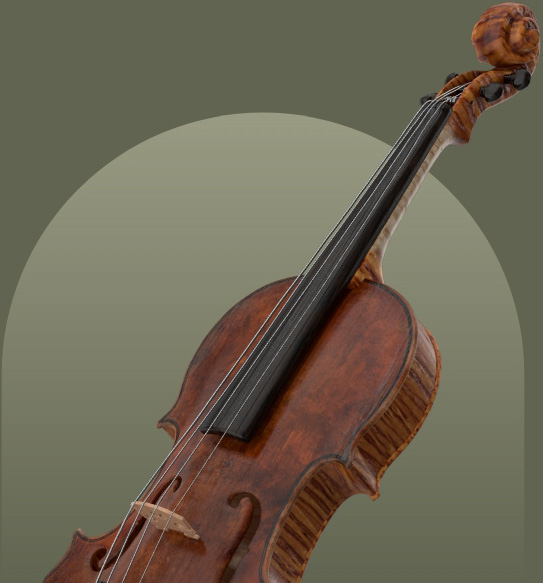
Italy School
Giuseppe Odoardi
Ascoli, Ascoli Piceno, Poggia and Ascoli, b. 1746
Giuseppe Odoardi (1746-after 1786), known as 'Il Vilano d'Ascoli', was an Italian luthier from Poggio di Bretta, Ascoli. Traditionally considered self-taught, he developed into an excellent violin maker, creating both high-arched models influenced by Stainer and flatter models with a Montagnana-like design. Despite using modest materials and a thin, golden-brown varnish, his flatter models are highly sought after for their sound. While his lifespan has been subject to conflicting accounts, his violins remain popular in Italy, though his name is often misused on other instruments.
Auction price history
Highest auction price
| Type | Details | Sold | Price |
|---|---|---|---|
| Violin | 35.2 cm Ascoli Piceno, 1780 c. | October 2009 | £21,600 |
| Violin | 34.7 cm Ascoli Piceno, 1780 (scroll possibly not original) | March 2009 | £16,380 |
| Violin | 35.1 cm Ascoli, 1780 c. [Lit: The Cooper Collection] | March 2008 | £34,100 |
| Violin | 35.0 cm Ascoli Piceno, 1770 c. | October 2007 | £12,562 |
| Violin | [Attributed to] | July 2004 | £10,755 |
| Violin | 178- | December 1994 | £10,321 |
Maker Overview
Life
Giuseppe Odoardi (1746-after 1786) was born in Poggio di Bretta, Ascoli, Italy, and was known as 'Il Vilano d'Ascoli' (the peasant of Ascoli). in The Brompton's Book of Violin & Bow Makers, he was traditionally said to be self-taught, although his labels refer to his father Antonio, which was likely for personal identification rather than indicating Antonio was an instrument maker. Willibald Leo Lütgendorff in Die Geigen- und Lautenmacher vom Mittelalter bis zur Gegenwart notes that Antonio Odoardi was a versatile dilettante. Sources contain conflicting information about his life span; Galeazzi (1791) and Cecie Stainer in A Dictionary of Violin Makers state he died at about 28 years old, having made around 200 violins, but Lütgendorff explicitly states this age of death is incorrect, and that his birth time is often given a century too early. Giuseppe Odoardi did have a nephew, also named Antonio, who is recorded as a luthier.
- Joseph Odoardi Asculi, 1779John Dilworth
- Joseph Odoardi fecit in Piceno
prope Asculum, An 1786
De ligno Plattuae Joseph Odoardi filius Antonii
Fecit prope Asculum 1781John Dilworth
Influence and legacy
- Training: Giuseppe Odoardi was traditionally said to be self-taught, with sources like Willibald Leo Lütgendorff and Cecie Stainer noting he developed into an excellent violin maker without a teacher.
- Stylistic Influences: Willibald Leo Lütgendorff states that some of his works show the influence of Mariani and Sacchini.
- Reputation: Cecie Stainer notes that his violins are much sought after in Italy.
- Misuse of Name: Willibald Leo Lütgendorff warns that his name is often misused and affixed to various old violins.
Biographies
The overview above is drawn from the following published accounts. Read them in the original:
John Dilworth+
ODOARDI, Giuseppe Born 1746, d. after 1786 Poggio di Bretta, Ascoli Italy. Known as ‘Il Vilano d’Ascoli’ (the peasant of Ascoli). Traditionally said to be self-taught, although his label refers to his father Antonio. As with G. B. Guadagnini whose label also mentions his father’s name, this is probably intended purely as personal identification rather than an indication that either Guadagnini’s or Odoardi’s father actually made instruments. The weight of evidence is that they did not. Giuseppe did have a nephew Antonio, above, who is recorded as a luthier. Giuseppe made both a high-arched Stainer-derived model and a flat model of noticeably plainer workmanship and materials; the flatter arch provides a better sound for modern players and is much in demand. There is more than a passing resemblance to Montagnana in the modelling, with elegantly curving soundholes, but the scroll is a little crude and unfinished. Materials generally modest (some examples with backs of plane tree wood) and varnish of relatively thin consistency; golden-brown or orange in colour. Joseph Odoardi Asculi, 1779 Joseph Odoardi fecit in Piceno / prope Asculum, An 1786 / De ligno Plattuae Joseph Odoardi filius Antonii / Fecit prope Asculum 1781
Cecie Stainer+
Was working until 1675 in Ascoli, Italy, according to one authority ; according to another was born about 1740. He was a peasant, and, though without any teaching in the art of violin making, showed great ability in the instruments he made. He died when 28 years old, but left about 200 violins, which are much sought after in Italy.
Willibald Leo Lütgendorff+
Sohn des Antonio Odoardi, der ein vielseitiger Dilettant war. Odoardi’s
Geburtszeit wird meist um ein Jahrhundert zu früh angegeben. Galeazzi erzählt
(1791) von ihm, dass er ein Bauer gewesen sei, ohne Lehrer sich zu einem
trefflichen Geigenmacher ausgebildet und an 200 Geigen gemacht habe, aber
schon mit etwa 28 Jahren gestorben sei, was offenbar unrichtig ist. Valdrighi
fand eine Violine von ihm von 1784 mit der No. 149, die aber durchaus nicht
aussergewöhnlich gut war. Andere Arbeiten von ihm stehen unter dem Einfluss
von Mariani und Sacchini. Sein Patron ist von mittlerer Grösse und erinnert an Montagnana. Der Lack ist gelbbraun oder auch dunkelbraun. Sein Name wird gern missbraucht und in allerlei Name wird gern missbraucht und in allerlei alten Geigen eingeklebt.
Sell your instrument with Amati
Get started by uploading photos of your instrument for our experts to review.
Sell your instrument with Amati
Get started by uploading photos of your instrument for our experts to review.