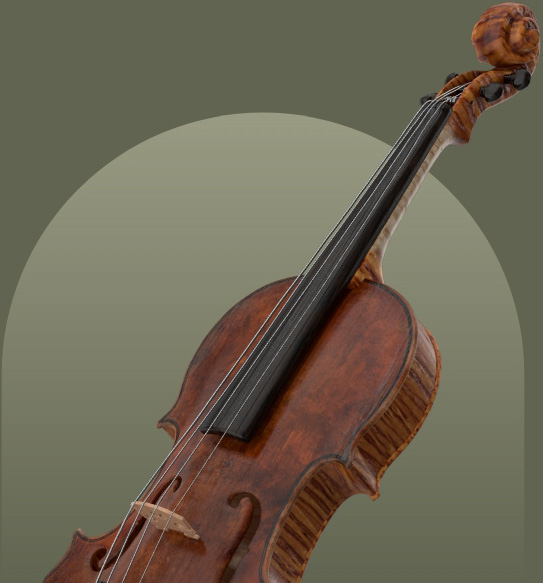
Giovanni Francesco Pressenda
Lequio-Berria, Turin, 1777–1854
Giovanni Francesco Pressenda (1777-1854) was a pivotal 19th-century Italian violin maker, celebrated for his exceptional craftsmanship and a significant figure in the history of string musical instruments. Born to a strolling fiddler in Piedmont, he developed an early interest in violin making, studying briefly with Lorenzo Storioni in Cremona. Despite early struggles that led him to combine violin making with cabinet-making, he established himself in Turin in 1820, where his abilities were quickly recognized. Pressenda's violins are predominantly based on the Stradivari model, distinguished by their superior varnish, well-arranged thicknesses, and expertly selected wood. His work marked a new departure in Italian violin making, demonstrating a sophisticated approach to the Stradivari model that surpassed his Italian contemporaries and drew comparisons to leading Parisian makers. Patronized by prominent violinists like Polledro, Wilhelmj, and Paganini, Pressenda's legacy endures through his highly acclaimed and influential instruments.
Auction Price History
Highest auction price
53 results
| Type | Details | Auction house | Sold | Price |
|---|---|---|---|---|
| Violin | Lot 209 | Bonhams | May 2015 | £37 |
| Violin | 35.6 cm Turin, 1825 c. | — | November 2011 | £90,219 |
| Violin | 35.2 cm 19th C. Ascribed to | — | October 2011 | £9,375 |
| Violin | 35.5 cm 1830 c. Attributed to | — | October 2011 | £67,250 |
| Viola | 39.4 cm Turin, 1833 | — | March 2010 | £79,250 |
| Violin | 35.5 cm 19th C. Ascribed to | — | October 2009 | £31,513 |
| Violin | 35.7 cm 1815-1820 c. | — | October 2009 | £9,000 |
| Cello | 76.4 cm 1880 c. Attributed to | — | May 2009 | £8,540 |
| Violin | 35.6 cm Italy Attributed to | — | October 2008 | £32,450 |
| Violin | 35.6 cm Turin, 1834, with Provenance | — | March 2008 | £132,500 |
| Violin | 35.5 cm Turin, 1827 | — | October 2007 | £90,500 |
| Violin | 35.6 cm Turin, 1829 | — | March 2007 | £92,000 |
| Violin | 35.5 cm Ascribed to | — | February 2007 | £31,200 |
| Violin | 36.1 cm Mid-19th C. | — | November 2006 | £81,600 |
| Violin | 35.5 cm Ascribed to | — | July 2006 | £19,200 |
| Violin | 35.4 cm Turin, 1828 | — | May 2006 | £108,401 |
| Violin | Turin, 1848 Exceptionally fine example | — | November 2004 | £106,050 |
| Violin | Turin, 1833 | — | November 2004 | £145,600 |
| Violin | Italy Attributed to | — | November 2004 | £28,680 |
| Violin | Turin, 1843 | — | May 2004 | £57,344 |
| Violin | 1825 | — | May 2003 | £112,250 |
| Violin | 1832 | — | November 2002 | £113,750 |
| Violin | 1832 | — | November 2002 | £138,650 |
| Violin | 1841 | — | June 2002 | £149,650 |
| Violin | 1827 | — | June 2002 | £141,413 |
| Violin | 1828 | — | March 2002 | £102,750 |
| Violin | 1832 | — | November 2001 | £120,000 |
| Violin | 1831 | — | March 2001 | £177,500 |
| Violin | 1835 c. (composite) | — | November 1999 | £40,000 |
| Cello | 1854 | — | March 1998 | £205,000 |
| Violin | 1836 | — | July 1997 | £84,000 |
| Violin | 1825 | — | November 1996 | £89,500 |
| Violin | 1832 | — | March 1996 | £128,000 |
| Violin | 1837 | — | March 1996 | £97,750 |
| Violin | 1833 | — | March 1995 | £124,700 |
| Violin | 1831 | — | June 1994 | £161,000 |
| Violin | 1839 | — | November 1992 | £82,500 |
| Violin | 1833 | — | November 1992 | £74,800 |
| Violin | 1835 | — | June 1990 | £36,300 |
| Violin | 1837 | — | June 1990 | £60,500 |
| Cello | 1845 | — | November 1989 | £105,600 |
| Violin | 1834 | — | November 1989 | £66,000 |
| Violin | 18-- | — | November 1989 | £27,500 |
| Violin | 1847 | — | November 1989 | £71,500 |
| Violin | 1831 | — | November 1989 | £66,000 |
| Violin | 1827 | — | November 1988 | £77,000 |
| Violin | 1846 | — | November 1987 | £42,900 |
| Violin | 1829 | — | April 1987 | £56,100 |
| Violin | 1828 | — | November 1986 | £19,250 |
| Violin | 1835 | — | May 1986 | £38,500 |
| Violin | 1829 | — | July 1985 | £33,000 |
| Violin | 1840 | — | June 1984 | £28,519 |
| Viola | 38.4 cm 1837 | — | March 1982 | £9,167 |
No results match those filters.
Maker Overview
Life
Giovanni Francesco Pressenda (b. 1777 Lequio-Berria, Alba; d. 1854 Turin, Italy) was the son of Raffaele Pressenda, a strolling fiddler from Lequio-Berria, a hamlet in Piedmont. Giovanni accompanied his father, playing the violin with some skill, and early on manifested a desire to learn about violin manufacture. Learning of Cremona's association with good violins, he traveled there, where he obtained rudimentary knowledge from Storioni. According to a passage in "L'Italie économique" (1847), he collected the traditions of the Cremonese school regarding modeling and varnish preparation.
Characteristics
- Innovation
- Pressenda initiated a return to a disciplined and highly finished style, notably influenced by Stradivari. His accurate depiction of the Stradivari model was considered more advanced than that of other contemporary Italian makers and compared favorably with the work of Parisian makers Pique and Lupot. The preparation of his varnish was a chief merit of his violins and was often deemed superior to other Italian violins of his century. He particularly concentrated on refining the Stradivari model and arching.
- Materials
- He selected wood with good judgment and utilized fine materials, often showing a predilection for one-piece backs. He attached great importance to the choice of wood, which he understood excellently. Purfling was typically of beech.
- Methods
- His violins are generally made on the Stradivari pattern, with sound-holes that are well cut and proportions of thicknesses that are correct and well-arranged in his best instruments. Early work is reported to have been on the Amati model. His instruments are not much arched. While his scrolls have much character, they are sometimes roughly cut and generally marked with a strongly scribed center line. His varnish ranged from orange to an intense thin red-brown, sometimes exhibiting a tendency towards craquelure. Soundholes feature strongly worked fluting around the lower circle and wing. He made few violas and cellos.
- Raphael
fecit Taurini anno Domini 1828John Dilworth
Influence and legacy
- Training and Mentorship: Pressenda encountered Lorenzo Storioni, either in Cremona or Turin around 1790, while still in his teens, from whom he received rudimentary knowledge of violin making. He served as a teacher to P. Pacharel, G. Rocca, and G. B. Rinaldi, who became his first biographer. He may also have influenced N. Bianchi. Giuseppe Rocca was associated with Pressenda from the beginning of his Turin career, possibly having first met in Alba.
- Schools/Tradition: Pressenda is considered one of the finest makers of the post-classical Italian school. He is noted for initiating a return to a disciplined style strongly influenced by Stradivari, departing from the "dying manufacture" evident in many Italian instruments of his century. In Turin, he came under the influence of Alessandro D’Espine and Gaetano Guadagnini (II), both active makers in the city.
- Notable Associations: Giovanni Battista Polledro, the famous violinist and Musical Director of the Royal Orchestra at Turin (appointed 1824), strongly encouraged and patronized Pressenda's manufacture. His work was subsequently recognized and taken up by violinists Wilhelmj and Paganini, as well as the collector Luigi Tarisio.
- Famous Owners: Although no specific instruments are named, Giovanni Francesco Pressenda's work was taken up and promoted by renowned violinists like Giovanni Battista Polledro, Wilhelmj, and Paganini, alongside the prominent collector Luigi Tarisio, indicating their high regard for his instruments.
- Modern Recognition: Highly successful and acclaimed during his lifetime, Giovanni Francesco Pressenda is regarded as one of the finest makers of the post-classical Italian school. His accurate portrayal of the Stradivari model was far more advanced than that of his contemporary Italian makers. His work, including his highly sought after fine musical instruments, continues to be highly valued today.
Biographies
The overview above is drawn from the following published accounts. Read them in the original:
John Dilworth+
PRESSENDA, Giovanni Francesco Born 1777 Lequio-Berria, Alba, died 1854 Turin Italy. One of the finest makers of the post-classical Italian school. Initiated a return to a disciplined and highly finished style, very strongly influenced by Stradivari. His early training is still unclear. He encountered Lorenzo Storioni, either in Cremona or Turin c.1790 whilst still in his teens. Although active in Alba from 1814 and Carmagnola from 1817, he is presumed to have been at that time a violin player rather than a maker. Established in Turin from 1820. From at least 1832 had a workshop at 30 via d’Angennes. In this early period he won copper medal for two violins in the Turin exposition of 1829, shared with Alessandro D’Espine, and similar award for a violin and cello in 1832. In Turin would have come under the influence of D’Espine and Gaetano Guadagnini (II), both already active there. Subsequently won silver medals in 1838, 1844, and 1850. Teacher of P. Pacharel, G. Rocca and G. B. Rinaldi, his first biographer, and possibly had some influence on N. Bianchi. Giuseppe Rocca was associated with him from the beginning of his career in Turin, and they may well have first become acquainted in Alba, Rocca’s birthplace. Rocca was working independently in Turin by 1844. The violinist G. B. Polledro had a significant role in promoting Pressenda’s work, which was subsequently taken up by violinist Wilhelmj and Paganini, and the collector Luigi Tarisio. Thus although highly successful and acclaimed in his own lifetime, his known authenticated work dates only from his Turin period after 1820 when he was already 43 years old. It is highly sophisticated, and his accurate depiction of the Stradivari model is far more advanced than any other contemporary Italian maker, and better compared with the work of Pique and Lupot in Paris. Early work on the Amati model is reported, but, particularly with the assistance of Rocca, he concentrated on refining the Stradivari model and arching. Violas and cellos few in number. Fine materials with a predilection for one piece backs. Varnish from orange to intense thin red-brown, with a tendency towards craquelure. Scrolls generally marked with a strongly scribed centre line. Purfling of beech. Soundholes with strongly worked fluting around the lower circle and wing. A bust of the maker by Reduzzi was erected in Turin in 1912. Joannes Franciscus Pressenda q. Raphael / fecit Taurini anno Domini 1828 [Rinaldi]
George Hart+
The Violins bearing the label of Pressenda are excellently made, and in many instances the varnish is superior to that met with on any Violins dated from Italy in the present century. Pressenda appears to have interested himself to some extent in the matter of varnish. In a little book published in Italy [“L’ltalie e”conomique,” 1847.] there is the following passage : “A pale reflexion of the old art (Violin-making) is found in Piedmont, with Guadagnini.” The writer continues with the following reference to Pressenda of Turin, who, he remarks, was in his youth at Cremona, “where he collected the traditions of the school as regards modelling and the preparation of the varnish, which is the chief merit of his Violins.” It is almost needless to remark that traditional information is frequently unsatisfactory, but particularly so in connexion with Cremonese Violinmaking and varnishing near the middle of the last century. In short, the great makers left no other record of the steps they took both in manufacture and in the preparation of their varnish than can be discovered in their works. The instruments of Pressenda present a singular contrast with others of Italian make belonging to this century, most of which evidence what may be termed the throes of a dying manufacture. With Pressenda we appear to have a new departure, in which there is some show of attention having been paid to the work accomplished in the best workshops of Paris. The then condition of Violin-making in Italy made it necessary for any Italian maker—no matter how great his ability—to seek information elsewhere, if desirous of excelling in his art. Pressenda appears to have sought to emulate and even surpass many Parisian makers by associating his name for the most part with good and unsophisticated work. The results of his labours reflect no little credit on his skill and judgment. Pressenda may be styled a born maker of Violins. From an account published by Signor Rinaldi, of Turin, in 1873, we learn that Pressenda was the son of poor parents, who lived in Lequio-Berria, a hamlet in the vicinity of Alba, in Piedmont. His father Raffaele was a strolling fiddler, and gained his precarious livelihood by playing at village fairs and other rejoicings. On these occasions he was accompanied by his son Giovanni, who followed the occupation of his father, playing the Violin with some degree of skill. It was at this period that he appears to have manifested a desire to know something of Violin manufacture, and frequently asked for information from his parent, who, however, was rarely able to satisfy his curiosity. Learning that Cremona was in some way associated with good Violins, he resolved to fiddle his way to that city. There he found Storioni, from whom he obtained some rudimentary knowledge of the manufacture he was so much interested in. Later he removed to Piedmont, and established himself in Alba in 1814, as a maker of Violins. The patronage he gained was, however, insufficient to maintain him, and he combined the business of cabinet-making with his favourite pursuit. After removing to Carmagnola, he went in the year 1820 to Turin, where his abilities were recognised and rewarded. He was encouraged in his manufacture by Giovanni Battista Polledro, the famous Violinist who, in 1824, became Musical Director of the Royal Orchestra at Turin. Pressenda died in the year 1854 at Turin. His Violins are chiefly of the model of Stradivari. The sound-holes are well cut. The thicknesses of his best instruments are well arranged, and the wood appears to have been selected with good judgment. The scrolls, whilst having much character, are somewhat roughly cut. The Violins belonging to his early period are chiefly of the Amatese character.
Cecie Stainer+
b. 1777 Turin ; d. there, 1854. Was the son of a strolling fiddler, Raffaele Pressenda, who generally lived in Lequio-Berria, a village near Alba, Piedmont. Giovanni also learnt to play the fiddle, but finding his way to Cremona there studied violin making under Lorenzo Storioni, and probably learnt there to make the varnish for which his violins were afterwards noted.
In 1814 he was working in Alba, combining cabinet making with violin making; then went to Carmagnole for a short time, and finally, in 1820, settled in Turin, where his ability was soon recognised. He was especially patronised by the celebrated violinist, Polledro, who was appointed Musical Director to the Royal Orchestra at Turin in 1824.
His violins are generally made on the Stradivari pattern, not much arched, the sound-holes well cut, the proportions of the thicknesses correct, the wood good, but the scrolls rather roughly finished; the red-brown varnish was of excellent quality.
Willibald Leo Lütgendorff+
Sohn des Raffaello Pr., eines Wandermusikanten, der ihn im Geigenspiel
unterrichtete. Gianfrancesco kam nach Cremona und wurde hier Schüler von
L. Storioni. 1814 liess er sich in Alba, wo auch sein Vater wohnte, als Kunstschreiner
und Geigenmacher nieder. Für kurze Zeit siedelte er nach Carmagnola
über und ging von hier 1820 nach Turin, wo sich der Hofmusikdirector Polledro
seiner besonders annahm. Er ist einer der wenigen Geigenmacher des 19. Jahrhunderts,
deren Arbeiten schon heute hochgeschätzt werden. Seine Violinen
stehen jetzt im Preise von 800—2000 M. und sind meist nach Strad gemacht.
Mit Ausnahme der Schnecke sind alle Einzelheiten vorzüglich durchgeführt,
und ganz besonders ist sein schöner Lack hervorzuheben. Er legte grossen
Werth auf die Wahl des Holzes, auf das er sich vorzüglich verstand, und erzielte
einen wundervollen Ton, der auch seinen gewöhnlicher durchgeführten Violinen nachgerühmt werden muss.
Sell your instrument with Amati
Get started by uploading photos of your instrument for our experts to review.
Sell your instrument with Amati
Get started by uploading photos of your instrument for our experts to review.