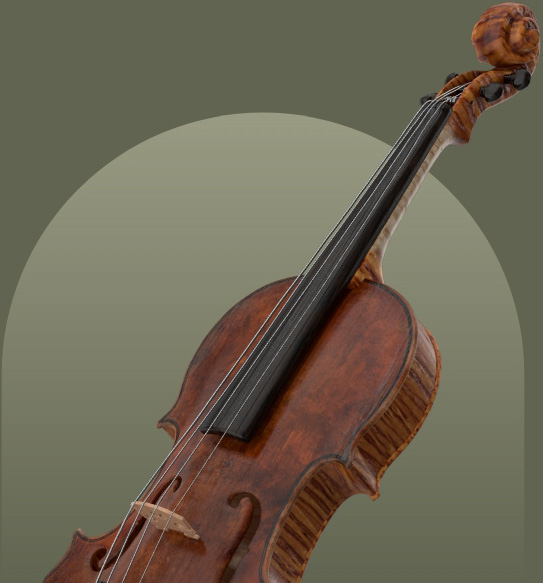
England School
William Atkinson
London, Stepney, Tottenham, 1851–1929
William Atkinson (1851-1929) was a distinguished English violin maker, born in Stepney, London. After an early career at sea and as a joiner, he made his first instrument in 1869 and established himself professionally in Tottenham, later moving to Paglesham, Essex. Atkinson was renowned for his meticulous craftsmanship, often destroying instruments that did not meet his exacting standards. He developed his own models, inspired by Stradivari and Amati, and was celebrated for his careful wood selection, graceful designs, and unique, soft oil varnish. His violins were highly regarded for their remarkable tone, described as strong, penetrating, and mellow, making them ideal for solo performances. Atkinson's dedication to his craft earned him a bronze medal in Paris (1889) and a silver medal in Edinburgh (1890).
Auction price history
Highest auction price
28 results
| Type | Details | Auction house | Sold | Price |
|---|---|---|---|---|
| Violin | Lot 231 | Bonhams | October 2014 | £4,750 |
| Violin | Lot 184 | Bonhams | March 2012 | £3,000 |
| Violin | 35.6 cm Tottenham, 1889 | — | December 2009 | £2,576 |
| Violin | 35.6 cm 1887 | — | March 2009 | £1,080 |
| Violin | 35.6 cm London, 1902 | — | November 2008 | £3,112 |
| Violin | 35.5 cm Tottenham, 1892 | — | July 2006 | £1,800 |
| Violin | 35.6 cm Tottenham, 1891 | — | July 2006 | £1,440 |
| Violin | 35.7 cm Tottenham, 1888 | — | February 2006 | £3,600 |
| Violin | Tottenham, 1890 | — | October 2005 | £2,620 |
| Violin | Tottenham, 1901 | — | November 2004 | £4,182 |
| Violin | 1891 | — | March 2001 | £1,840 |
| Violin | 1908 | — | March 2000 | £2,415 |
| Violin | 1891 | — | June 1999 | £1,035 |
| Violin | 1907 | — | June 1999 | £1,825 |
| Violin | 1909 | — | November 1998 | £2,530 |
| Violin | 1902 | — | March 1998 | £1,725 |
| Violin | 1892 | — | November 1997 | £1,725 |
| Violin | 1907 | — | March 1997 | £3,450 |
| Viola | 39.2 cm 1906 | — | March 1995 | £1,495 |
| Violin | 1890 | — | February 1995 | £1,955 |
| Violin | 1909 | — | October 1994 | £1,495 |
| Violin | 1906 | — | October 1994 | £978 |
| Violin | 1892 | — | March 1994 | £1,210 |
| Violin | 1909 | — | December 1993 | £1,650 |
| Violin | 1904 | — | November 1993 | £1,955 |
| Violin | 1892 | — | June 1993 | £1,045 |
| Violin | 1889 | — | November 1992 | £1,100 |
| Viola | 42.2 cm 1906 | — | March 1990 | £1,980 |
No results match those filters.
Maker Overview
Life
William Atkinson (1851-1929) was born William Thomas Reed Atkinson on October 23, 1851, in Stepney, London, the son of James and Hannah Atkinson. He received his education at Lukeing's Grammar School in Mile End Road, Stepney. At the age of fourteen, he relocated with his parents to Liverpool, where he worked for a period at his uncle's public-house, the "Shrewsbury Arms," near Birkenhead. Subsequently, he served as a second steward on several steamships belonging to Messrs. Bibby, including the Italian and the Arabian, under Captain Urquhart. After his seafaring career, he returned to London and apprenticed himself to a joiner named Mr. Hume. He married Miss Mary Elizabeth Camper on October 6, 1880, at Bromley-by-Bow Church, and they had two sons, William Camper and John Benjamin Camper. Atkinson made his first instrument in 1869 while still an apprentice joiner. He established himself as a professional violin maker in Tottenham, north London, operating from a general supply shop on Church Road and later at Holt House, High Road. In 1911, he moved to Paglesham, Essex, where he died in 1929. Throughout his life, Atkinson maintained other employments, which allowed him the financial independence to destroy work he deemed unsatisfactory, particularly later in his career when his early examples no longer met his standards.
Characteristics
- Output
- Atkinson was a prolific maker, producing at least 130 numbered violins and many more unnumbered instruments, a majority of which he destroyed if they did not meet his high standards of excellence.
- Models
- He worked on models derived from Stradivari or Amati, and also developed two original models.
- Wood Selection
- His wood was considered excellent, with maple typically featuring a medium-width figure. His pine, sourced from Berne, was described as perfect, possessing a "reed" that was slightly under medium width, perfectly straight, and well-defined.
- Design Elements
- His outline was noted for its gracefulness, described as being in the best Italian style. The scroll was considered a masterly conception of "Pheidian beauty." The first turn of the scroll parted suddenly from the boss, akin to the finest examples of Stradivari. Edges were gently softened with black lines to emphasize the extreme outline. The button was nearly semicircular with a toned-down edge, harmonizing with the contour. The margin was one-fifth wide, and the edges were strong and rounded without being over-pronounced. The elevation of the edge above the purfle-bed was almost imperceptible, contributing to a delicately refined appearance. The purfling was one-sixteenth wide, with the inner strip slightly wider than the combined outer ones.
- Varnish
- Atkinson developed his own oil varnish, which was soft, slow-drying, and developed color without added pigmentation. It ranged in color from pale straw to light ruby, displaying delicate tints. It was perfectly transparent, elastic, and soft to the touch. Applied in very thin coats and dried in the open air, sometimes with as many as twenty coats, the final thickness of the varnish was scarcely more than one-sixty-fourth of an inch. However, in some cases, this varnish has worn or crazed excessively.
- Tone
- His instruments were known for a remarkable and unique tone, described as strong without being loud, penetrating without being piercing, and mellow with a silver ring. It was considered ideal for solo performances.
- Pricing and Workmanship
- His violins were sold at a uniform price of £15. He exclusively made violins, and all the work was personal.
- Markings
- Instruments were branded beneath the button. The label was varnished over with the same color varnish used on the fiddle to prevent ink fading. His maker's monogram was also inlaid on the back under the button.
- William Atkinson in
Tottenham 1893John Dilworth - William Atkinson
in Paglesham 1924John Dilworth
Influence and legacy
- Apprenticeship: William Atkinson apprenticed as a joiner to a Mr. Hume after his seafaring career.
- Stylistic Evolution: After 1890, Atkinson significantly developed his ideas, freeing himself entirely from the "trammels of the French school."
- Awards: Atkinson received a bronze medal at Paris in 1889 and a silver medal at Edinburgh in 1890.
- Notable Recognition: A specimen of his work, featuring straw-colored varnish, was examined and highly praised by the late Duke of Saxe-Coburg-Gotha.
- Character: He was described as a man of persistent personality, unique without being eccentric, with his entire character centered around his craft. He was noted for his consummate skill as a mechanic.
Biographies
The overview above is drawn from the following published accounts. Read them in the original:
John Dilworth+
ATKINSON, William Born 1851 Stepney, London, died 1929 Paglesham, Essex UK. Worked as a seaman until c.1869, when he made his first instrument during an apprenticeship as a joiner. Professional violin maker in Tottenham, north London, working from a general supply shop on Church Road. Moved to Paglesham, Essex in 1911. Prolific maker on Stradivari- or Amati-derived models. Fine craftsmanship and good oil varnish, if a little stiff in execution and design; certainly amongst the best makers of this period in England. His oil varnish was his own concoction, soft and slow drying, developing colour without added pigmentation. In some cases this has worn or crazed excessively. It is frequently reported that he destroyed work that he considered unsatisfactory, particularly at the end of his life when early examples failed to match his later standards. He was able to do this at least in part because he always maintained other employments throughout his life and was never entirely dependent on his income from violin making. Branded beneath the button. William Atkinson in / Tottenham 1893 William Atkinson / in Paglesham 1924
Willibald Leo Lütgendorff+
eröffnete 1881 in Tottenhamm seine Werkstatt und baut nach eigenen Modellen Geigen, die er mit Bernsteinlack überzieht. Seine Arbeit ist sorgfältig, der Ton gut. Er erhielt in Paris 1889 und in Edinburg 1890 Medaillen.
William Meredith Morris+
He was born at Stepney, on October 23, 1851, and is the son of James and Hannah Atkinson. He works at Holt House, High Road, Tottenham, and is one of the best makers of modern times. His full name is William Thomas Reed Atkinson, but he always signs his name simply ” William Atkinson.” He was educated at Lukeing’s Grammar School, Mile End Road, Stepney. At the age of fourteen he re- moved with his parents to Liverpool, where he had to serve behind the bar for some time at his uncle’s public-house, the “Shrewsbury Arms,” Oxton, near Birkenhead. This was much against the boy’s inclination, but necessity knows no choice.
After that he served as second steward on board several steamships belonging to Messrs. Bibby, such as the Italian the Arabian &c., — the captain, a Mr. Urquhart, taking him with him from one vessel to the other.
During his seafaring career his parents removed back to London, and when he had got tired of ” ploughing the blue ” he joined them there, and apprenticed himself to a Mr. Hume, a joiner. He was married on October 6, 1880, to Miss Mary Elizabeth Camper, at Bromley-by-Bow Church. He has two sons, viz., William Camper, and John Benjamin Camper.
His first instrument dates back to 1869, and was made whilst serving his time as a joiner. Since he has taken up the gouge as a professional violin-maker, he has made 130 violins, numbered consecutively, and many more unnumbered. The majority of the latter he has destroyed, because they did not come up to his standard of excellence. He works on two original models. The measurements of model No. 1 are as follows : —
Length of body … 13 15/16ins,Width across upper bouts … 6 5/8ins,Width across middle bouts … 4 3/8ins,Width across lower bouts … 8 3/16ins,Depth of ribs at bottom … 1 1/4ins,Depth of ribs at top … 1 3/32ins,Length of sound-holes … 3 1/32ins,Distance between sound-holes at top … 1 19/32ins,Elevation from ½ inch to … 5/8ins,
The measurements of model No. 2 are the same, except that at the top, middle, and bottom bouts, it is 3/32 inches narrower.
Mr. Atkinson’s wood is excellent. The figure of his maple is, as a rule, of medium width. His pine, which is from Berne, is simply perfect, having a ” reed ” rather under medium width, perfectly straight and well-defined. His outline is in the best Italian style. It is gracefulness incarnate. A very strong expression, but a true one. As the form of the gazelle is to that of the ordinary antelope, so is the outline of Atkinson to that of the ordinary fiddle. The scroll is a masterly conception and of Pheidian beauty.
The following measurements carefully taken will give a correct idea of its proportions : —
Length from scollop to apex of volute … 4 1/4 ins. Width from boss-edge to boss-edge … 1 3/4insWidth of volute close to scollop … 1ins,Width of volute at apex … 1/2ins,Depth of peg-box close to scollop 1ins,Depth of peg-box at throat … 5/8ins, Width of peg- box inside … 5/8ins, Diminishing to … 1/2ins, Depth of first curl of volute … 1/2ins, Depth of second curl of volute … 3/10ins,Thickness of sides of peg-box … 1/5ins,
The first turn parts suddenly from the boss, as in the best examples of Stradivari. The edges are softened down gently, with black lines to emphasise the extreme outline.
The button is nearly semicircular, with toned-down edge, and is in perfect keeping with the contour. The margin is one-fifth wide. The edges are strong and rounded ; but the “rounding” is not over-pronounced. The elevation of the edge above the purfle-bed is almost imperceptible. The margin and edges present a delicately refined appearance. In fact, everything about the Atkinson violins betokens aristocratic refinement. The purfling is one-sixteenth wide, the inner strip having a width which is slightly greater than that of the outer ones combined.
The varnish is beautiful, ranging in colour from pale straw to light ruby, and of the most delicate tints. On a specimen recently seen by me, and which had been examined and most flatteringly commented upon by the late Duke of Saxe-Coburg-Gotha, the varnish was straw-coloured and of the richest and tenderest hue. It is perfectly transparent and elastic, and soft as velvet to the touch. It is laid on in very thin coats and dried in the open air. Sometimes as many as twenty coats are given, but the final thickness of varnish is scarcely more than one-sixty-fourth of an inch.
Mr. Atkinson’s tone is quite remarkable. It is not exactly like the tone of any other maker, classical or post-classical, that I am acquainted with. The size of the instrument would lead one to expect a tone of small volume, but such is not the case. The tone is strong without being loud, penetrating without being piercing. One need not go to Atkinson for mere loud- ness. His is a mellow tone with a silver ring. Its echo in a large hall is like the sound of an anvil struck at a distant smithy and borne by the breeze. It is the tone of the dulcimer magnified, clarified, beatified. It is a delicious tone! For this reason the Atkinson fiddles are pre-eminently solo instruments. For a similar reason it would not be wise to furnish the same orchestra with them throughout. That the gods rain honey on flowers is a kind provision ; if they did it on grass they would spoil the world.
Mr. Atkinson obtained a bronze medal at Paris, 1889, and a silver medal at Edinburgh, 1890. Since 1890, he has developed his ideas considerably, and has freed himself entirely from the trammels of the French school.
His price is fixed at a uniform figure, £15. He makes violins only, and all the work is personal.
As a man, the subject of this sketch is highly interesting. He is possessed of a persistent personality. He is unique without being eccentric. His whole character is cast into a mould, and the fiddle is the pivot of his life. He has no spare moments save for one thing — religion. He is busy, but not anxious ; modest, but not suspicious. He is consummately skilful as a mechanic — nothing proving too difficult for his gouge.
The label is varnished over with the same colour varnish as that used on the fiddle, to prevent the ink from fading or running. The maker’s monogram is also inlaid on the back under the button.
Sell your instrument with Amati
Get started by uploading photos of your instrument for our experts to review.
Sell your instrument with Amati
Get started by uploading photos of your instrument for our experts to review.