
Ancona School
Giuseppe Baldantoni
Ancona, 1784–1873
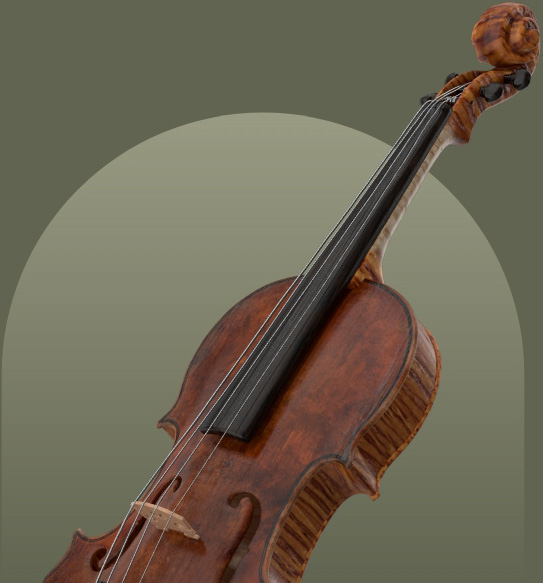
Giuseppe Baldantoni (1784-1873) was an Italian violin maker from Ancona, influenced by violinist Nappi and Bagatella's treatise. He developed a Stradivari-derived model known for its flat arching, distinctive scroll, and fine red-brown varnish. Baldantoni produced around 200 instruments, including highly regarded double basses, and was also recognized for his mechanical inventions.
Auction price history
Highest auction price
| Type | Details | Sold | Price |
|---|---|---|---|
| Violin | 36.2 cm 19th C. [Attributed to] | December 2010 | £2,090 |
| Violin | 35.3 cm Ancona, 1830 c. | March 2009 | £31,974 |
| Violin | 35.3 cm Ancona, 1800 c. [Ascribed to] | May 2007 | £32,403 |
| Cello | 1843 | June 1988 | £15,400 |
| Violin | 1800-25 | January 1984 | £1,124 |
| Violin | 1839 | November 1981 | £10,730 |
Maker Overview
Life
Giuseppe Baldantoni (1784-1873) was born in 1784 and died in 1873 in Ancona, Italy. He was influenced by the violinist Nappi and the treatise by Bagatella, which prompted him to seriously study violin making. Initially, his self-built violins were flawed in their measurements, but after studying Bagatella's work, he dedicated himself to the craft. After years of diligent effort, he was able to produce violins of beautiful form and good sound, constructing approximately 200 new violins, violas, cellos, and basses. Baldantoni was also a busy mechanic and received a gold medal in 1869 for his invention of a very practical mechanism for drums.
Characteristics
- Model
- His instruments were based on a large Stradivari-derived model, characterized by small corners and very flat arching.
- Soundholes
- The soundholes were set very upright and positioned close to the edges.
- Scroll
- He crafted a striking scroll with a neat and concentric volute, which was notably broad across the front face and pegbox.
- Varnish
- His instruments featured a fine red-brown varnish, described as being a little thin but with a good ground.
- Workmanship
- His violins are described as cleanly worked through.
- Double Basses
- His double basses were highly regarded.
- Tuning Forks
- The tuning forks he made were also valued.
- Joseph Baldantonj
Anconae fecit Anno 1856John Dilworth - Josephus Baldantonus
Anconiae fecit Anno 1839John Dilworth - Joseph Baldantoni
Anconae Ancona.1809John Dilworth
Influence and legacy
- Influences: He was influenced by the violinist Nappi and the treatise by Bagatella.
- Teaching: Baldantoni also carried out minor repairs on violins himself and instructed his students in this practice.
- Awards: In 1869, he received a gold medal for his invention of a very practical mechanism for drums.
- Family: His son, Benjamin, was a known violin virtuoso.
- Market Practices: Curiously, his violins, or those attributed to him, were often backdated by dealers to the mid-18th century.
Biographies
The overview above is drawn from the following published accounts. Read them in the original:
John Dilworth+
BALDANTONI, Giuseppe Born 1784, died 1873 Ancona Italy. Influenced by the violinist Nappi, and the treatise by Bagatella. Large Stradivari-derived model. Small corners and very flat arching. Soundholes set very upright and close to the edges. Striking scroll with neat and concentric volute, but very broad across the front face and pegbox. Fine red-brown varnish, if a little thin, with good ground. Double basses highly regarded. Joseph Baldantonj / Anconae fecit Anno 1856 Josephus Baldantonus / Anconiae fecit Anno 1839 Joseph Baldantoni / Anconae Ancona.1809
Willibald Leo Lütgendorff+
kleinere Reparaturen an Geigen selbst aus und leitete auch seine Schüler darin
an, was Baldantoni veranlasste, selbst zu versuchen, eine Geige zu bauen. Wenn
diese im Äussern auch wohlgelungen aussah, so war sie doch in allen Maassen
etc. verfehlt, und erst, als ihm Bagatella’s Schrift in die Hand fiel, kam er dazu,
den Geigenbau ernsthafter zu studiren. Er hat dies von nun an mit Eifer und
war nach jahrelangen Bemühungen wirklich im Stande, Geigen von schöner
Form und gutem Klang herzustellen. Er hat an 200 neue Violinen, Violen,
Violoncelli und Bässe gebaut, obwohl er auch als Mechaniker vielbeschäftigt
war. 1869 erhielt er eine goldene Medaille für seine Erfindung einer sehr
zweckmässigen Mechanik für Trommeln, auch die von ihm verfertigten Stimmgabeln
waren geschätzt. Seine Geigen sind sauber durchgearbeitet, haben flache
Wölbung und braungelben Lack. Merkwürdiger Weise werden seine Geigen
oder solche, die man ihm nur zuschreibt, von Händlern
und dergl. gerne bis in die Mitte des 18. Jahrhunderts
zurückdatiert Sein Sohn Benjamin ist
ein bekannter Geigenvirtuose.
Sell your instrument with Amati
Get started by uploading photos of your instrument for our experts to review.
Sell your instrument with Amati
Get started by uploading photos of your instrument for our experts to review.
Working in Ancona at the same time
Antonius Marinelli worked 1830