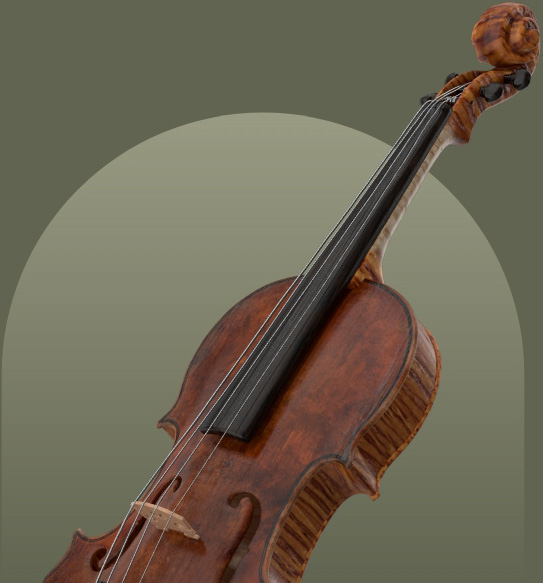
James Banks
Salisbury, 1758–1831
James Banks (1758-1831) was a violin maker and the son of Benjamin Banks (I). He continued his father's business in Salisbury with his brother Henry before relocating to Liverpool in 1811. Banks was known for consistently following his father's models and using similar varnish, though some noted a 'metallic harshness' in the tone of his instruments. After his death, unfinished instruments were found and sold from his Liverpool workshop.
Auction Price History
Highest auction price
25 results
| Type | Details | Auction house | Sold | Price |
|---|---|---|---|---|
| Cello | 73.3 cm London, 1799 | — | May 2011 | £14,567 |
| Violin | 35.5 cm Salisbury, 1796 | — | May 2011 | £13,839 |
| Cello | 75.7 cm 1800 c. (restorations) Attributed to | — | March 2011 | £6,960 |
| Cello | 73.0 cm Salisbury, 1797 | — | June 2008 | £31,122 |
| Violin | 35.7 cm Liverpool, 1819 | — | March 2008 | £4,800 |
| Viola | 38.4 cm Salisbury, 1800 | — | October 2005 | £4,016 |
| Violin | England, 1760 c. | — | July 2004 | £1,920 |
| Cello | 1805 | — | November 2002 | £17,925 |
| Viola | 40.7 cm 1898 | — | June 2002 | £5,661 |
| Cello | 1800 c. | — | May 2001 | £12,867 |
| Viola | 38.6 cm 1803 | — | November 2000 | £7,475 |
| Viola | 40.7 cm 1898 | — | May 2000 | £4,217 |
| Viola | 1803 | — | November 1999 | £7,000 |
| Violin | 1796 | — | April 1998 | £7,475 |
| Viola | 39.1 cm 1800 c. | — | February 1998 | £3,105 |
| Violin | 1807 | — | May 1997 | £2,000 |
| Cello | 1805 | — | March 1995 | £4,600 |
| Violin | 1803 | — | March 1994 | £9,200 |
| Cello | 1792 | — | June 1991 | £12,100 |
| Violin | 1803 | — | March 1991 | £9,350 |
| Violin | 1798 | — | March 1991 | £4,400 |
| Viola | 38.4 cm 1798 | — | November 1989 | £4,950 |
| Violin | 1820 | — | November 1989 | £506 |
| Violin | 1809 | — | September 1987 | £242 |
| Viola | 40.6 cm 1898 | — | May 1980 | £1,210 |
No results match those filters.
Maker Overview
Life
James Banks (1758-1831) was the son of Benjamin Banks (I). Born in Salisbury around 1756 or 1758, he died on June 15, 1831, in Liverpool. He continued his father's business in Catharine Street, Salisbury, with his brother Henry. In 1811, they sold their Salisbury business and relocated to Liverpool., they opened a shop at 28 Church Street and later at 10 Great Nelson Street. However, Cecie Stainer and William Meredith Morris state they moved to Church Street and then to Bold Street in Liverpool. James Banks was buried in St. Mary's, Edge-hill, Liverpool. After their deaths, many unfinished instruments were found in the cellar of their Liverpool house and were sold in that state, often to the trade.
Characteristics
- Role
- James Banks was a violin maker, while his brother Henry was a pianoforte tuner and repairer.
- Workmanship
- He was regarded as an excellent workman by Cecie Stainer and a very good workman by William Meredith Morris.
- Models
- He consistently followed the models established by his father, Benjamin Banks (I).
- Varnish
- He used similar varnish to his father, though occasionally his red-colored varnish had more black in it, or was of a 'somewhat blacker tint'.
- Tone
- William Meredith Morris noted a 'metallic harshness' in the tone of his instruments, suggesting he might have baked his wood, which Morris believed accounted for the inferiority compared to his father's work.
- Collaborative Work
- A violoncello made jointly by James and Henry Banks in 1797 was exhibited in 1872.
- Labels
- Examples of labels include "JAMES AND HENRY BANKS, MUSICAL INSTRUMENT MAKERS AND MUSICSELLERS, SALISBURY, 1800" and "JAMES AND HENRY BANKS, SALISBURY, 1805".
Influence and legacy
- Mentorship: James Banks was a student of his father, Benjamin Banks (I).
- Stylistic Adherence: He emulated his father's work, using the same models and similar varnish.
- Exhibitions: A violoncello crafted jointly by James and Henry Banks in 1797 was exhibited at the South Kensington Museum, London, in 1872.
- Ownership: This exhibited violoncello was the property of Mr. C. J. Read of Salisbury.
Biographies
The overview above is drawn from the following published accounts. Read them in the original:
John Dilworth+
BANKS, James Born 1758 Salisbury, died 1831 Liverpool UK. Son of Benjamin Banks (I), above. Continued the Catharine Street shop in Salisbury with his brother James until 1811, when they moved to Liverpool, opening a shop at 28 Church Street and later 10 Great Nelson Street. Many unfinished instruments were left in the house, which were bought and sold by the Palmer brothers, to be finished up and sold within the London trade.
William Meredith Morris+
They continued their father’s business till 1811, when they sold up and went to Church Street, and later to Bold Street, Liverpool. Both were born in Salisbury; James about 1756, and Henry about 1770. The former died on June 15, 1831, and the latter on Oct. 16, 1830. Henry was a pianoforte tuner and repairer, and James a violin-maker. James was a very good workman, and ought to have done better than he did. He followed his father’s model, and occasionally succeeded in producing much the same varnish. The tone cannot for a moment be compared with that of the old man. There is a metallic harshness about it which offends the ear, I am not sure that he did not bake his wood in some cases. I cannot otherwise account for the inferiority of the tone. The brothers left a number of unfinished instruments in the cellar of their Liverpool house, which were sold as they were, mostly to the trade. Labels : —
JAMES AND HENRY BANKS, MUSICAL INSTRUMENT MAKERS AND MUSICSELLERS, SALISBURY, 1800
JAMES AND HENRY BANKS, SALISBURY, 1805
One of their violoncellos, made by both jointly in 1797, was amongst the exhibits in the South Kensington Museum, 1872. It was the property of Mr. C. J. Read, of Salisbury. It was said to be a well-finished instrument, with a moderately powerful tone of very good quality. Nothing that I have seen by any one of the sons could be said to possess a tone of any distinction. I have heard better many times in an ordinary trade fiddle. The father’s mantle fell, not on the sons, but into the river, and was borne away by the flood.
Willibald Leo Lütgendorff+
Vierter Sohn von Benj. B. (I), Schüler seines Vaters, den er gleichwerthig
nachahmte. Er gebrauchte die gleichen Modelle und verwendete den gleichen
Lack, nur von etwas schwärzlicherer Färbung. Er
arbeitete mit seinem Bruder Henry zusammen, mit
dem er das väterliche Geschäft in der Catherine Street
fortsetzte. Im Jahre 1811 verkauften sie dasselbe
und siedelten nach Liverpool über, wo sie erst in
Cecie Stainer+
Fourth and sixth sons of B. Banks (1727-95). Both born in Salisbury, James about 1756, d. June 15, 1831; Henry about 1770, d. Oct. 16, 1830. They were in business together, Henry as a pianoforte tuner and repairer and James as a violin maker; the latter was an excellent workman, followed the same models as his father, used similar varnish, though occasionally the red-colour varnish had more black in it.
In 1811, they sold their business in Catherine Street, Salisbury, and went to Liverpool, to Church Street and then to Bold Street, where they died ; they were buried in St. Mary’s, Edge-hill. A number of unfinished instruments in the white wood were found in the cellar of their Liverpool house, and sold in that state.
A violoncello made by both of them in 1797 was exhibited in the South Kensington Museum, London. 1872.
Sell your instrument with Amati
Get started by uploading photos of your instrument for our experts to review.
Sell your instrument with Amati
Get started by uploading photos of your instrument for our experts to review.