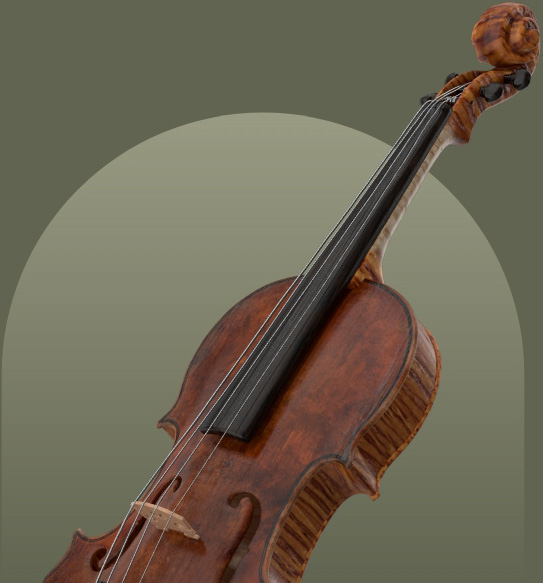
John (I) Betts
London, Stamford, 1752–1823
John (I) Betts was a pivotal figure in the history of string musical instruments in London during the late 18th and early 19th centuries. While making few instruments himself, his significant contributions lay in his role as a knowledgeable dealer and entrepreneur. He was an influential importer of fine musical instruments, particularly Italian works including those by makers like Stradivarius, and became the official valuer for customs. His workshop employed many skilled artisans, whose collective output, particularly cellos, is highly valued today. Instruments bearing his label reflect a range of characteristics due to the various craftsmen he employed, but his personal work, though rare, displays traits consistent with his training under Richard Duke. Known for his keen business sense and comprehensive knowledge of old music instruments, Betts was instrumental in shaping London's prominence in the international violin trade.
Auction Price History
Highest auction price
79 results
| Type | Details | Auction house | Sold | Price |
|---|---|---|---|---|
| Viola | Unlabelled Lot 38 | Tarisio | October 2024 | £6,490est. £ 5,000-8,000 |
| Violin | Lot 41 | Bonhams | May 2015 | £7,500 |
| Violin | Lot 298 | Bonhams | May 2014 | £500 |
| Violin | Lot 25 | Bonhams | May 2013 | £11,250 |
| Violin | 35.7 cm London, 1782 | — | December 2011 | £1,057 |
| Violin | 35.6 cm London, 1820 c. | — | November 2011 | £1,108 |
| Violin | Lot 41 | Bonhams | October 2011 | £7,500 |
| Cello | 74.0 cm London, 1780 c. | — | June 2011 | £21,600 |
| Violin | 35.1 cm London, 1780 c. | — | April 2011 | £7,501 |
| Viola | 38.8 cm London, 1803 | — | March 2011 | £3,600 |
| Violin | 35.6 cm London, 1800 c. | — | December 2010 | £4,800 |
| Viola | 38.4 cm Early 19th C. Possibly by | — | July 2010 | £2,115 |
| Violin | 35.1 cm London, 1785-1790 c. | — | June 2010 | £7,249 |
| Viola | 38.9 cm London, 1800 c. | — | March 2010 | £4,375 |
| Violin | 35.5 cm Late 18th C. Workshop of | — | February 2010 | £3,079 |
| Violin | 35.4 cm London, 1790 c. | — | October 2009 | £8,156 |
| Violin | 35.0 cm Worskhop of | — | October 2009 | £4,560 |
| Violin | 35.7 cm London, 1800 c. | — | June 2009 | £7,440 |
| Violin | 35.6 cm 1790 c. Worskhop of | — | June 2009 | £360 |
| Violin | 35.6 cm London, 1810 c. after "Nicolo Amati" | — | June 2009 | £7,440 |
| Cello | 73.3 cm London, 1797 | — | June 2008 | £12,152 |
| Violin | 35.8 cm London, 1780 c. Workshop | — | May 2008 | £1,686 |
| Cello | 73.6 cm London, Early 19th C. Workshop of | — | October 2007 | £4,750 |
| Violin | 35.4 cm London, 1800 c. | — | October 2007 | £3,500 |
| Violin | 35.5 cm 1790 c. | — | February 2007 | £1,200 |
| Violin | 35.0 cm London, 1790 c. | — | June 2006 | £3,120 |
| Cello | London, 1780 c. | — | November 2005 | £26,271 |
| Violin | London, 1810 c. Attributed to | — | May 2005 | £2,400 |
| Violin | 1810 c. Workshop | — | November 2004 | £1,553 |
| Violin | 1809 c. Workshop | — | April 2004 | £2,827 |
| Violin | London, 1800 c. | — | March 2004 | £1,680 |
| Violin | 1792 | — | July 2003 | £8,400 |
| Violin | 1850 c. | — | March 2003 | £9,360 |
| Violin | 1820 | — | March 2003 | £4,800 |
| Viola | 38.9 cm 1770 | — | October 2002 | £3,628 |
| Cello | 1780 | — | November 2001 | £43,883 |
| Viola | 35.8 cm 1800 | — | September 2000 | £2,990 |
| Violin | 1786 | — | May 2000 | £1,833 |
| Violin | 1755 | — | March 2000 | £5,175 |
| Violin | 1800 | — | September 1999 | £2,185 |
| Cello | 1791 | — | June 1999 | £13,000 |
| Cello | 1780 | — | March 1999 | £2,070 |
| Violin | 1810 c. | — | June 1998 | £4,255 |
| Violin Bow | Ivory 53 g. Open frog | — | April 1998 | £1,495 |
| Violin | 1790 c. | — | February 1998 | £2,875 |
| Violin | 1790 | — | May 1997 | £851 |
| Violin | 1785 | — | March 1997 | £1,495 |
| Violin Bow | Ivory 52 g. Open frog | — | March 1997 | £977 |
| Violin | 18-- | — | November 1996 | £4,600 |
| Violin | 1810 c. | — | November 1996 | £2,875 |
| Violin | 1810 | — | June 1996 | £3,450 |
| Violin | 1790 | — | March 1996 | £7,475 |
| Violin | 1789 | — | March 1996 | £1,265 |
| Violin | 1804 | — | November 1995 | £10,350 |
| Violin | 1786 | — | October 1995 | £8,050 |
| Viola | 38.1 cm 1800 c. | — | June 1995 | £6,900 |
| Viola | 38.6 cm 18-- | — | March 1995 | £4,830 |
| Viola | 37.8 cm 1800 | — | March 1995 | £1,610 |
| Violin Bow | S/E 58 g. | — | June 1994 | £920 |
| Cello | 1830-40 | — | June 1994 | £28,750 |
| Cello Bow | S/E 78 g. | — | March 1994 | £690 |
| Cello | 1813 | — | November 1993 | £8,250 |
| Viola | 40.3 cm 1800 c. | — | November 1993 | £5,750 |
| Violin | 1800 c. | — | August 1993 | £1,760 |
| Violin | 17-- | — | April 1993 | £5,980 |
| Viola | 38.9 cm 1800 c. | — | March 1992 | £2,860 |
| Violin | 1850 | — | November 1991 | £6,600 |
| Cello | 1800 c. | — | November 1991 | £3,960 |
| Viola | 38.3 cm 1800 c. | — | November 1991 | £4,950 |
| Violin | 1814 c. | — | April 1991 | £8,800 |
| Violin | 1810 c. | — | April 1991 | £770 |
| Cello | 1800 c. | — | November 1990 | £17,050 |
| Cello | 1800 c. | — | June 1989 | £13,200 |
| Viola Bow | Ivory 62 g. Open frog | — | November 1987 | £858 |
| Violin Bow | S/I 58 g. | — | May 1986 | £1,045 |
| Violin Bow | S/E 60 g. | — | November 1985 | £330 |
| Viola | 39.7 cm 1775-99 | — | June 1984 | £2,037 |
| Viola Bow | S/E 67 g. | — | June 1983 | £540 |
| Viola | 40.2 cm 1790 | — | March 1981 | £2,308 |
No results match those filters.
Maker Overview
Life
John (I) Betts (c.1752/1755-1823), universally known as "Old John Betts," was a significant figure in the London trade of string musical instruments. Born in Stamford, Lincolnshire (sources vary on his birth year, stating either 1752 or 1755), he died in London in March 1823 and was buried at Cripplegate Church. He began his career apprenticed to Richard Duke in 1765, later acquiring Duke's business from Duke’s daughter Anne. By 1781, Betts was independently established in Holborn, moving to the Royal Exchange area in 1782. He became the Official Valuer of violins to the Customs office, highlighting his expertise in violin valuation. While he made few instruments himself, his primary importance stemmed from his role as an expert and entrepreneur, playing a key role in establishing London as a major center for violin making activity in the 19th century. His business successor was his brother, Arthur B., who had been a violin teacher. A German source notes that he was "less outstanding as a violin maker than as a dealer and connoisseur."
Characteristics
- Methods
- John Betts made few instruments himself, largely employing excellent workmen to produce instruments under his name. These craftsmen, including the Panormos, John Carter, Edward Betts (his nephew), Bernhard Fendt (father and son), G. Gillingham, Richard Tobin, John Furber, and Isaac Newton, primarily copied old English and Italian instruments. Consequently, instruments bearing his name exhibit considerable variation in quality and characteristics. He advertised that he could make violins "in the neatest manner, the patterns of Ant. Stradivarius, Hieronymus Amatus, Jacobus Stainer, and Tyrols," claiming they were "Equal for the fine, full, mellow tone to those made in Cremona."
- Jo. Betts, No. 2
near Northgate the
RoyalExchange London, 1789John Dilworth - John Betts, No. 2 North Piazza
Royal Exchange, London, fecit
January 9. 1782John Dilworth
Influence and legacy
- Training and Mentorship: John Betts was a pupil of Richard Duke, senior, in London, having apprenticed with him and later purchased his business. He is noted for having "imbibed much of Duke's lore," with his own instruments showing similar characteristics in workmanship and varnish.
- Schools/Tradition: Betts was instrumental in making London a major hub for violin making activity in the 19th century. He was one of the first in England to conduct extensive business in Italian instruments, facilitating the import of a significant number of fine musical instruments into the country during his time.
- Notable Associations: He employed a significant number of skilled craftsmen, including the Panormos, John Carter, Edward Betts, and Bernhard Fendt, who contributed to the substantial body of work produced by his workshop, particularly cellos, which have become highly sought-after.
- Modern Recognition: Betts' greatest contribution is recognized as his expertise and entrepreneurial spirit. Cellos produced by the craftsmen in his employ are particularly highly sought-after.
Biographies
The overview above is drawn from the following published accounts. Read them in the original:
John Dilworth+
BETTS, John (I) Born 1752 Stamford, died 1823 London UK. Apprenticed to Richard Duke in 1765, subsequently buying the business from Duke’s daughter Anne. In 1781 he was established independently in Holborn, moving to Royal Exchange in 1782. He employed G. Gillingham, Edward Betts and John Carter, then Vincenzo Panormo, Joseph and Henry Lockey Hill, Richard Tobin, Bernard Fendt (father and son), John Furber, and a minor maker named Isaac Newton. Betts himself became Official Valuer of violins to the Customs office. While these craftsmen produced a very important body of work, particularly the cellos which have become highly sought-after, Betts’ greatest importance was as an expert and entrepreneur, responsible for making London a major centre of violin making activity in the 19th century. Often signed internally on front. Branded below the back button: Betts / Royal Exchange / London. Printed label: Jo. Betts, No. 2 / near Northgate the / RoyalExchange London, 1789 John Betts, No. 2 North Piazza / Royal Exchange, London, fecit / January 9. 1782 [BVMA]
William Meredith Morris+
He was universally known as ” Old John Betts,” and was well respected and patronised. He was a pupil of Richard Duke, and, in the few instruments made by himself, showed that he had imbibed much of Duke’s lore. The workmanship and varnish have much the same characteristics — the latter being, as a rule, of a tint which is a shade warmer than the varnish of Duke. He did not make many instruments himself, but employed excellent workmen, such as the Panormos, John Carter, Edward Betts, Bernhard Fendt, &c. The work is excellent, but poor instruments were occasionally sold by him, bearing his label. My great-grandfather ordered a violoncello of Betts in the year 1780, to be made by Betts himself. This instrument is now in my possession, and in excellent condition, having been recently repaired by Mr. J. W. Owen of Leeds. It is of the Amati model, plain wood, golden-brown varnish, with rather wide sound-holes. The tone is moderately powerful, and very sweet and mellow. The workmanship is solid and sober, without being refined and artistic like the work of Betts’ master. Betts was one of the first in this country to do extensive business in Italian instruments, and a large number of fine violins found their way into this country in his time. He used two or three different labels. The one inserted into the violoncello just referred to reads : —
JOHN BETTS, NO, 2, NORTH PIAZZA, ROYAL EXCHANGE, LONDINI, FECIT, JANUARY 9, 1782
the last line being written. The words “Jo. Betts, No. 2 North Piazza, Londini,” are also written across the back on the inside, near the top, and an inscription, which is not decipherable, is written across the belly near the left sound- hole.
Cecie Stainer+
Known as “Old John Betts,” b. 1755, at Stamford, Lincolnshire; d. March, 1823, was buried at Cripplegate Church. Pupil of Richard Duke, senior, in London. He made few instruments; the sound-holes are rather wide, the purfling broad, and the scrolls well cut; but he had great knowledge of Italian instruments.
Clever workmen, such as the Panormos, Bernhard Fendt, his nephew Edward, and John Carter were employed by him, principally to copy old English and Italian instruments.
He advertised that he “makes in the neatest manner, violins the patterns of Ant. Stradivarius, Hieronymus Amatus, Jacobus Stainer, and Tyrols. Equal for the fine, full, mellow tone to those made in Cremona.”
Willibald Leo Lütgendorff+
Schüler des älteren R. Duke. Er stammte aus Stamford, Lincolnshire und
war weniger hervorragend als Geigenmacher wie als Händler und Kenner. Die
Geigen, die seinen Namen tragen, sind sehr verschieden, was daher kommt, dass
Carter, sein Neffe Betts, B. Fendt und seine Söhne,
Panormo etc. für ihn arbeiteten. Er liess u. A. treffliche
Copien nach den Cremoneser Meistern herstellen.
Sein Geschäftsnachfolger war sein Bruder Arthur B.,
der Violinlehrer gewesen war.
Sell your instrument with Amati
Get started by uploading photos of your instrument for our experts to review.
Sell your instrument with Amati
Get started by uploading photos of your instrument for our experts to review.