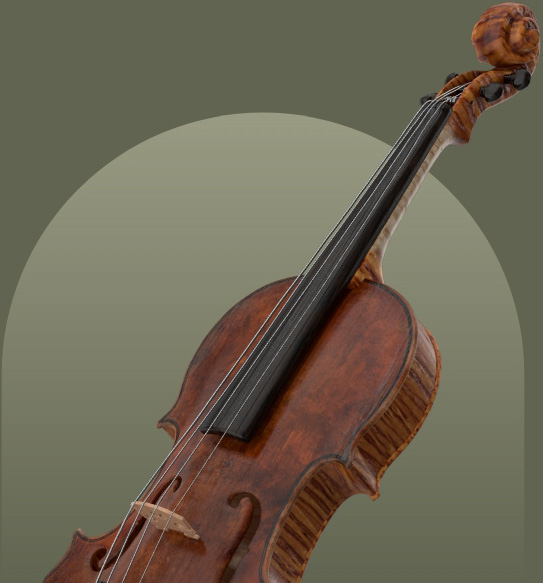
Tiefenbruck School
Gaspar Duiffobrugcar
Tiefenbruck, 1514–1570
Gaspar Duiffobrugcar (1514-1570) was a prominent luthier born in Germany, part of a significant family of instrument makers. He settled in Lyons, France, in 1533, becoming naturalised French in 1558. While his family often focused on lutes, Duiffobrugcar diversified into viols and various bowed instruments, as evidenced by a 1562 engraving. He was particularly renowned for his intricate inlay work and ornamentation, though his instruments are generally valued more for their decorative qualities than their tone. His career faced a tragic downturn when his workshop was demolished for city defences, leading to his death in poverty. His family received a royal pension, and his sons continued the lutherie tradition. Duiffobrugcar is also notable for being at the centre of a historical misconception, with French historians attempting to credit him as the inventor of the violin, leading to numerous later forgeries by makers like Vuillaume and Derazey, which often featured distinctive decorative elements like male heads instead of scrolls.
Maker Overview
Life
Gaspar Duiffobrugcar (1514-1570) was born in Tiefenbruck, Füssen, Germany, in 1514 and died in Lyons, France, around 1570. He was the son of an established lute maker, possibly Ulrich Tieffenbrucker of Venice and Bologna, and belonged to a large and significant family of luthiers. While one branch of his family worked in Italy, Gaspar initiated another stream by settling in Lyons in 1533. He was naturalised French in 1558. Sources contain conflicting information about his early career; George Hart states he settled in Bologna in the early 16th century and was prevailed upon by François I. to move to France in 1515, but Cecie Stainer notes that this tradition has no foundation, suggesting he likely learned his trade in South Germany before moving to Lyons. The first definite mention of him in Lyons is a receipt for wine signed by "Gaspard Duiffobrocard allemand" on November 23, 1553, followed by another receipt signed "Gaspard Duiffoprougar" on November 4, 1555. "Lettres de naturalite" were granted to "Gaspard Dieffenbruger" by Henri II. from Paris in January 1558. Although initially very successful, his house and workshop were demolished in 1564 or 1566 to make way for city defences, and he could not obtain any indemnity. His business never recovered, and he eventually died in the poor-house, leaving a widow and four children in debt and misery.
Characteristics
- Instrument Diversification
- An engraving by Woeiriot dated 1562 depicts Duiffoprugcar surrounded by instruments of his making, indicating that he diversified into viols and various forms of bowed instruments, while other members of his family remained lute makers.
- Decorative Work
- 's instruments are more valued for their inlaid work and ornamentation than for the quality of their tone. Hart notes his abilities appear to have been chiefly directed to the art of wood-inlaying.
- Known Instruments
- Genuine surviving examples of his work are not plentiful. A viola da gamba in the Musée de la Musique, Paris, bears the label: "Fait par Dviffoprvgcar / A la coste saint Sebastien / A Lyon". Other known instruments include a famous bass-viol with the plan of Paris inlaid in different coloured woods on the back and a neck ending in a horse's head, now in the Brussels Conservatoire Collection. Another bass-viol features its back inlaid with the picture known as the "Vieillard dans la chaise d'enfant", also with a horse's head neck. A small bass-viol has a similarly finished neck and a beautifully ornamented back, inscribed with the Latin legend: "Viva fui in sylvis, sum dura occisa securi; dum vixi tacui, mortua dulce cano" (I was living in the forest, the cruel axe killed me. Living, I was mute; dead, I sing sweetly). A bass-viol with Michel Angelo's "Moses" represented on the back is also noted. A "lyradabraccio," probably made at the beginning of the 16th century, is labelled: "Gaspard Duiffopruggar Bononiensis, anno 1515."
- Violin Attribution Controversy
- The tradition that Duiffobrugcar was the true inventor of the violin, tuned in fifths, led to the production of several violins in the second half of the 19th century bearing his labels, dated from 1510 to 1520. However, these were later identified as products of the Vuillaume or Derazey workshops. J. B. Vuillaume of Paris caused much misapprehension by producing beautifully inlaid and carved violins in Duiffobrugcar's style in 1827, which were subsequently copied by factories in Germany and Mirecourt. These instruments often feature a male head in place of the scroll and extensive decorative inlay, but there is no evidence to suggest Duiffobrugcar himself made violins.
- Fait par Dviffoprvgcar
A la coste saint Sebastien
A LyonJohn Dilworth
Influence and legacy
- Family Tradition: Gaspar Duiffobrugcar was a member of a large and important family of luthiers, with one stream working in Italy and another, initiated by him, settling in Lyons.
- Training: He probably learned his trade in South Germany.
- Family Continuity: His family was granted a pension by Charles IX, and his son, Gaspar (II), moved to Paris, where he married the sister of the luthier Jacques Delamotte and established his own business in the rue Pot-de-Feu in 1582. Another son, Jean, revived the workshop in Lyons and appears to have overcome all outstanding debts by 1585.
- Royal Pension: His family was awarded a pension by Charles IX in 1571 following his death in poverty.
- Historical Misconceptions: A movement by French historians attempted to prove that Duiffobrugcar was the true inventor of the violin, leading to the later production of numerous spurious violins attributed to him by makers like Vuillaume and Derazey, and subsequently by German and Mirecourt factories.
- Rarity of Genuine Works: Genuine surviving examples of his work are not plentiful, and those that exist are primarily valued for their elaborate inlay and ornamentation rather than their acoustic properties.
Biographies
The overview above is drawn from the following published accounts. Read them in the original:
John Dilworth+
DUIFFOPRUGCAR (TIEFFENBRUCKER), Gaspar Born 1514 Tiefenbruck, Füssen, Germany, died 1570 Lyons France. Son of an established lute maker, possibly Ulrich Tieffenbrucker of Venice and Bologna, he was a member of a large and important family of luthiers. The family separated into two streams, one working in Italy and the other, initiated by Gaspar, settling in Lyons in 1533. He was naturalised French in 1558. Although hugely successful, in 1564 his house and workshop were demolished to make way for city defences and his business never recovered. He eventually died in the poor-house. His family were granted a pension by Charles IX and his son, Gaspar (II), moved to Paris. There he married the sister of the luthier Jacques Delamotte and established his own business in the rue Pot-de-Feu 1582. Another son, Jean, revived the workshop in Lyons and appears to have overcome all outstanding debts by 1585. An engraving by Woeiriot dated 1562 presents Duiffoprugcar surrounded by instruments of his making, and shows that he diversified into viols and various forms of bowed instruments (while others of his family remained lute makers). This triggered a movement by French historians to prove that Duiffoprugcar was the true inventor of the violin. Several violins appeared in the second half of the 19th century with Duiffoprugcar labels dated from 1510 to 1520, but these all turned out to be the product of the Vuillaume or Derazey workshops. Third rate instruments, essentially cheap copies of these Parisian violins, started to emerge from Mirecourt and German factories exploiting the situation. Almost all of these instruments, some very finely made but generally over-sized, have as the would-be identifying ‘Duiffoprugcar’ characteristics of a male head in place of the scroll, and generally extensive decorative inlay. Genuine surviving examples of his work are not plentiful. A viola da gamba in the Musée de la Musique, Paris, bears the label: Fait par Dviffoprvgcar / A la coste saint Sebastien / A Lyon
George Hart+
This famous maker of Viols is said to have settled in Bologna in the early part of the sixteenth century. He appears to have obtained much renown as an inlayer of musical instruments, and it is stated that Francis I., upon the occasion of his visit to Italy in 1515, prevailed upon the Viol-maker to settle in France. The name of Duiffoprugcar has been made familiar to us, not so much on account of his merits as a Viol-maker, but almost wholly on account of his having been represented as the first maker of the Violin tuned in fifths, and the representation having been supported by the production of three Violins signed and dated 1511, 1517, 1519. I saw, about the year 1877, one of these, and was informed by the owner that the others were almost identical. The instrument bore distinct evidence of its being a modern French imitation, or rather an ingenious creation evolved from a myth, which in all probability had its origin in France. Duiffoprugcar was unquestionably an artist of a high order, but his abilities appear to have been chiefly directed to the art of wood-inlaying, rather than to the making of stringed instruments. He made Viols da Gamba, and he may have made smaller Viols, though I am not aware of any being in existence ; but there is no evidence whatever to show that he made Violins.
Cecie Stainer+
b. about 1514 in Freising, Bavaria; d. about 1570, Lyons. Was the principal member of a large family of Germans, who were working in North Italy—Padua, Venice—till about the middle of the 17th century, and still later in South Germany. There is much variety in the way in which the family name is spelt, ranging from the German form ” Tieffenbrucker,”to ” Dieffenbruger, ” “ Duiffo-brocard,” ” Duiffoprougar,” ” Duiffo-pruggar,” ” Dubrocard,” ” Dufourbourcar ” ” Duyfautbrocard,” and ” Diffobricard.”
The tradition that Gaspard was a viol maker in Bologna, and that, at the request of François I. of France, he accompanied him to Paris, seems to have no foundation. He probably learnt his trade in South Germany, and then went to Lyons, at that time celebrated, owing to the large fairs held there three times a year. The first definite mention of him there is a receipt for some wine signed by “Gaspard Duiffobrocard allemand,” on Nov. 23, 1553 ; another receipt, signed ” Gaspard Duiffoprougar” is dated Nov. 4, 1555. “Lettres de naturalite ” were granted to Gaspard Dieffenbruger by Henri II., from Paris, in Jan., 1558.
It was at Lyons that Pierre Woeiriot engraved, in 1562, his celebrated portrait of him, in which he is represented at the age of 48 years. Gaspard’s instruments are rare, and are more valued for their inlaid work and ornamentation than for the quality of their tone. Instruments known are : the famous bass-viol with the plan of Paris inlaid in different coloured woods on the back, and the neck ending in a horse’s head, now in the Brussels Conservatoire Collection ; the bass-viol with its back inlaid with the picture known as the ” Vieillard dans la chaise d’enfant,” the neck also ending in a horse’s head ; the small bass-viol with the neck finished in exactly the same way, and the back beautifully ornamented; and inscribed with the Latin legend, ” Viva fui in sylvis, sum dura occisa securi; dum vixi tacui, mortua dulce cano ” (It is supposed to be the viol that speaks, ” I was living in the forest, the cruel axe killed me. Living, I was mute; dead, I sing sweetly.”) ; and the bass-viol, with Michel Angelo’s ” Moses” represented on the back.
J. B. Vuillaume, of Paris, caused much misapprehension on the subject of Gaspard’s instruments by, in 1827, producing violins beautifully inlaid and carved in his style, which were so successful that orders for similar instruments were at once received ; his example was soon followed in Germany and Mirecourt, so that now violins and violoncellos of this description are numerous. The ” violins ” known are : one dated 1510, said to have been made for François I. (he only ascended the throne in 1515); one dated 1511, with an oil painting said to be by Leonardo da Vinci; one dated 1515 ; another dated either 1515 or 1539 ; one dated 1517, with a portrait of Gaspard copied from the 1562 engraving; one labelled “Gaspard Duiffoprugcar Bononiensis a. 1515,” the neck ending in an old man’s head ; one dated 1521 ; and one with the label : ” Gaspard Duiffoprugcar a la coste Saint-Sebastien a Lyon.” A “lyradabraccio,” probably made at the beginning of the 16th century, is also labelled : ” Gaspard Duiffopruggar Bononiensis, anno 1515.”
It has only lately been known that Gaspard was not born before 1514. He married Barbe Homeau ; he was in easy circumstances, but unfortunately his house stood on some ground required for the enlargement of a fortress (built in Lyons, 1564); he was turned out of his home in 1566, and it was pulled down; he could not obtain any indemnity and died shortly afterwards, leaving a widow and four children in debt and in great misery. They were awarded a pension by Charles IX. in 1571.
Sell your instrument with Amati
Get started by uploading photos of your instrument for our experts to review.
Sell your instrument with Amati
Get started by uploading photos of your instrument for our experts to review.