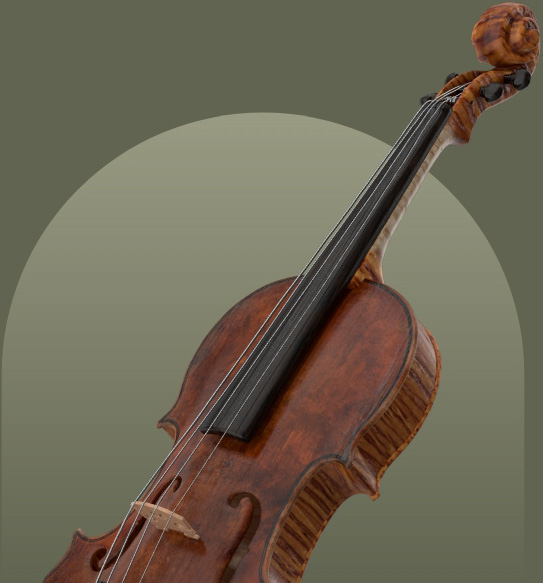
Italy School
Tomaso Eberle
Naples, Vils, b. 1727
Tomaso Eberle (1727-1792) was an Austrian-born luthier who worked in Naples, Italy, from approximately 1750 to 1792. He was the brother of Johann Anton Eberle (II) and became deeply influenced by the Gagliano school, working alongside prominent members of the family. His instruments are noted for their consistent and disciplined workmanship, distinctive scrolls, well-regulated archings, and upright soundholes. Eberle employed a golden-yellow Neapolitan varnish and often included a religious dedication on his internal labels. His violins are considered rare, partly due to their frequent misattribution to Nicolaus Gagliano.
Auction price history
Highest auction price
30 results
| Type | Details | Auction house | Sold | Price |
|---|---|---|---|---|
| Violin | Lot 235 | Bonhams | October 2014 | £37,500 |
| Violin | 35.4 cm Naples, 1771 | — | June 2011 | £29,758 |
| Violin | 35.3 cm 1780 c. (restorations) Attributed to | — | March 2011 | £28,800 |
| Violin | 35.4 cm Naples, 1776 | — | October 2010 | £63,840 |
| Violin | 35.9 cm Naples, 1770 c. | — | October 2010 | £43,250 |
| Violin | 35.4 cm Naples, 1770 c. | — | October 2009 | £30,000 |
| Violin | 35.4 cm Naples, 1777 | — | June 2008 | £8,892 |
| Violin | 35.5 cm Naples, 1770 c. | — | November 2006 | £34,800 |
| Violin | 35.4 cm Naples, 1775 c. (later top) | — | October 2006 | £5,175 |
| Violin | Naples, 1780 c. | — | May 2005 | £30,000 |
| Violin | Naples, 1770 c. | — | May 2005 | £14,400 |
| Violin | 1780 c. | — | October 2002 | £10,884 |
| Violin | 1780 | — | June 2002 | £15,375 |
| Violin | 1780 | — | November 2001 | £18,000 |
| Violin | 1770 | — | November 2001 | £11,500 |
| Violin | 1770 | — | June 2001 | £12,650 |
| Violin | 34.8 cm 1780 | — | November 1999 | £14,195 |
| Violin | 1780 | — | March 1999 | £18,975 |
| Violin | 1780 c. | — | November 1998 | £39,100 |
| Violin | 1770 c. | — | June 1998 | £36,800 |
| Violin | 1779 | — | June 1996 | £18,400 |
| Violin | 1786 | — | March 1995 | £31,050 |
| Violin | 1779 | — | November 1991 | £8,250 |
| Violin | 1784 | — | November 1990 | £17,600 |
| Violin | 1793 | — | November 1988 | £14,300 |
| Violin | 1783 c. | — | November 1985 | £11,000 |
| Violin | 1776 | — | November 1985 | £7,700 |
| Viola | 37.5 cm 17-- | — | November 1981 | £2,420 |
| Violin | 177- | — | May 1980 | £8,800 |
| Cello | 1762 | — | March 1980 | £18,368 |
No results match those filters.
Maker Overview
Life
Tomaso Eberle (1727-1792) was born in Vils, Austria, and worked circa 1750-1792 in Naples, Italy. He was the brother of Johann Anton Eberle (II). The exact circumstances of his transition from the Tyrol to Naples remain unknown. In Naples, he absorbed the methods, materials, and style of the Gagliano school, working contemporaneously with Nicolo, Gennaro, and Ferdinando Gagliano. in Die Geigen- und Lautenmacher vom Mittelalter bis zur Gegenwart, his name suggests German ancestry. Lütgendorff notes that the claim by Grillet that Eberle was a relative of Joh. Ur. Eberle is unproven, and Lütgendorff himself believes there might be a connection to Heinr. Ebert or Eberl in Venice.
Characteristics
- Workmanship
- His work is described by John Dilworth in The Brompton's Book of Violin & Bow Makers as more consistent and disciplined than that of the Gagliani themselves.
- Scrolls
- Most distinctive are his scrolls, which are well cut and finely finished but exhibit a slight squareness to the spiral, leaning back a little from the pegbox.
- Archings
- The arching is typically a little boxy but of medium height and very well regulated.
- Soundholes
- His soundholes are generally upright and narrow.
- Varnish
- He utilized a golden-yellow Neapolitan type of varnish, which lacks the greenish tone that sometimes undermines lesser Gagliano work but also lacks the red fire of the best examples. Willibald Leo Lütgendorff also notes his use of red-brown and brown-yellow varnish and very beautiful wood, with all parts executed very cleanly.
- Labels
- Like other Gagliano makers, he frequently inserted a religious dedication on a small label inside the upper rib, reading: "Gesù e Maria Tomaso Eberle fecit / Nap. 177.."
- Like other Gagliano makers frequently inserted a religious dedication on a small label inside the upper rib: Gesù e Maria Tomaso Eberle fecit
Nap. 177..John Dilworth
Influence and legacy
- School: Tomaso Eberle absorbed the methods, materials, and style of the Gagliano school in Naples.
- Mentorship: Willibald Leo Lütgendorff suggests that due to the strong similarity of his violins to those of the Gagliano family, he can reasonably be considered a pupil of the Gaglianos.
- Rarity: His violins are relatively rare, a fact attributed by Willibald Leo Lütgendorff to many of them being traded under the more recognized name of Nicolaus Gagliano.
Biographies
The overview above is drawn from the following published accounts. Read them in the original:
John Dilworth+
EBERLE, Tomaso Born 1727 Vils Austria, Worked circa. 1750-1792 Naples Italy. Brother of Johann Anton Eberle (II), above. How he made the transition from the Tyrol to Naples is not known. In Naples absorbed the methods, materials, and style of the Gagliano school. Contemporary with Nicolo, Gennaro, and Ferdinando Gagliano. Work more consistent and disciplined than that of the Gagliani themselves. Most distinctive are his scrolls; well cut and finely finished but with slight squareness to the spiral which leans back a little from the pegbox. Arching a little boxy but of medium height and very well regulated. Soundholes are generally upright and narrow. Varnish of the golden-yellow Neapolitan type, without the greenish tone which undermines some of the lesser Gagliano work but lacking the red fire of the best. Like other Gagliano makers frequently inserted a religious dedication on a small label inside the upper rib: Gesù e Maria Tomaso Eberle fecit / Nap. 177..
Willibald Leo Lütgendorff+
Der Name lässt auf deutsche Abstammung schliessen. Dass er aber »sans
doute« ein Verwandter Joh. Ur. Eberle’s gewesen sei, wie Grillet behauptet, ist
nicht zu erweisen. Eher glaube ich, dass er zu Heinr. Ebert oder Eberl in
Venedig in Beziehung steht. Seine Geigen sind denen der Gagliano so ähnlich,
dass man ihn wohl mit gutem Grund für einen Gaglianoschüler halten darf.
Er verarbeitete sehr schönes Holz, verwendete rothbraunen und braungelben
Lack und führte alle Theile sehr sauber durch. Seine Geigen kommen verhältnissmässig
selten vor, was darauf zurückzuführen ist, dass die meisten jetzt unter
dem gangbareren Namen des Nicolaus Gagliano in den Handel gekommen sind.
Sell your instrument with Amati
Get started by uploading photos of your instrument for our experts to review.
Sell your instrument with Amati
Get started by uploading photos of your instrument for our experts to review.