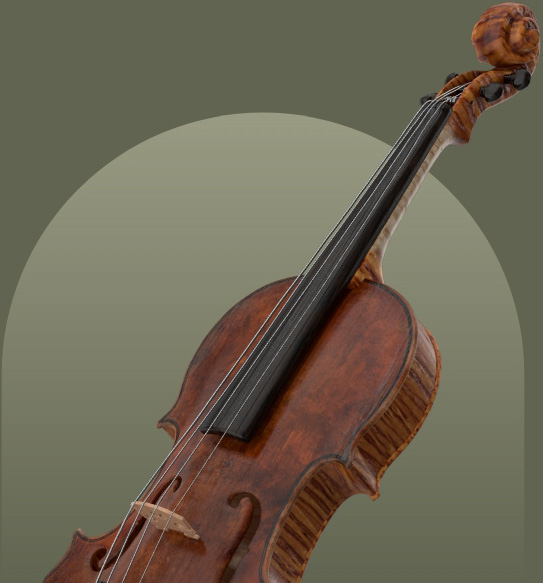
Carlo Antonio Galbusera
Milan, worked 1830–1836
Carlo Antonio Galbusera was an Italian instrument maker active in Milan circa 1830-1836, initially serving as an army officer. He gained recognition for his violins, which adopted principles from François Chanot, notably featuring a "violin-guitar" form without corners. He received a medal from the Milan Academy of Sciences in 1832 for one such instrument, though sources conflict on whether it was gold or silver. Despite early praise, his innovative designs did not achieve lasting influence, and his guitars are noted to have been better preserved than his violins.
Maker Overview
Life
Carlo Antonio Galbusera (worked circa 1830-1836) initially served as an officer in the Italian army before settling in Milan and commencing the construction of musical instruments. In 1832, he was awarded a medal by the Milan Academy of Sciences for a violin that was notably similar to the designs of François Chanot. This instrument, described as a "violin-guitar," garnered significant attention at the time, with the Leipzig paper, the Allgemeine Musikalische Zeitung, concluding a laudatory article on December 23, 1832, by stating, "It is indeed surprising that it should have taken centuries to give the violin this more simple form." George Hart, in 1847, noted Galbusera's recognition in Italy, mentioning him as a maker who rivaled Vuillaume, though Hart himself was not acquainted with his instruments.
Characteristics
- Construction Principles
- Carlo Antonio Galbusera constructed instruments based on the principles of François Chanot.
- Violin Design
- His violins, particularly the one awarded a medal in 1832, were described as a "violin-guitar" due to their lack of corners and a lessened curve in their outline, while retaining the stringing, sound-holes, scroll, and borders of an ordinary violin.
- Other Instruments
- He also produced guitars, which, have been preserved better than his violins.
- Material Treatment
- George Hart noted that Galbusera applied a preparation to the wood of his instruments for the purpose of extracting resinous particles, a method Hart believed made it unlikely his instruments would be "worthy of notice."
Influence and legacy
- Design Influence: Carlo Antonio Galbusera adopted and applied the instrument construction principles of François Chanot.
- Awards: Sources contain conflicting information regarding the color of the medal awarded to Carlo Antonio Galbusera by the Milan Academy of Sciences in 1832; John Dilworth states it was a gold medal, while Cecie Stainer and Willibald Leo Lütgendorff refer to it as a silver medal.
- Contemporary Reception: Despite the initial acclaim and prophecies from admirers, such as those in the Allgemeine Musikalische Zeitung, that he had given the violin a new form for the entire century, these predictions did not materialize.
- Later Assessment: Cecie Stainer observes that Carlo Antonio Galbusera is "completely ignored now."
Biographies
The overview above is drawn from the following published accounts. Read them in the original:
John Dilworth+
GALBUSERA, Carlo Antonio Worked circa. 1830-1836 Milan Italy. Officer in the Italian Army as well as violin maker. Violins in guitar form and guitars. Gold medal at Milan 1832.
George Hart+
Thismaker appears to have attracted attention in Italy. In a little volume entitled ” L’Italic economique,” 1847, he is mentioned as a maker who rivals Vuillaume. I am not acquainted with his instruments. Mention is made of his having made Violins without corners, and that he applied to the wood a preparation for the purpose of extracting the resinous particles from it. The adoption of such means of forcing on maturity makes it unlikely that he made instruments worthy of notice.
Cecie Stainer+
At first an officer in the Italian army, then settled in Milan, and began to construct instruments on the principles of François Chanot. In 1832 he was awarded a silver medal by the Milan Academy of Sciences for a violin very similar to that of Chanot; it was a sort of violin-guitar, with the stringing, sound-holes, scroll, and borders of an ordinary violin; but recalled a guitar in having no corners and in the lessened curve of its outline. Although completely ignored now, it was considered such a great success at the time that the Leipzig paper, the Allgemeine Musikalische Zeitung (Dec. 23, 1832), concluded a laudatory article by saying “It is indeed surprising that it should have taken centuries to give the violin this more simple form.”
Willibald Leo Lütgendorff+
Er war Kriegscommissar in Mailand und wollte die Form der Geige, ähnlich
wie Chanot, dadurch verbessern, dass er, was ältere Meister, z. B. Guarneri u. A.,
auch schon gethan, die Ecken wegliess und ihr eine der Guitarre sich nähernde
Form gab. Da seine Geigen trotzdem gut klangen, erhielt er von der Mailänder
Akademie der Wissenschaften 1832 sogar eine silberne Medaille. Die Prophezeiungen
seiner Verehrer (vgl. Allg. Musikzeitung, Leipzig, 23. Dec. 1832),
dass er der Geige für das ganze Jahrhundert eine neue Form gegeben haben
dürfte, haben sich nicht erfüllt. Besser haben sich seine Guitarren erhalten.
Sell your instrument with Amati
Get started by uploading photos of your instrument for our experts to review.
Sell your instrument with Amati
Get started by uploading photos of your instrument for our experts to review.