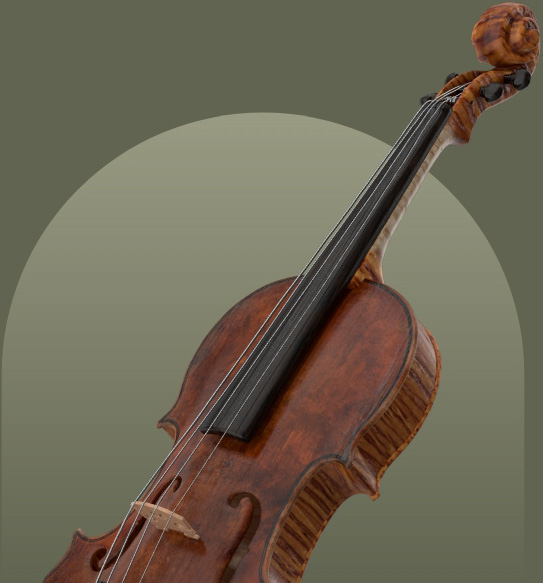
Charles Francois Gand
Marseille, Paris, Versailles, 1787–1845
Charles François Gand (1787-1845) was a highly esteemed French luthier, born in Versailles and active primarily in Paris. He apprenticed with Nicolas Lupot, whose adopted daughter he later married, eventually succeeding to Lupot's prominent business in 1824. Gand was known for his exceptional craftsmanship, producing instruments on Stradivari models with beautifully shaded, thick red-brown varnish and rather open soundholes. He was also renowned for his unparalleled skill in repairing antique instruments, demonstrating a deep understanding of Italian work. Appointed luthier to the Royal Court and the Paris Conservatoire, he made prize instruments for students and was considered a significant rival to his contemporaries, Lupot and Vuillaume. His legacy continued through his two sons, who also became makers.
Auction Price History
Highest auction price
19 results
| Type | Details | Auction house | Sold | Price |
|---|---|---|---|---|
| Violin | Labelled Gand, Luthier de la Musique du Roi et du Conservatoire de Musique, Rue Croix de Petits ... Lot 33 | Ingles & H. | October 2024 | £28,800est. £ 25,000-35,000 |
| Viola | Bearing the maker's label, fair condition Lot 61 | Laurent | June 2024 | £2,553est. € 2.000-3.000 |
| Viola | Lot 82 | Bonhams | March 2012 | £11,250 |
| Violin | 35.7 cm Paris, early 19th C. | — | November 2011 | £30,073 |
| Violin | 35.9 cm Paris, 1840 | — | June 2011 | £8,817 |
| Violin | 35.8 cm Paris, 1928 | — | March 2009 | £21,250 |
| Violin | 35.8 cm Paris, 1829 | — | March 2008 | £19,700 |
| Violin | 35.9 cm Paris, 1830 c. | — | May 2006 | £11,650 |
| Violin | Paris, 1844 #108 | — | November 2005 | £11,448 |
| Violin | 1843 | — | May 2005 | £2,963 |
| Violin | Paris, 1837 | — | November 2004 | £24,000 |
| Violin | 1843 | — | May 1999 | £14,071 |
| Violin | 1840 c. | — | November 1997 | £6,325 |
| Violin | 18-- | — | November 1994 | £4,025 |
| Cello | 1830 c. | — | November 1994 | £34,500 |
| Violin | 1843 | — | November 1994 | £13,800 |
| Violin | 1830 | — | March 1990 | £15,400 |
| Cello | 1839 | — | November 1989 | £27,500 |
| Violin | 18-- | — | March 1986 | £8,800 |
No results match those filters.
Maker Overview
Life
Charles François Gand (1787-1845) was born on August 5, 1787, in Versailles, France, and passed away on May 10, 1845, in Paris. Known as 'Gand père', he was the son of Charles Michel Gand. He began his training in 1802, apprenticing with Nicolas Lupot in Paris, where he remained for four years., he returned to his father's workshop in Versailles in 1810, while Cecie Stainer notes his return in July 1806. In 1810, he established his own business in Paris at 5, rue Croix-des-Petits-Champs. By 1820, he acquired the business of Koliker at No. 24 on the same street, where he continued his work until his death. He married Lupot's adopted daughter and, upon Lupot's death in 1824, succeeded to his esteemed business. Gand completed a set of instruments for the Royal Orchestra that Lupot had left unfinished, comprising six violins, three violas, five violoncellos, and four double-basses between 1824 and 1828. Sadly, these instruments were destroyed in a fire at the Tuileries in 1871. He was appointed luthier to the Royal Court and the Paris Conservatoire. Some sources, including John Dilworth, rank him as a serious rival to both Lupot and Vuillaume as a luthier. Charles François Gand had two sons, Charles Adolphe and Charles Nicolas Eugene, both of whom also became makers.
Characteristics
- Models
- Charles François Gand produced wonderful work on Stradivari models, and several Brescian copies are also extant.
- Construction
- On some instruments, the fronts were made of three pieces, with the middle section bent from flat stock. These are generally not considered as successful tonally and are less sought-after.
- Varnish
- His instruments featured beautifully shaded varnish as brilliant red-brown and rather thick in quality.
- Soundholes
- He was known for rather open soundholes.
- Workmanship
- He followed in Lupot's footsteps, making his instruments with the same care and ability, never letting an instrument leave his shop that was not entirely made by his own hands. George Hart describes his instruments as well-made, though heavy in appearance, and good serviceable instruments where the wood was not browned by baking or other injurious processes, allowing age to mellow them greatly. Willibald Leo Lütgendorff considered him unsurpassed in diligence and artistic execution.
- Repair Expertise
- Gand obtained a high reputation as a repairer of the works of great masters, perhaps restoring more valuable instruments than any other repairer of his time. He possessed great knowledge of Italian work, which made him especially skillful in repairing old instruments. Hart highlights his exceptional care and judgment in bringing together broken parts, closing splintered cracks, and deftly inserting pieces so that their presence was often undetectable.
- Gand, chez Lupot,
rue de Grammont, 1805John Dilworth - Ch. f. Gand fils
Luthier à Versailles, 1807John Dilworth - Gand, Luthier breveté
rue Croix-des-Petits-Champs 24
Paris. Ch. F. Gand, élève de Lupot
successeur du sieur Koliker
rue Croix-des-Petits-Champs 5
Paris 1810John Dilworth - Ch. f. Gand, Elève de N. Lupot
Luthier, rue Croix-des-Petits-Champs No. 12, à Paris
an 1812John Dilworth - Gand, Luthier, élève de Lupot
rue Croix-des-Petits-Champs No. 24
Paris 1820 à 1824John Dilworth - Gand, Luthier de la Musique
du Roi et de l’Ecole Royale
de Musique.
rue Croix-des-Petits-Champs
à Paris Gand, Luthier du Conservatoire de Musique
rue Croix-des-Petits-Champs. 1835John Dilworth - Gand, Luthier de la Musique du Roi
et du Conservatoire de Musique
Paris 18..John Dilworth
Influence and legacy
- Apprenticeship: Charles François Gand was apprenticed to Nicolas Lupot in 1802, remaining with him for four years. George Hart notes that he proved himself an excellent maker during this time and was much valued by his famous instructor.
- Family Workshop: He worked with his father, Charles Michel Gand, in Versailles, returning to his workshop around 1806 or 1810.
- Successor to Lupot: He married Lupot's adopted daughter and succeeded to Lupot's business in 1824, following his mentor's methods and standards of craftsmanship.
- Official Appointments: He was appointed luthier to the Royal Court and the Paris Conservatoire.
- Prize Instruments: As 'Luthier du Conservatoire', he made violins and violoncellos that were given as prizes to the pupils of the Paris Conservatoire.
- Family Continuity: His legacy was continued by his two sons, Charles Adolphe and Charles Nicolas Eugene, both of whom became violin makers.
Biographies
The overview above is drawn from the following published accounts. Read them in the original:
John Dilworth+
GAND, Charles François Born 1787 Versailles, died 1845 Paris France. Known as ‘Gand père’. Son of Charles Michel Gand, below. Apprenticed to Nicolas Lupot 1802, returning to his father’s Versailles workshop 1810. Established independently in Paris, acquiring the business of Koliker 1820. Married the adopted daughter of Lupot, and succeeded to his business 1824. He completed a set of instruments begun by Lupot for the Royal Orchestra, but this was destroyed in a fire at the Tuileries 1871. Appointed luthier to the Royal Court and Paris Conservatoire. Ranked by some as a serious rival to both Lupot and Vuillaume as a luthier. Wonderful work on Stradivari models; rather open soundholes and beautifully shaded varnish. Several Brescian copies also extant. On some instruments the fronts are made of three pieces, the middle section bent from flat stock. These are not considered so successful tonally and consequently are less sought-after. Gand, chez Lupot, / rue de Grammont, 1805 Ch. f. Gand fils / Luthier à Versailles, 1807 Gand, Luthier breveté / rue Croix-des-Petits-Champs 24 / Paris. Ch. F. Gand, élève de Lupot / successeur du sieur Koliker / rue Croix-des-Petits-Champs 5 / Paris 1810 Ch. f. Gand, Elève de N. Lupot / Luthier, rue Croix-des-Petits-Champs No. 12, à Paris / an 1812 Gand, Luthier, élève de Lupot / rue Croix-des-Petits-Champs No. 24 / Paris 1820 à 1824 Gand, Luthier de la Musique / du Roi et de l’Ecole Royale / de Musique. / rue Croix-des-Petits-Champs / à Paris Gand, Luthier du Conservatoire de Musique / rue Croix-des-Petits-Champs. 1835 Gand, Luthier de la Musique du Roi / et du Conservatoire de Musique / Paris 18..
George Hart+
He became the pupil of Nicolas Lupot in the year 1802. During his apprenticeship he proved himself an excellent maker, and was much valued by his famous instructor. He married the daughter of Lupot, and succeeded him in the Rue Croix des Petits Champs in the year 1824. The career of François Gand was one of much activity. As a repairer of the works of the great masters he early obtained a high reputation, and perhaps restored more valuable instruments than any repairer of his time. The care that he took and the judgment which he exercised in endeavouring to bring together the various broken parts of an imperfect instrument, that the original appearance might be maintained as closely as possible, cannot be too highly praised. He often accomplished seeming impossibilities. Splintered cracks were by his ingenuity closed as though no fibre had been severed, while at other times, pieces were inserted so deftly that the most experienced eyes might fail to detect their presence. It was with him a labour of love, and he did not scruple to spend days over work on which others would only spend hours. He made many Violins, several of which were given as prizes at the Paris Conservatoire. They are well-made instruments, though heavy in appearance. They are good serviceable instruments, and, the wood not having been browned by baking or other injurious process, age mellows them greatly. He died in the year 1845.
Cecie Stainer+
Eldest son of Charles Michel Gand, b. Aug. 5, 1787, Versailles; d. May 10, 1845, Paris. First worked at Versailles with his father; in 1802 was apprenticed to Nicolas Lupot, of Paris ; he remained for four years, returning to his father July 17, 1806. In 1810 he again went to Paris, and started his own business at 5, rue Croix-des-petits-Champs ; in 1820 he bought Koliker’s property at No. 24, in the same street, where he remained till his death.
In 1824 he succeeded Lupot, whose daughter he had married. He followed in Lupot’s footsteps, making his instruments with the same care and ability, never letting an instrument leave his shop which was not entirely made by his own hands; he used brilliant red-brown varnish, rather thick in quality. Lupot left unfinished an order for the Royal Orchestra ; Gand completed it, making 6 violins, 3 violas, 5 violoncellos, and 4 double-basses between 1824 and 1828. These beautiful specimens of his work were unfortunately destroyed when the Tuileries was burnt down in 1871.
He was especially skilful in repairing old instruments, owing to his great knowledge of Italian work. Appointed” Luthier du Conservatoire,” he for some time made the violins and violoncellos given as prizes to the pupils.
Labels : ” Gand chez Lupot, rue de Grammont, 1805,” used when in Lupot’s workshop;
” Ch, F. Gand fils, luthier Versailles, 1807,” used when working with his father;
He had two sons, both makers, Charles Adolphe and Charles Nicolas Eugene.
Willibald Leo Lütgendorff+
Sohn von Michel G. Würdiger Schüler, Schwiegersohn und seit 1824 auch
Nachfolger Nic. Lupot’s. Von 1807 bis 1810 war er in Versailles ansässig und
ging dann nach Paris, wo er zunächst in der Rue des Petits-Champs No. 5 und
seit 1820 in derselben Strasse No. 24 seine Werkstatt aufschlug. 1820 kaufte
er das Geschäft und den Nachlass Koliker’s und übernahm nach Lupot’s Tode
1824 auch dessen Werkstatt. Er war unstreitig der bedeutendste französische
Geigenmacher seiner Zeit, unübertroffen in der Sorgfalt und künstlerischen Durchführung
Sell your instrument with Amati
Get started by uploading photos of your instrument for our experts to review.
Sell your instrument with Amati
Get started by uploading photos of your instrument for our experts to review.