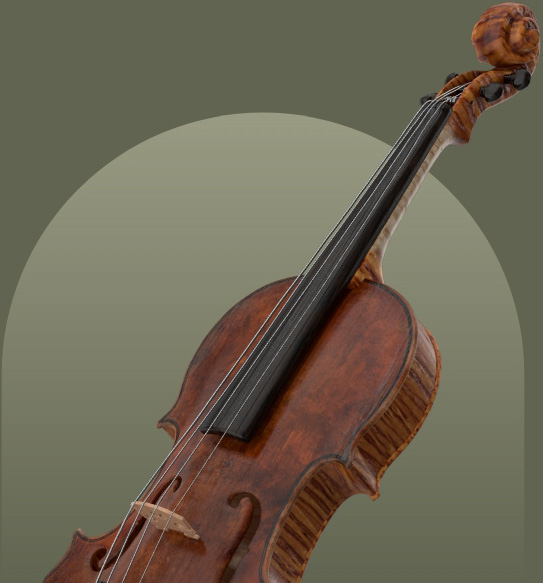
Francois Gavinies
Bordeaux, Paris, 1683–1772
Francois Gavinies (1683-1772) was an influential French luthier who began his career in Bordeaux before moving to Paris around 1730-1741, where he became a prominent figure in the pre-revolutionary 'vieux Paris' school.
Auction Price History
Highest auction price
9 results
| Type | Details | Auction house | Sold | Price |
|---|---|---|---|---|
| Cello | Lot 152 | Bonhams | May 2015 | £12 |
| Violin | 35.6 cm Paris, 1770 | — | September 2011 | £2,400 |
| Violin | 35.7 cm Paris, 1760 c. (soundpost crack) | — | June 2010 | £4,971 |
| Violin | 35.5 cm Paris, 1760 c. | — | June 2010 | £3,935 |
| Violin | 35.5 cm Paris, 1769 | — | April 2010 | £1,381 |
| Violin | 36.1 cm Paris, 1747 | — | December 2007 | £1,361 |
| Viola | 40.6 cm 1755 | — | March 1996 | £8,970 |
| Violin | 1750 | — | March 1990 | £3,080 |
| Violin | 177- | — | September 1983 | £715 |
No results match those filters.
Maker Overview
Life
Francois Gavinies (1683-1772) was born in Bordeaux in 1683 and established his workshop in the rue des Minimes in Bordeaux, working there from 1723 to 1734.
Characteristics
- Workmanship
- He was known for good, precise work, sometimes with extra elaboration, and integrated many Cremonese ideas into his craft.
- Materials
- His good violins were constructed from beautiful wood, exhibiting good form and varnish. However, his varnish was generally described as dull and chippy, typically of a yellow or red-brown tint.
- Distinctive Features
- Instead of a traditional scroll, he occasionally incorporated carved heads, such as a King David on a double bass from 1757, which is now part of the Paris Conservatoire's collection.
- Models
- He frequently imitated the large Stradivari model.
- Branding
- He generally branded his instruments with his name and also utilized a brand mark.
- Notable Instruments
- His cellos were highly sought-after. Known instruments include a six-string viol dated 1744 in the Paris Conservatoire Collection, a quinton from 1749 mentioned in Bruni-Gallay's Inventaire (from the collection of Count Puységur), and several violins and double basses housed in the Musée de la Musique at the Paris Conservatoire.
- Six-string viol in Musée de la Musique, Paris. Gaviniès, rue
S. Thomas du Lou
vre, à Paris, 17..John Dilworth
Influence and legacy
- School: Francois Gavinies was a significant maker associated with the pre-revolutionary 'vieux Paris' school.
- Technique: He notably integrated many Cremonese ideas into his instrument making.
- Family: His son, Pierre Gaviniés, became a celebrated violinist.
- Collections: Several of his instruments, including a six-string viol and a double bass with a carved King David head, are preserved in the Paris Conservatoire Collection and the Musée de la Musique in Paris.
Biographies
The overview above is drawn from the following published accounts. Read them in the original:
John Dilworth+
GAVINIÈS, François Born 1683, Bordeaux, Worked 1723-1734 Bordeaux, died 1772 Paris France. Bordeaux workshop in the rue des Minimes. Established in Paris in rue St-Thomas-du-Louvre. Appointed head of the Corporation of Luthiers 1762. Significant maker of the pre-revolutionary ‘vieux Paris’ school. Integrated many Cremonese ideas into his work. Good, precise work, sometimes with extra elaboration, but varnish generally dull and chippy, of yellow or red-brown tint. Cellos sought-after; at least one double bass with carved head recorded. Six-string viol in Musée de la Musique, Paris. Gaviniès, rue / S. Thomas du Lou / vre, à Paris, 17..
Cecie Stainer+
b. about 1700. Lived first at Bordeaux, but about 1730 moved to Paris with his son, and was living in rue St.-Thomas-du-Louvre, 1734-63. He made two very different kinds of instruments; the one inferior, the other, for which he used varnish and wood of good quality, was much liked. He generally branded them with his name.
Instruments dated 1734, 1735, and 1751; also a six-stringed viol dated 1744 in the Paris Conservatoire Collection, are known. The Conservatoire also has, for the use of its pupils, one of his double-basses with the head sculptured to represent King David ; its tone is excellent, it was made in 1757.
He had a son, Pierre, the celebrated violinist.
Willibald Leo Lütgendorff+
Ein geschickter Meister, der, wenn er wollte, sehr gute Geigen machen
konnte, häufig aber so minderwerthige Waare herstellte, dass böse Zungen von
ihm behaupteten, er habe nur ein gutes Werk zu Stande gebracht und das sei
sein Sohn — der treffliche Geiger Pierre Gaviniés — gewesen. Er folgte seinem
Sohne 1741 nach Paris und liess sich in der Rue St. Thomas du Louvre nieder,
wo er von der Lautenmacherzunft zum geschworenen Meister für 1762 erwählt
wurde. Seine guten Geigen sind aus schönem Holz gebaut, gut in der Form
und im Lack. Statt der Schnecke verwendete er auch geschnitzte Köpfe, z. B.
einen König David an einem Contrabass, den die Schule des Pariser Conservatoriums
besitzt. Dieser Bass hat einen trefflichen Ton und stammt aus dem Jahre
1757. Im Museum desselben Conservatoriums befinden sich noch mehrere Geigen
und Violinen von ihm. Ein Quinton von 1749 wird in Bruni-Gallay’s Inventaire
(aus dem Besitz des Grafen Puységur) erwähnt (S. 121). — Er ahmte gerne das
grosse Stradivari-Modell nach und versah seine Arbeiten auch mit einer Brandmarke.
Sell your instrument with Amati
Get started by uploading photos of your instrument for our experts to review.
Sell your instrument with Amati
Get started by uploading photos of your instrument for our experts to review.