
England School
William Glenister
Buckinghamshire, London, b. 1850
William Glenister (1850-1936) was a self-taught English amateur violin maker who transitioned from a career in gardening and the corn trade. Working from his workshop at 23 Beak Street, London, from approximately 1888 to 1936, he specialized in classical models, particularly favoring the 1690 Stradivari 'Tuscan' violin. He was known for his good workmanship, utilizing old pine and commercial varnishes from suppliers like Whitelaw, Caffyn, and later Urquhart. His instruments, numbering around 70, were noted for their delicate, sensitive, and sweet tone.
Auction price history
Highest auction price
| Type | Details | Sold | Price |
|---|---|---|---|
| Violin | October 2014 | £2,250 | |
| Violin | 35.7 cm London, 1910 c. | September 2010 | £600 |
| Viola | 41.5 cm London, 1908 | March 2008 | £4,375 |
| Violin | 35.6 cm London, 1922 | July 2006 | £840 |
| Violin | 35.7 cm London, 1922 | July 2006 | £840 |
| Viola | 41.5 cm London, 1914 | November 2004 | £2,629 |
| Violin | 1895 | May 2001 | £1,400 |
| Violin | 1912 | November 2000 | £1,093 |
| Cello | 1924 | November 1999 | £2,300 |
| Violin | 1906 | June 1998 | £1,035 |
| Violin | 1924 | June 1998 | £1,380 |
| Violin | 1917 | February 1998 | £920 |
| Violin | 1918 | October 1997 | £550 |
| Violin | 1924 | July 1997 | £345 |
| Violin | 1911 | May 1997 | £680 |
| Violin | 1915 | August 1996 | £1,955 |
| Violin | 1901 | March 1995 | £1,610 |
| Violin | 1912 | February 1994 | £1,955 |
| Cello | 1890 | October 1990 | £1,430 |
| Cello | 1928 | April 1988 | £1,500 |
| Viola | 41.6 cm 1917 | August 1984 | £1,078 |
| Viola | 41.6 cm 1900 c. | November 1982 | £972 |
Maker Overview
Life
William Glenister (1850-1936) was born on May 16, 1850, at Chenies, Buckinghamshire, and later resided at 23 Beak Street, Regent Street, W. His family moved to Watford, Hertfordshire, when he was three years of age. He began his career as a gardener, remaining in that profession until he was twenty-two. Subsequently, he entered the corn trade, where he became manager of the firm he joined twenty-seven years prior as an apprentice. On July 3, 1875, Mr. Glenister married Jane, daughter of Mr. J. E. Chambers, at Willesden Parish Church, Middlesex. He worked in London, UK, from approximately 1888 to 1936. His biography was published by William Meredith Morris in The Strad. No. 124 (1899), and he is also noted in Willibald Leo Lütgendorff's Die Geigen- und Lautenmacher vom Mittelalter bis zur Gegenwart and John Dilworth's The Brompton's Book of Violin & Bow Makers.
Characteristics
- Models
- He worked on the lines of Stradivari, Guarnerius, and Nicolo Amati, with a particular preference for the 1690 Stradivari 'Tuscan' violin.
- Design Characteristics
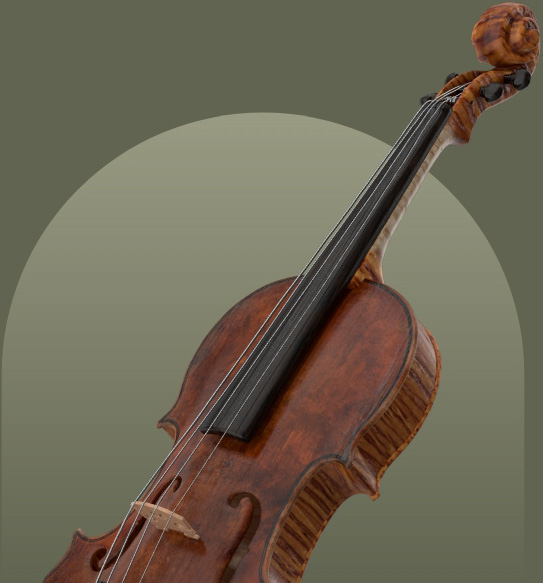
- His Stradivari copies precisely followed the 'Tuscan' outline and measurements. The model was slightly flatter and more extended towards the margins, in the style of Maggini. He incorporated a bold and masculine scroll, a rounded and graceful button, and sound-holes that were a slight modification of Stradivari's, placed a shade nearer the edge. The purfling was inlaid perfectly.
- Materials
- He utilized old pine retrieved from dilapidated buildings, with some of his best pine sourced from an old house in Beak Street. The pine was described as having a close, even grain and excellent tonal qualities. He left his plates thick and solid.
- Varnish
- Initially, he used Whitelaw's and Caffyn's varnishes. Later, he transitioned to a varnish made by Mr. Urquhart of Derby Street, Mayfair, which was described as brilliant, transparent, lasting, non-chipping, tough, and elastic. It was an oil amber varnish, typically used in golden brown and golden red hues.
- Workmanship
- Described as having good workmanship, he produced his first violin in 1888. Sources contain conflicting information about the total number of instruments; John Dilworth records about 70 instruments, while William Meredith Morris states he produced sixty violins and one 'cello. The mechanical part of the work presented little trouble due to his aptitude for making small wooden articles.
- Tone
- The tone of his instruments was not large but possessed splendid qualities, described as delicate, sensitive, and sweet.
- Wm. Glenister
23 Beak Street
London.
1899.John Dilworth
Influence and legacy
- Self-Taught: William Glenister was a self-taught amateur maker.
- Mentorship/Study: His first violin, made in 1888, was the result of a careful study of the masterly work of Mr. Ed. Heron-Allen.
Biographies
The overview above is drawn from the following published accounts. Read them in the original:
John Dilworth+
GLENISTER, William Born 1850 Chenies, Buckinghamshire, Worked circa. 1888-1936 London UK. Businessman and self-taught amateur maker. Established at Beak Street. Classical models, but preference given to the 1690 Stradivari ‘Tuscan’ violin. Flat arch and soundholes rather close to the edge. Old pine retrieved from dilapidated buildings with commercial varnish supplied by Whitelaw, Caffyn, or Urquhart. Good workmanship; about 70 instruments recorded. Manuscript label: Wm. Glenister / 23 Beak Street / London. / 1899.
William Meredith Morris+
He was born on May 16, 1850, at Chenies, Bucks, and resides now at 23 Beak Street, Regent Street, W. The early years of his life were spent at Watford, Herts, the family having removed there when he was three years of age. His father was a gardener by occupation, and young Glenister also became a gardener on his leaving school, which was at a very early age. He remained among the ” flowers, fruits, and trees ” till he was twenty-two, when an opening occurred and was offered him in the corn trade. He availed himself of the opportunity, and he has followed that trade ever since, he being now manager of the firm into which he came twenty-seven years ago as apprentice.
Not very long after he entered the corn trade, i.e. on July 3, 1875, Mr. Glenister was married to Jane, daughter of Mr. J. E. Chambers, of Stanstead, Kent, at Willesden Parish Church, Middlesex. In business, he is described as a gentleman actuated by the highest principles ; and in the home, as the embodiment of amiability and gentleness.
Mr. Glenister works on the lines of Strad, Guarnerius, and N. Amati, but his “divinity” is the greatest of these three, and his prototype the great “Tuscan.” His first fiddle was made in 1888, and was the result of a careful study of the masterly work of Mr. Ed. Heron-Allen. Since that date he has produced sixty violins and one ‘cello. All these, with the exception of the first three or four, are fine instruments. The mere mechanical part of the work never offered much trouble to Mr. Glenister, for he ever had an aptitude for making little articles in wood.
The outline of the Strad copies is exactly that of the “Tuscan,” and the measurements are the maestro’s to the nth. The model is a trifle flatter and more extended towards the margins, after the style of Maggini. The scroll is bold and masculine. The button is rounded, graceful, and lies evenly with the plane of the instrument. The sound-holes are a slight modification of those of Strad, and placed a shade nearer the edge. They are in perfect keeping, however, with the outline, and the effect, arising from their position and inclination in the subdued arching, is highly artistic. The purfling is inlaid perfectly and without a tremor. The back of one specimen examined by me was whole, the curl running at an angle of thirty degrees to the long axis, i.e. in the lower alternate angle of the left side. The ” flame ” was vivid and fairly broad. In another it was cut sur maille with the curl running ” buttonwise.” The pine was of close, even grain, and of excellent tonal qualities. Some of Mr. Glenister’s best pine has been obtained from an old house in Beak Street, and although it is old and well past the age at which shrinking may be supposed to cease, still he leaves his plates thick and solid.
Mr. Glenister used Whitelaw’s varnish on his first efforts, and also Caffyn’s ; but now he uses a varnish made by Mr. Urquhart, of Derby Street, Mayfair. This varnish gives highly satisfactory results. It is brilliant, transparent, and lasting. It does not chip, and it is tough and elastic. It has that undefinable, unctuous something about it, which is not seen every day in varnish except when you are in the goodly fellowship of the holy Cremonese. It is an oil amber one, and made in all the usual colours. Mr. Glenister uses, almost without exception, the golden brown, and the golden red.
The tone is not a large one, but it has splendid qualities ; it is delicate, sensitive, and sweet.
Willibald Leo Lütgendorff+
Englischer Geigenmacher der Gegenwart, dessen Biographie Meredith-
Morris in der Zeitschrift »The Strad.« No. 124 (1899) veröffentlichte.
Sell your instrument with Amati
Get started by uploading photos of your instrument for our experts to review.
Sell your instrument with Amati
Get started by uploading photos of your instrument for our experts to review.
Pupils
Working in Buckinghamshire at the same time
A. R. Meynell worked 1914
Albert E. Warrick worked 1889–1915
Albert Edgar Phillips Hill (Phillips) 1883–1981
Albert Henry Price worked 1850–1890
Alexadner Kennedy worked 1910–1924
Alexander Ritchie b. 1888
Alfred Ernest Chanot b. 1890
Alfred James Burling worked 1891–1924