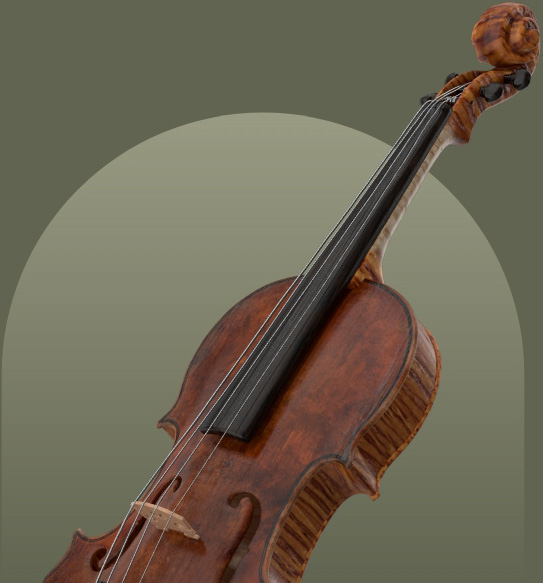
Bartolomeo Giuseppe Guarneri
Cremona, 1698–1744
Bartolomeo Giuseppe Guarneri (1698-1744), known as 'del Gesù' due to the 'I.H.S.' monogram on his labels, was a preeminent Cremonese violin maker whose radical approach to the craft profoundly influenced violin making. Despite conflicting historical accounts regarding his birth (1698, 1683, or 1686) and death (1744 or 1745), his artistic genius is undisputed. He apprenticed with his father but later sought independence, eventually returning to full-time making after his father's illness. His work is typically divided into three periods, showcasing a progression from traditional forms to highly experimental designs, characterized by varied archings, distinctive sound-holes, and a focus on powerful tone over meticulous finish. While initially unappreciated, his reputation soared after Niccolò Paganini adopted his 'Cannone' violin, leading to widespread imitation and establishing Guarneri's models as one of the two primary alternatives for luthiers alongside Stradivari's.
Auction Price History
Highest auction price
7 results
| Type | Details | Auction house | Sold | Price |
|---|---|---|---|---|
| Violin | 35.5 cm Cremona, 1720 c. With provenance | — | October 2007 | £460,669 |
| Violin | 1735 (composite) | — | November 2000 | £311,500 |
| Violin | 1736 | — | November 1997 | £551,500 |
| Violin | 1738 | — | June 1989 | £253,000 |
| Violin | 1743 | — | November 1988 | £572,000 |
| Violin | 1720 c. | — | November 1988 | £242,000 |
| Violin | 1741 c. | — | March 1986 | £214,500 |
No results match those filters.
Maker Overview
Life
Bartolomeo Giuseppe Guarneri (1698-1744) was a pivotal Cremonese violin maker, often referred to as 'del Gesù'. Sources contain conflicting information regarding his birth and death dates; John Dilworth states he was born in 1698 and died in 1744, while George Hart identifies his birth as June 8, 1683, and Cecie Stainer as October 17, 1686, both citing his death in 1745. Similarly, his parentage is described differently: Dilworth refers to him as the younger son of Giuseppe, while Hart and Stainer name his father as Giovanni Battista Guarneri (or Gian Battista) and his mother as Angela Maria Locatelli (or Locadella).
His apprenticeship was traditional, working with his father, and his hand is detectable in his father's work after 1720. However, trade in Cremonese workshops was in decline, or at least dominated by Antonio Stradivari, during this period. His elder brother, Pietro, left for Venice around 1717, and Giuseppe himself left the family home in 1722. His whereabouts for the next few years are unclear, but a rare label from this time, where he describes himself as 'Andreae Nepos' ('grandson of Andrea') without reference to his father or the sign of St. Theresa, suggests an attempt to establish himself independently in Cremona. In 1728, he became involved in renovating an inn, the 'Osteria dei Mori', selling the lease the following year.
In 1730, his father fell ill, prompting Giuseppe's gradual return to full-time violin making. The following year, he completed a cello that was labeled by his senior father, marking the last instrument to bear the St. Theresa identification. Also in 1731, Giuseppe moved to a new home in San Prospero, and from this point, his work featured the symbol 'I.H.S.' (sacred monogram: 'Jesus Christ' or 'Iesus Hominum Salvator'), a popular dedication that earned him his familiar title 'del Gesù'. This symbol was likely posted above his workshop, similar to his father's St. Theresa sign, further distinguishing the younger Giuseppe from his father, who lived for another nine years. Del Gesù was unique in his family, apart from Andrea himself, in not acknowledging his father on his labels.
For some time, del Gesù's work was not widely appreciated; Cozio disparagingly wrote of his poor imitations of Stradivari, and there was no evidence of other makers being influenced by his ideas. However, his reputation dramatically changed when Niccolò Paganini discovered a pristine example in 1802. Paganini immediately recognized its qualities, naming it his 'Cannone', and it remained his primary concert instrument throughout his performing life, now preserved in the Genoa Civic Museum. This event transformed perceptions of del Gesù across Europe, leading to a rapid increase in the popularity and price of his work. By the mid-19th century, makers throughout Europe were producing imitations and incorporating many of the innovations Guarneri introduced to the Stradivari model. For the entire 20th century, the models of Guarneri and Stradivari effectively represented the only two alternatives for luthiers to follow.
A persistent tradition, particularly in Italy, suggested that Guarneri made some violins while imprisoned, with materials supplied by a gaoler's daughter. This story, and alluded to by Vincenzo Lancetti, likely arose to explain the existence of numerous inferior violins bearing his labels, many of which are spurious. While the tradition may have some factual basis regarding an unfortunate incident, possibly an encounter where an antagonist lost his life, the claims of his death in prison and his reported love of wine and idleness are likely embellishments added by successive narrators.
Characteristics
- Innovation
- Bartolomeo Giuseppe Guarneri's radical reimagining of the craft is considered by John Dilworth as perhaps the final artistic contribution to the development of the violin. He went his own way, independent of his predecessors, and is regarded as a brilliant artist whose works are equal to, and sometimes preferred over, those of Stradivari.
- Models (1731-1735)
- During this period, Guarneri worked on a fine model, utilizing the ancient 'Grand Amati' outline as a foundation, combined with well-worked, low Stradivarian arching. These instruments were compact in size, thickly wooded, and well-made in the Guarneri tradition, possessing strong character despite lacking the polished finesse of Stradivari or Amati.
- Scrolls (1731-1735)
- Del Gesù made few scrolls himself during this time; those he did make were surprisingly delicate with a fine chamfer, unlike other Guarneri family work. Most instruments from this period bear scrolls that are evidently the work of the elder Giuseppe, possibly his only contribution to the business due to his frail health.
- Transformation (1735-1739)
- Guarneri underwent an astonishing transformation, becoming less concerned with formal balance and precision. He experimented widely with different archings and, most notably, with various soundhole forms. These soundholes, resembling the extended 'f's of earlier Brescian work, became a hallmark of his mature period.
- Late Period (1740-1744)
- In a concentrated burst of activity during the last four years of his life, del Gesù produced his most inventive and challenging work. During this time, almost every aspect of the violin maker's aesthetic and technique was stretched to its limit.
- Work Periods
- M. Fétis, guided by M. Vuillaume, divided Guarneri's career into three periods, an arrangement widely adopted by historians like George Hart and Cecie Stainer.
- First Period Characteristics
- Instruments from this period show varied patterns and changeable sound-holes, sometimes displaying a mixture of grace and boldness, or appearing singularly deformed with roughly executed purfling, as if hastily finished (Hart). Cecie Stainer notes a lack of originality, with imitations of Nicola Amati or G. P. Maggini, reviving the latter's pattern with arched purfling, semicircular middle bouts, pointed sound-holes, and short corners, producing a good tone.
- Second Period Characteristics
- This period yielded some of the finest specimens of violin making, characterized by exquisite finish, an artistic and original form, and handsome materials. The lustre of the wood, particularly on backs, with its deep amber varnish, is highly praised (Hart). Cecie Stainer describes a small pattern, slightly arched with a gradual rise from the purfling, varying thicknesses (increasing at the center, which could hinder free vibration), accurate proportions, well-cut (often sharply pointed) sound-holes, brilliant tone, and a rich golden or brownish-red elastic and transparent varnish comparable to Stradivari's. The workmanship was most carefully finished.
- Third Period Characteristics (from ~1735/1740)
- Violins from this era, including Paganini's and Alard's, are of a bolder conception, massively constructed, and possess materials with the finest acoustic properties. The sound-hole loses its pointed form, the purfling is embedded, edges are heavy, corners are somewhat grotesque, and the scroll exhibits a mixture of vigor, comicality, and majesty (Hart). Cecie Stainer adds that they are made on a large pattern with excellent wood, accurate proportions and thicknesses, and beautiful elastic varnish (rich amber or rose-red, slightly darker and thicker than Stradivari's). The quaint, characteristic head is entirely different from Stradivari's, and the tone is powerful, mellow, and rich.
- Wood Selection
- When he could exercise his own judgment, his wood selection was exemplary, particularly the choice pine used for bellies. He seems to have obtained a large piece of pine with extraordinary acoustic properties, from which he made nearly all his bellies. These bellies often exhibit a singular, unmistakable stain running parallel to the fingerboard on either side. The sycamore used for backs varied in appearance and quality, often displaying a broad grain, with whole-backs impressively marked like a tiger's skin. In some jointed-backs, the wood markings run upwards.
- Graduation
- Guarneri varied the quantity of wood left in his instruments, but always followed a guiding principle based on the wood's quality, treating harder material as needing less solidity than softer wood.
- Workmanship
- While his workmanship in numerous instances is undoubtedly careless, even in instruments where negligence is most apparent, there is an appearance that excites admiration and forces acknowledgment of a style defying imitation. His quaint head carvings, achieved with a mere turn of the chisel, possess a singular character that is difficult to replicate without appearing ludicrous.
- Sound-hole and Button
- The sound-hole consistently preserves its distinctive character and a grotesque humor, though it varies considerably across his three periods. The button, the portion of the back against which the neck rests, shows a remarkably pronounced development in his violins, contributing vitality to the overall work.
- Experimental Nature
- His variety of work—different sized patterns, sometimes arched, sometimes flat; sound-holes that were long, perpendicular, or short and slanting—represented a continuous effort to enhance the tone of his instruments. He ultimately succeeded in achieving a notably pure and powerful volume of tone.
- Instrument Output
- He made more violins than violas. Approximately fifty genuine violins and ten violas are known, but no violoncello is known to exist.
- Joseph Guarnerius, Andreae Nepos
fecit Cremonae Anno 17..John Dilworth - Joseph Guarnerius
fecit Cremone anno 1741John Dilworth
Influence and legacy
- Apprenticeship: Bartolomeo Giuseppe Guarneri's apprenticeship was traditional, working with his father, and his hand can be detected in his father's work after 1720.
- Independence: A very rare label from his early independent period, in which he describes himself as 'Andreae Nepos' ('grandson of Andrea'), without reference to his father, indicates his attempt to establish himself independently in Cremona.
- Stradivari as Teacher (Debunked): The assertion that he was a pupil of Antonio Stradivari has been widely made but lacks proof. Willibald Leo Lütgendorff states it is 'unwahrscheinlich' (unlikely), and George Hart finds 'not a shadow of proof', noting nothing in common between the two makers except perhaps varnish and high finish in Guarneri's second epoch. Cecie Stainer also states that the character of his work 'does not authorise such a statement'.
- Alternative Instructor (Proposed): George Hart suggests that analogy points to Giuseppe Guarneri, son of Andrea (his cousin), as a more likely instructor, given the strong similarity in their work and style. This cousin was many years his senior, making his workshop a more reasonable place for del Gesù's initial instruction.
- Artistic Independence: Lütgendorff emphasizes that Guarneri 'ging seinen eigenen Weg und ist vollkommen unabhängig von seinen Vorgängern' (went his own way and is completely independent of his predecessors).
- Model Inspiration: In forming his model, Guarneri seems to have followed the lead of Gasparo da Salò, retaining the pointed form of the sound-hole and showing much affinity in the outline of the body, particularly the middle bouts. He appears to have aimed to continue and complete the plan left unfinished by the great Brescian maker.
- Paganini's 'Cannone': In 1802, Niccolò Paganini discovered a very pure example of del Gesù's work, which he immediately recognized for its qualities. This violin, which he named his 'Cannone', remained his concert instrument throughout his performing life and is now preserved in the Genoa Civic Museum (Palazzo Municipale).
- Increased Popularity and Price: Paganini's endorsement dramatically changed perceptions of del Gesù throughout Europe, leading to a rapid growth in the popularity and price of his work.
- Influence on Later Makers: By the mid-19th century, makers across Europe were producing imitations of his instruments and absorbing many of the changes Guarneri made to the Stradivari model. For the entire 20th century, the models of Guarneri and Stradivari have effectively been the only two alternatives for luthiers to follow.
- Notable Instruments: Besides Paganini's 'Cannone' (dated 1743), other famous instruments include one dated 1714 that belonged to Ole Bull, another magnificent one from 1734 nicknamed 'Le violon du diable', and a beautiful violin from 1742 that belonged to the violinist Alard. A violin dated 1741, formerly owned by Vieuxtemps, is noted for its pristine condition and splendid brownish-red varnish. The 'King Joseph' violin was a large-pattern instrument made of splendid wood with amber-colored varnish.
- Value Appreciation: His instruments have steadily increased in price, partly due to the strong wood he used, which, though initially depreciating the tone, allows it to vibrate more freely and develop a stronger, more refined quality over time. A violin was sold for 600 guineas in 1876, and another recently for £500.
- Imitators: His imitators far exceeded in number all other violin makers from Cremona. These imitators are categorized into bona fide copyists (e.g., Lupot, Gand, Vuillaume), subtle copyists who exploit his varied styles and misfortunes, and wholesale copyists who mass-produce instruments in factories, artificially aging them.
Further Information
- Labels: His labels include 'Joseph Guarnerius, Andreae Nepos / fecit Cremonae Anno 17..' and 'Joseph Guarnerius / fecit Cremone anno 1741 IHS'.
- I.H.S. Symbol: The 'I.H.S.' symbol, a sacred monogram meaning 'Jesus Christ' or 'Iesus Hominum Salvator', was adopted on his labels from 1731 onwards and gave him his familiar title 'del Gesù'. It was likely posted above his workshop as an identifying sign.
- Workshop Location: His home was located at No. 5, Piazza S. Domenico, now known as Piazza Roma.
- Birth Registration: His birth was registered in the parish of San Donato, at the Chapel of Ease of the Cathedral in Cremona.
- Geographic Focus: The phrase 'fecit Cremonae' on all his labels confirms that all his work was done in Cremona.
Biographies
The overview above is drawn from the following published accounts. Read them in the original:
John Dilworth+
GUARNERI, Bartolomeo Giuseppe Born 1698, died 1744 Cremona Italy. Younger son of Giuseppe, below. Known as ‘del Gesù’. The last truly great maker in the astonishing list of Cremonese masters that ranges from Andrea Amati to Antonio Stradivari. His radical reimagining of the craft was perhaps the final artistic contribution to the development of the violin. His apprenticeship was a traditional one with his father and his hand can be detected in the father’s work after 1720. But trade in the several Cremonese workshops in this period seems to have been in decline, or at least dominated by Antonio Stradivari. Giuseppe’s elder brother Pietro left for Venice c.1717 and Giuseppe himself quit the family home in 1722. It is not clear where he was working for the next few years, but a very rare label from this period in which he describes himself as ‘Andreae Nepos’ (‘grandson of Andrea’) without reference to the sign of St Theresa or his own father is seen to indicate that he was attempting to establish himself independently in Cremona. In 1728 he became involved in the renovation of an inn, the ‘Osteria dei Mori’, selling the lease in the following year. In 1730 his father fell ill and Giuseppe returned gradually to full-time violin making. The following year he completed a cello which was labelled by Giuseppe senior, the last instrument to bear the label with the St Theresa identification. Also in that year the young Giuseppe moved into a new home in San Prospero, and from this time onwards his work bears a label with the symbol ‘I.H.S.’ (sacred monogram: ‘Jesus Christ’ or, sometimes, ‘Iesus Hominum Salvator’), a popular dedication which gave Guarneri his familiar title ‘del Gesù’. The I.H.S. symbol was in all probability posted above his workshop as an identifying sign, just as his father had worked under the sign of St Theresa. This was a further step in distinguishing the young Giuseppe from the elder who lived on for a further nine years. Del Gesù was the only one of the family not to acknowledge his father on his label, Andrea himself excepted. From 1731 until about 1735 Guarneri worked on a fine model, using the ancient ‘Grand Amati’ outline as a basis, with well-worked low Stradivarian arching. Very compact in size and thickly wooded, they are well-made in the Guarneri tradition, lacking the final polished finesse of Stradivari or Amati, but with strong character. Del Gesù made few scrolls in this period. They are surprisingly delicate, with a fine chamfer unlike any other Guarneri family work. Most of the instruments bear scrolls which are obviously the work of the elder Giuseppe, perhaps the only contribution to the business that the frail older man could manage. From about 1735 to 1739 del Gesù went through an astonishing transformation. He became less interested in the formal balance and precision of his work and experimented widely with different archings and most obviously with different soundhole forms. Resembling the extended ‘f’s of earlier Brescian work, these became a hallmark of del Gesù’s mature period. Then, in a concentrated burst of activity in what was to be the last four years of his life, 1740-1744, del Gesù produced his most inventive and challenging work, with almost every aspect of the violin maker’s aesthetic and technique stretched to its limit. For some time del Gesù was not appreciated. Cozio wrote disparagingly of his poor imitations of Stradivari and there is no evidence of any other makers being influenced in any way by his ideas. But when Paganini chanced upon a very pure example in 1802 he immediately recognised its qualities, and the violin he named his ‘Cannone’ remained his concert instrument throughout his performing life (the violin is still preserved in the Genoa Civic Museum). This changed perceptions of del Gesù throughout Europe and his work rapidly grew in popularity and price. By the mid 19th century makers throughout Europe were making imitations and absorbing many of the changes Guarneri made to the Stradivari model. For the whole of the 20th century these have been effectively the only two alternatives for luthiers to follow. Joseph Guarnerius, Andreae Nepos / fecit Cremonae Anno 17.. Joseph Guarnerius / fecit Cremone anno 1741 IHS [Biddulph]
George Hart+
Better known as Giuseppe del Gesu, his labels having the cypher [IHS below a Maltese cross] upon them. It is not known why he adopted this monogram, but it is possible that he belonged to a fraternity in Cremona, common at that period among Italian tradesmen, who banded themselves together in various societies bearing religious titles. This famous maker of Violins was born at Cremona in the year 1683, and died in 1745. To M. Vuillaume, of Paris, we are indebted for the identification of the date of his birth, which he succeeded in obtaining in the year 1855. The house of Giuseppe Guarneri was No. 5, Piazza S. Domenico, now called Piazza. Roma. The extract from the register proves that Giuseppe Antonio Guarneri, legitimate son of Giovanni Battista Guarneri and Angela Maria Locatelli, was born at Cremona on the 8th of June, 1683, and was baptized on the nth of the same month, in the parish of San Donate, at the Chapel of Ease of the Cathedral. The original of this extract is as follows:— ” ‘Guarneri (Giuseppe Antonio) figlio de’ legittimi eonjugi Giovanni Battista Guarneri ed Angela Locadella nacque nella parocchia di San Donato aggregata alia Cattedrale il giorno 8 Giugno 1683 e batezzato il giorno 11 del detto mese.’ Libro dei nati dal 1669 al 1692 G. dalla Cattedrale di Cremona, li 19 Settembre 1855. (Signe) Fusetti Giulio Vic”—Fetis, notice of Anthony Stradivarius. The father of Guarneri del Gesu does not appear to have had any knowledge of the manufacture of stringed instruments, and was thus an exception to the majority of a family which numbered many prominent makers within it. It has been asserted on all sides that Giuseppe Guarneri del Gesu was a pupil of Antonio Stradivari, but in every case this statement has been made without a shadow of proof, either from recorded fact or analogy. That this bare assertion should have so long remained unchallenged is a matter of some surprise to the writer of these pages, who fails to see anything in common between the two makers, with the exception of the varnish, and perhaps the high finish, as apparent in the works of the second epoch of Guarneri. The following remarks on this point are the result of the most careful consideration of the subject, and may serve to assist the reader in forming an opinion. Had Giuseppe Guarneri received his early instructions from Stradivari, should we not expect his instruments to bear the character of the master in some slight degree ? The most diligent student will, however, fail to discover an early work of Guarneri bearing any likeness whatever to the work of Stradivari. Among the instruments of the second epoch may be found a few that show some gleam of the desired similarity in respect to high finish ; but it would be to the earliest efforts of Guarneri that we should turn in our endeavour to discover the source of his first instructions. The faint gleam of similarity, then, attaching to the instruments of the second epoch, be it understood, is in no way sufficient to demonstrate that Guarneri was a pupil of Stradivari. Upon turning to other makers, what will be the result if we judge them by the criterion above mentioned ? Bergonzi, Guadagnini, Gagliano, and others, whose names it is unnecessary to mention, leave upon their earliest efforts the indelible stamp of the master who first instructed them. To suppose that Guarneri del Gesu formed the single exception to the likeness between the work of master and pupil is scarcely sufficient to satisfy the enquirer. There are three essential points of difference between Guarneri and Stradivari. The first is the outline of the work, which, as the mere tyro must at once observe, is totally different in their respective instruments. The second is the sound-hole, in which, again, the two do not approach one another ; that of Guarneri is long, and a modified form of that of Gasparo da Salo. The third is the scroll, in which Guarneri is as distinct from Stradivari as it is possible to be. It may be asked, then, if not from Stradivari, from whom did Guarneri receive instruction ? To disagree with what is popularly accepted, and yet to withhold one’s own counter theory, may perhaps tend to weaken one’s case. There can be but one method to be pursued if, in the absence of any historical data, we set about the investigation of the question, viz., that of analogy. Starting upon this ground, the first step to be taken is to endeavour to discover the maker whose work and style bear some degree of similarity to those of Giuseppe del Gesu. If we carefully review the works of the Cremonese makers, it will be found that Giuseppe Guarneri, son of Andrea, and cousin of Guarneri del Gesu, is the only maker in whose productions we can find the strong similarity needed. Analogy, therefore, would point to him as the instructor of his cousin. Giuseppe Guarneri, son of Andrea, was del Gesu’s senior by many years, and it is far more reasonable to conclude that it was in his workshop that del Gesu was first instructed, than that he was the pupil of a maker whose work he never copied, and whose style has nothing in common with his own. Enough has been said on this question to enable the reader to judge for himself, and this may the more readily be conceded when it is also admitted that, after all, it is of little importance to determine where the early training of this kingly maker was passed, as he so soon displayed that rare originality which separated him from his brethren for ever. We will now inquire into the character of Guarneri del Gesu’s model. In forming this, he seems to have turned to Gasparo da Salo as the maker whose lead he wished to follow; and if each point be critically considered, an impression is left that, after well weighing the merits and demerits of Gasparo’s model, he resolved to commence where Gasparo ceased, and carry out the plan left incomplete by the great Brescian maker. To commence with that all-important element, the sound-hole, it will be seen that Guarneri del Gesu retained its pointed form. Next comes the outline of the body, where, again, there is much affinity to the type of Gasparo da Salo, particularly in the middle bouts. Lastly, the quality of wood selected for the bellies is in both makers similar. In continuing the path trodden by Gasparo, Guarneri proved himself an artist possessed of no little discernment. His chief desire was evidently to make instruments capable of producing a quality of tone hitherto unknown, and that he succeeded is universally acknowledged. Workmanship, as evidenced by the instruments of his first and last epoch, was with him a purely secondary consideration. In the second epoch, his work shows him to have been not unmindful of it. That he brought much judgment to bear upon his work, the vast number of instruments that he has left, and the great variety of their construction, is sufficient to prove. The extent of his researches is surprising, and there is no ground for the assertion frequently made that he worked without plan or reason. The idea that such a maker as Guarneri groped in the dark savours of the ridiculous; moreover, there is direct evidence, on the contrary, of his marvellous fertility of design. At one period his instruments are extremely flat, without any perceptible rise; at another, the form is raised in a marked manner, and the purfling sunk into a groove; a parallel of this type of instrument is to be found in the works of Pietro Guarneri and Montagnana. At one time his sound-holes were cut nearly perpendicularly (a freak which, by the way, has some show of reason, for though it sacrifices beauty, it also prevents the breaking up of the fibres), at another, shortened and slanting, and some, again, are occasionally seen immoderately long. These hastily marshalled instances are quite sufficient to show the extent of his experiments, and the many resources which he adopted in order to produce exceptional qualities of tone. In order that the reader may better understand the subject, before going further into the peculiar features belonging to the instruments of Guarneri, we will classify his work. M. Fetis, doubtless under the guidance of M. Vuillaume, has divided the career of Guarneri into three periods—an excellent arrangement, and one that cannot be improved upon. It only remains to point out certain peculiarities omitted in the description of these three stages which M. Fetis gives us. In the first epoch we find instruments of various patterns, the character of the sound-hole being very changeable. At one time there is a strange mixture of grace and boldness; at another, the whole is singularly deformed, and the purfling roughly executed, as though the maker had no time to finish his work properly. It seems as if he had hastily finished off a set of Violins that he had already tested, eager to lay the stocks for another fresh venture. The second epoch has given us some of the finest specimens of the art of Violin making. In these culminate the most exquisite finish, a thoroughly artistic and original form, and the most handsome material. In some cases the lustre of the wood of the backs, set in its casing of deep amber, that unrivalled varnish, may be likened to the effect produced by the setting summer sun on cloud and wave. The reader may pardon a somewhat novel application of the loveliest description of the glow of evening to be found in the compass of the English language, which paints the heavens’ colours as—
” Melted to one vast iris of the west, Where the day joins the past eternity. All its hues, From the rich sunset to the rising star, Their magical variety diffuse. And now they change ; a paler shadow strews Its mantle o’er the mountains ; parting day Dies like the dolphin, whom each pang imbues With a new colour as it gasps away, The last still loveliest, till—’tis gone—and all is grey.”
The effect of this beautiful corruscation upon the backs of Violins is obtained by cutting the wood upon the cross, or, as the French term it, sur maille. The most perfect and the handsomest Guarneri in existence (Plate 9) has the appearance here described. It is also seen, though rarely, on backs divided, when the wood is particularly handsome in curl. The varnish on such instruments is of a rich golden hue, highly transparent; it is lightly laid on. The size of these works varies ; they are sometimes a trifle smaller than the other specimens of Guarneri. In the last epoch we find Violins of an altogether bolder conception, dating from about 1740 and a little later. They are massively constructed, and have in them material of the finest acoustic properties. The sound-hole loses the pointed form so much associated with Guarneri; the purfling is embedded, the edges heavy, the corners somewhat grotesque, the scroll has a mixture of vigour, comicality, and majesty, which may force a smile and then a frown from the connoisseur. The comparison may seem a little forced, but the head of a thoroughbred English mastiff, if carved, might give some idea of the appearance sought to be described. Mr. Reade says of these instruments, with much truth, ” Such is the force of genius, that I believe in our secret hearts we love these impudent fiddles best, they are so full of chic” Among the Violins of this period may be mentioned Paganini’s and M. Alard’s, both rare specimens. These splendid chefs-d’oeuvre are strangely mixed with those commonly known as the “prison fiddles”—a sorry title. The name arose from the story current in Italy that Guarneri made some Fiddles whilst undergoing imprisonment, and that the gaoler’s daughter procured him the necessary materials, which were of the coarsest kind. M. F£tis refers to the story, and mentions that Benedetto Bergonzi, who died in 1840, used to relate it. Allusion is also made to it by Vincenzo Lancetti, to whom it was doubtless communicated by Count Cozio di Salabue. These references lead to the belief that the tradition has some foundation in fact, though not to the extent that he ended his days in durance vile. Lancetti refers to the offence as an encounter with some person in which his antagonist lost his life. A deplorable circumstance of this kind may have occurred without the accused having been criminally at fault, though he may have suffered the penalty of being so. His reported love of wine and pleasure, his idleness and irregularity, in all probability were statements added by successive narrators of the prison story.
I have referred to the three periods of this remarkable man’s life in relation to his art, and it remains to point out some other features in his work and material. His selection of wood, when he had the opportunity of exercising his own judgment, was all that could be desired, and the belly wood in particular was of the choicest description. He seems to have obtained a piece of pine, of considerable size, possessing extraordinary acoustic properties, from which he made nearly the whole of his bellies. The bellies made from this wood have a singular stain running parallel with the finger-board on either side, and unmistakable, though frequently seen but faintly. If we may judge from the constant use he made of this material, it would seem that he regarded it as a mine of wealth. The care he bestowed, when working it, that none should be lost, affords clear evidence of the value that he set upon this precious piece of wood. I have met with three Violins by Carlo Bergonzi, having bellies evidently cut from the same piece of pine, and these instruments passed as the work of Guarneri for a long period. The sycamore that he used was varied both in appearance and quality; it is chiefly of a broad description of grain, the whole-backs being impressively marked like a tiger’s skin. There are a few instances where, in his jointed-backs, the markings of the wood are turned upwards.
Upon examining the works of Guarneri with respect to their graduation, it is found that he varied very much as to the quantity of wood left in the several instruments. Notwithstanding these differences, however, it will be found, upon closer comparison of the thicknesses, that there is every reason to be sure that he had a guiding principle in their management. They vary with the quality of the wood; and hard material was treated as needing a slighter solidity than wood of a soft nature. His workmanship in numerous instances is, without doubt, careless; but, even in the instruments where this negligence is most observed, there is an appearance which at once excites the admiration of the beholder, and forces from the most exacting the admission that, after every deduction on account of want of finish, there remains a style defying all imitation. Who can fail to recognize the quaint head, into which he seems to have thrown such singular character by the mere turn of his chisel, and which, when imitated, always partakes of the ludicrous, and betrays the unhappy copyist who is unable to compass that necessary turn ! In matters of the highest art it is always so ; the possessor of genius is constantly showing some last resort, as it were, impregnable to imitation.
The sound-hole, also, of Guarneri always preserves its distinctive character, and a grotesque humour which at once pleases the eye, though it is found to vary considerably with the three periods of his life. Again, the button—that portion of the back against which the head of the neck rests, which forms a prominent mark in all Violins, and evidence of style, has a remarkably pronounced development in the Violins of Guarneri, and, in fact, may be said to give a vitality to the whole work. There are many instances where excellent and original specimens of workmanship have been, speaking artistically, ruined for want of skill in handling that simple factor of the Violin.
Having endeavoured to point out the chief features in the work and style of this remarkable maker, I have only to add that his imitators would far exceed in number all the Violin makers that the city of Cremona ever sheltered. There has ever been a diversity of purpose with these Guarneri imitators, distinct from those of Stradivari and others. They may be divided into three orders, viz., the bona fide copyist, the subtle copyist, and the wholesale copyist. The first sets about making his instrument resemble the original as closely as possible, and when completed, sends it forth as a copy and nothing else. Among these legitimate imitators were Lupot, Gand, Vuillaume, and others.
The subtle copyist takes advantage of the disturbed styles belonging to Guarneri, coupled with his misfortunes, manufactures and translates at will. He ” spots ” a back on an old fiddle, in which he sees Guarneri in embryo; he secures it. In his possession is a belly which, with a little skilful manoeuvring of sound-holes and corners, may be accommodated to the back. The sides need well matching in point of colour; workmanship is purely secondary. The scroll he sets himself to carve, giving it a hideous, burglar-like appearance. The inevitable label is inserted, and the Violin leaves the translator’s hands a ” Prison Joseph.” Now comes the difficulty. How is this ” Joseph,” unaccustomed to elbow his legitimate namesakes in the world of fiddles, to maintain the character he has assumed ? The subtle copyist puzzles his brain without arriving at anything very satisfactory. He resolves to slip it into a sale of household effects. It is described in the catalogue, in glowing terms, as having been in the possession of Geminiani (he not being alive to dispute the assertion). Previous to the sale the instrument is viewed. The knowing ones pass it by with contempt. The half-informed turn it over and over, puzzled, and replace it in its case, disconsolate. The thoroughly ignorant look inside; ” Joseph Guarnerius Cremonensis faciebat 1724,” in old type, stares him in the face; he puts the bow on the strings and demands the maker’s name—his thoughts are echoed back in gentle sounds, ” Joseph Guarnerius.” He returns it to its case, shuts the lid, and exultingly sallies forth, congratulating himself again and again upon his good fortune in having at last the opportunity of securing the real thing at the price of ” a mere song.” The time of sale arrives. The beauties of the instrument are dwelt upon by the auctioneer; he begs to be permitted to say two hundred guineas to commence with. Silence around. ” Well, gentlemen, shall I say one hundred and fifty guineas ? ” Dogged silence. ” Come, come, gentlemen, this is mere trifling. A ‘ Joseph Guarnerius’ for one hundred and fifty guineas! Shall I say one hundred guineas ?” The customary witty frequenter of sale-rooms, unable to restrain himself longer, cries out, ” I’ll give yer a pound.” The auctioneer sees the whole thing; it is a copy that he is selling, and not the original. The pound bid is capped by another from our friend, who fondly fancies himself behind the scenes. The subtle copyist, seeing his eagerness, bids on his bid, and the “Joseph Guarnerius del Gesu ” falls with the hammer to the anxious buyer for ten pounds. He demands possession of it at once, in case another may be substituted, and retires, perfectly satisfied with his day’s work. The wholesale copyists are those who manufacture Violins in Bavaria and France in large factories, where the Violins undergo all kinds of processes to make them modern antiques. The wood is put into ovens and baked until it assumes the required brownness, or steeped in strong acids until it becomes more like a piece of charred wood than anything else—the sharp edges removed by the file—the wear of years effected in a few moments by rubbing down those parts subject to friction—ticketed and dated, regardless alike of orthography and chronology, the date being generally before or after the original’s existence. There imitations are so barefaced as to render them comparatively harmless.
Cecie Stainer+
Known as “del Jesu,” because of the mark of a cross with the letters ” I.H.S.” beneath on all his labels. Was the second son of Gian Battista Guarneri, b. Oct. 17, 1686, at Cremona; d. there 1745. The date of his birth is entered in the registers of the parish of San Donato, at Cremona ; his name also appears in other archives till the end of the year 1702, when all trace of him is lost ; but ” fecit Cremonae” on all his labels proves that all his work was done at Cremona.
Was said to be a pupil of Antonio Stradivari, but the character of his work does not authorise such a statement; it is impossible to say from whom he learnt, he worked on such totally different principles from those of contemporary makers; but his work sometimes resembles that of his cousin Giuseppe, son of Andrea. There is a tradition that he led an irregular life, was finally imprisoned until his death, and made violins in prison, with wood and varnish obtained first from one maker and then from another by the gaoler’s daughter, who afterwards hawked the instruments round at miserable prices, to obtain money for him. This was probably invented to account for the number of inferior violins which contain his labels, probably all spurious, for even early imitations, which are well made, are numerous.
Giuseppe del Jesu was the greatest maker of this family, his violins are especially celebrated for their powerful tone. Paganini played on a particularly fine one, of grand tone, dated 1743 ; he bequeathed it to the City of Genoa, where it is now kept in the Palazzo Municipale. Another very fine one, dated 1714, belonged to Ole Bull, the great violinist. Another magnificent one, dated 1734, was nicknamed ” Le violon du diable,” because it was the instrument played on in an opera of that name. A most beautiful one, which belonged to the violinist Alard, was labelled ” Joseph Guarnerius fecit Cremonae, anno 1742, I.H.S.”
A violin, dated 1741, which formerly belonged to Vieuxtemps, has not a single crack ; the wood is very thick, it is not arched, with high sides; the varnish, thickly put on, is a splendid brownish-red tinged golden colour ; the work is carelessly finished, but the tone is splendid. The ” King Joseph ” violin was on a large pattern, made of splendid wood, not arched, with peculiarly shaped sound-holes, and rich amber-coloured varnish ; it was sold for 700 guineas. A violin, made with the back in two parts, with brownish-red varnish, was dated 1723.
A beautifully made viola was labelled: “Joseph Guarnerius Cremonensis faciebat, 1724.” His work is generally divided into three periods: the first shows no originality, for he either imitated Nicola Amati or G. P. Maggini, reviving the pattern of the latter, which is arched from the purfling, with semicircular middle bouts, pointed sound-holes, and short corners; the tone is good. In the second period, the pattern is small and slightly arched in a gradual rise from the purfling, the thicknesses vary, but especially increase at the centre of the back—a defect, in so far as it prevents free vibration ; the proportions are accurate, the sound-holes well cut (often sharply pointed top and bottom), the tone is full of brilliancy, the rich golden or brownish-red varnish is of fine elastic quality, very transparent, and rivals that of Stradivari.
The work is most carefully finished; the wood, generally sycamore, varies both in quality and appearance ; it is thought that he used the same large piece of pine for nearly all the bellies- a stain or sap mark runs through it, which, though sometimes faint, can always be seen. For this reason three violins of Carlo Bergonzi, with bellies evidently cut from the same piece of pine, were for a long time thought to be Giuseppe’s work.
In the third period, dating from about 1735, to which Paganini’s and Alard’s violins belong, the instruments vary greatly in pattern and appearance, but show his originality and ability ; they are equal to the most beautiful work of Stradivari. Made on a large pattern, of excellent wood, with accurate proportions and thicknesses, and beautiful varnish, as remarkable for its fine and elastic quality as for its colour, either rich amber or rose-red, slightly darker and thicker than that of Stradivari; the quaint head, very characteristic, is entirely different from Stradivari’s; the purfling is embedded, the sound-hole, losing its pointed form, is rather open ; the edges are heavy, the tone is powerful, mellow, and rich. It was at this time that the so-called “prison” violins, already mentioned, suddenly appeared.
All his variety of work—the different sized patterns, sometimes arched, sometimes flat ; the sound-holes, long, perpendicular, or short and slanting— was a continuous effort to increase the tone of his instruments, and he finally succeeded in obtaining a notably pure and powerful volume of tone.
He made more violins than violas. About fifty genuine violins and ten violas are known ; no violoncello is known. His instruments have steadily increased in price, no doubt owing to the strong wood he used ; it depreciates the tone at first, but with time vibrates more freely, the quality of tone becoming stronger and more refined. In 1876 a violin was sold for 600 guineas in a sale-room ; another was recently sold for £500.
Willibald Leo Lütgendorff+
Angiola Maria, geb. Locadelli. Gian Battista’s Vater war Bernardo G., ein
Vetter von Andrea G. Dass er ein Schüler Stradivari’s gewesen, lässt sich
durchaus nicht beweisen und ist sogar unwahrscheinlich. Er ging seinen eigenen
Weg und ist vollkommen unabhängig von seinen Vorgängern, ein genialer
Künstler, dessen Werke denen Stradivari’s ebenbürtig sind und diesen jetzt mit
Recht sogar manchmal vorgezogen werden. Da er auf seinen Geigen das eucharistische Zeichen IHS — die ersten drei griechischen Initialen des Namens
Jesu — anbrachte, erhielt er den Beinamen »del Gesu«. Über seinen Lebenslauf
ist wenig bekannt; die Sage, dass er im Gefängniss gestorben sei, ist wohl
nur darauf zurückzuführen, dass thatsächlich ein Verbrecher Namens Guarneri
am Anfange des 18. Jahrhunderts eingekerkert wurde, dieser aber hatte den Vornamen Giacomo. Gius. G. wechselte seine Modelle häufig und liess das Holz in
der Brust sehr stark, bei getheiltem Boden liess er die Flammen manchmal auch
abwärts laufen. Man unterscheidet bei ihm drei Perioden. In der ersten
Sell your instrument with Amati
Get started by uploading photos of your instrument for our experts to review.
Sell your instrument with Amati
Get started by uploading photos of your instrument for our experts to review.