
Germany School
Louis Guersan
Markneukirchen, Paris, Paris mid, b. c.1713
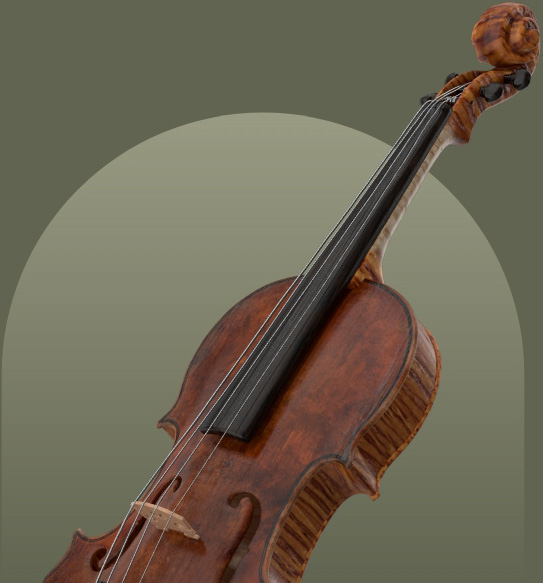
Louis Guersan (circa 1713-after 1781) was a prominent Parisian luthier, pupil and successor of Claude Pierray, and a member and later head of the corporation of luthiers. Appointed maker to the Dauphin and the Opéra, he was known for his distinctive instrument patterns, including a unique comma-shaped volute, and finely finished work. While he experimented with arching and thicknesses, his use of a hard, dry spirit varnish was often cited as detrimental to tone. Guersan produced a wide array of instruments, including violins, violas, cellos, quintons, and viols, many of which are preserved in significant museum collections like the Paris Conservatoire.
Auction price history
Highest auction price
| Type | Details | Sold | Price |
|---|---|---|---|
| Violin | 35.6 cm Paris, 1742 | December 2011 | £1,440 |
| Violin | 35.9 cm Paris, 1757 | December 2011 | £9,511 |
| Cello | 69.2 cm Paris, 1740 -1745 c. 3/4 size | December 2011 | £5,073 |
| Violin | October 2011 | £11,000 | |
| Violin | 35.3 cm Paris, 1760 c. [Attributed to] | October 2011 | £11,000 |
| Violin | 35.9 cm Paris, 1747 | October 2011 | £6,600 |
| Violin | 35.5 cm Paris, 1751 | June 2011 | £2,094 |
| Violin | 35.8 cm Paris, 1760 c. [Probably by] | December 2010 | £2,880 |
| Violin | 35.7 cm Paris, 1740 - 1745 c. (head replaced, restored soundpost crack, more) | June 2010 | £7,249 |
| Cello | 75.1 cm Paris, 1761 | October 2009 | £9,639 |
| Violin | 35.4 cm Paris, 1711 | October 2009 | £6,673 |
| Violin | 35.1 cm Paris, 1755, Quinton later transformed to violin (head replaced) | December 2008 | £1,024 |
| Violin | 35.4 cm Paris, 1745 | October 2008 | £1,614 |
| Violin | 35.4 cm Paris, mid 18th C. [Probably by] | October 2008 | £1,321 |
| Violin | 35.4 cm 1720 c. | June 2008 | £4,001 |
| Violin | 36.0 cm Paris, 1750 c. | June 2008 | £9,284 |
| Violin | 35.4 cm 1770 c. | April 2008 | £11,904 |
| Violin | 35.5 cm Paris, 1746 (restored soundpost crack) | December 2007 | £5,105 |
| Violin | 35.4 cm Paris, 1760 c. | December 2007 | £11,913 |
| Violin Bow | S/E 56 g. without hair | December 2007 | £5,531 |
| Violin | 35.4 cm Paris, 1749 | October 2007 | £8,125 |
| Violin | 35.3 cm Paris, 1756 (restorable conditon) | July 2007 | £1,822 |
| Violin | 35.4 cm 1740-1745 c. (scroll replaced) | June 2007 | £8,417 |
| Violin | 35.9 cm France, mid-18th C. [Attributed to] | November 2006 | £1,560 |
| Violin | 35.3 cm Paris, 1755 | November 2006 | £6,600 |
| Violin | 35.3 cm Paris, 1756 | July 2006 | £2,029 |
| Violin | 35.8 cm Markneukirchen, 1895 | July 2006 | £1,311 |
| Violin | 36.0 cm Paris, 1750 c. | June 2006 | £7,285 |
| Violin | Paris 18th C. [Attributed to] | November 2005 | £3,360 |
| Violin | Paris, 1761 | November 2005 | £4,421 |
| Cello | Paris, 1743 | July 2004 | £8,400 |
| Violin | Paris, 1760 c. [Probably by] | July 2004 | £2,160 |
| Violin | 1750 | December 2002 | £3,405 |
| Cello | 1766 | November 2002 | £9,200 |
| Violin | 1747 | October 2002 | £4,716 |
| Violin | 1798 | February 2001 | £1,370 |
| Violin | 1755 | November 2000 | £8,050 |
| Violin | 1746 | October 1999 | £2,751 |
| Violin | 1760 | June 1999 | £345 |
| Violin | 1760 c. | October 1997 | £506 |
| Cello | 1850 c. | November 1996 | £1,380 |
| Violin | 1757 | October 1995 | £3,450 |
| Viola | 41.0 cm 1763 | March 1995 | £10,925 |
| Violin | 1671 | June 1994 | £3,520 |
| Cello | 17-- | March 1994 | £8,625 |
| Cello | 1775 | March 1993 | £2,750 |
| Violin | 1755 | November 1992 | £2,420 |
| Cello | 1738 | March 1991 | £4,950 |
| Viola | 42.4 cm | November 1990 | £14,300 |
| Violin | 1739 | September 1990 | £1,705 |
| Violin | 1850 c. | June 1988 | £1,980 |
| Violin | 1760 c. | April 1987 | £1,485 |
| Violin | 1745 | September 1986 | £2,750 |
| Violin | 1787 | May 1986 | £2,592 |
| Violin | 1762 | March 1986 | £3,520 |
| Cello | 1746 | April 1984 | £2,601 |
| Violin | 1750 | January 1984 | £978 |
| Violin | 1740 | November 1981 | £3,740 |
| Violin | 1743 | January 1981 | £978 |
| Violin | 1751 | January 1981 | £978 |
| Violin | 1752 | July 1980 | £3,300 |
Maker Overview
Life
Louis Guersan (circa 1713-after 1781) was born around 1713 and died after 1781 in Paris, France. He was a pupil and later the successor of Claude Pierray. Guersan became a member of the corporation of luthiers in 1748 and was appointed its head in 1769. His workshop was located in the rue Fossé-St-Germain des Prés, and he was also noted to be living in rue de la Comedie-Francaise in 1760 and rue des Fosses St.-Germain in 1769. He was appointed maker and repairer to the Dauphin and to the Opéra. was one of the best French makers of his period and came from a family of violin makers spanning over a century. After leaving Pierray's workshop, he conducted various experiments in altering the arching and thicknesses of his instruments. Willibald Leo Lütgendorff notes that Guersan was the only one from his family to achieve significant fame and was a master of rare manual dexterity, though his works often fell short in terms of tone. He received considerable recognition during his lifetime, serving as a sworn guild master in 1748 and counting both high and low society among his clientele. His work was imitated, leading Lütgendorff to consider him the head of a school.
Characteristics
- Pattern
- Instruments produced by Guersan typically followed a small pattern, often narrow, and with medium arching, though some exhibited a broader Tyrolian aspect. Cecie Stainer notes that the proportions, depth of the sides, and thicknesses varied continually, especially in his violoncellos.
- Head and Fluting
- He crafted a very distinctive head with the last turn of the volute extended upwards into a slightly bizarre comma-shaped eye. The fluting of the front face also extended beyond the throat outside the pegbox.
- Materials and Workmanship
- Guersan utilized fine materials and, his work was very well executed and finely finished. Willibald Leo Lütgendorff mentions his use of cedar wood for decorations and his skill in carving attractive scrolls and heads. Cecie Stainer also describes his work as beautifully finished.
- Varnish
- John Dilworth describes his varnish as pale golden-amber. However, Cecie Stainer and Willibald Leo Lütgendorff state that he used a spirit varnish, which was hard, dry, and either a pale yellow or rose color. This spirit varnish was noted to dry too quickly, paralyzing vibrations and harming the tone, a fact Guersan himself seemed aware of, as he continually experimented with arching and thicknesses to improve the sound. Lütgendorff attributes the introduction of spirit varnish into French violin making to Guersan.
- Instrument Variety
- He made a wide range of instruments, including quintons, pardessus de viols, violins, violas, and cellos. Cecie Stainer specifically mentions five-stringed viols, six-stringed viols, and treble-viols.
- Louis Guersan
près la commedie Françoise
A Paris 1738John Dilworth - Ludovicus Guersan
prope
Comoediam
Gallicam
Lutetiae
Anno
1760John Dilworth - Ludovicus Guersan prope comediam
Gallicam. Anno 1737John Dilworth
Influence and legacy
- Mentorship: Louis Guersan was a pupil and later the successor of Claude Pierray.
- School: His work was imitated, and Willibald Leo Lütgendorff suggests he can be considered the head of a school of makers.
- Market Value: Many of his instruments were made and, they fetch good prices.
- Museum Collections: Instruments by Guersan are well represented in various museums. The Museum of the Paris Conservatoire holds several of his five-stringed viols, dated 1747, 1751, and 1755, as well as two six-stringed viols dated 1755 and 1763. A treble-viol in beautiful preservation, dated 1752, is also noted. The Snoeck collection once included a violin from 1734 and a viola from 1752 (now in Berlin), and the Gothenburg Museum possesses a quinton from 1763.
- Dated Instruments: Known dated instruments include violins from 1737, 1744, and 1766, and violoncellos from 1740.
Biographies
The overview above is drawn from the following published accounts. Read them in the original:
John Dilworth+
GUERSAN, Louis Born circa. 1713, d. after 1781 Paris France. Pupil and successor of Claude Pierray. Member of the corporation of luthiers from 1748 and made head in 1769. Workshop located in the rue Fossé-St-Germain des Prés. Appointed maker and repairer to the Dauphin and to the Opéra. Pattern usually of small dimensions, somewhat narrow, and of medium arching, but very well executed and finely finished. Others are of broader Tyrolian aspect. Very distinctive head with last turn of the volute extended up into a slightly bizarre comma-shaped eye. Fluting of front face also extends beyond the throat outside the pegbox. Fine materials, and pale golden-amber varnish. Many and various instruments, quintons, pardessus de viols, as well as violins, violas, and cellos recorded. Louis Guersan / près la commedie Françoise / A Paris 1738 Ludovicus Guersan / prope / Comoediam / Gallicam / Lutetiae / Anno / 1760 Ludovicus Guersan prope comediam / Gallicam. Anno 1737
George Hart+
Succeeded Claude Pierray. Ludovicus Guersan prope Comaediam Gallicam, Lutetiae, Anno 1766.
Cecie Stainer+
A maker in Paris about 1730-69; was living in rue de la Comedie-Francaise in 1760, and in rue des Fosses St.-Germain in 1769. Was one of a family whose members for more than a century had been violin makers; he himself was one of the best French makers of his period. Pupil and successor of Claude Pierray.
When he left the latter’s workshop he made various experiments in altering the arching, the thicknesses, &c., using spirit varnish on his instruments; the result, however, was not good, the tone produced being harsh and shrill. He was appointed maker to the Dauphin and to the Opera; in the archives of the latter is a quaint memorandum of repairs done by him to the double-bass of the Opera, which proves that at this date (1749) there was only one double-bass in the orchestra.
He made many instruments, and they fetch good prices. Made on a small pattern, the proportions, depth of the sides and thicknesses vary continually, especially in the violoncellos ; the alcoholic varnish is hard and dry, either a pale yellow or rose colour; its great drawback is that it dries too quickly and paralyses the vibrations, doing a great deal of harm to the tone; the work is beautifully finished.
A viola of middle size, with the back in two parts and a brownish-red varnish, is known. Several five-stringed viols of his are in the Collection of the Paris Conservatoire ; two are dated 1747 one 1751 and one 1755. Two six-stringed viols are dated 1755 and 1763. A treble-viol, in beautiful preservation, with pale yellow varnish, and of very careful workmanship, is dated 1752. A handsome violin is dated 1737, another 1744, and another 1766. Two violoncellos were dated 1740.
and ” Ludovicus Guersan, prope comcediam gallicam, Lutetiae, 1766.”
Willibald Leo Lütgendorff+
Er ist der Einzige aus seiner Familie, die mehrere Geigenmacher zählte, der
einen gewissen Ruhm erlangte. Erst Schüler von Cl. Pierray, wurde er später
auch dessen Nachfolger. Er war jedenfalls ein Meister von seltener Handgeschicklichkeit,
der alles zu machen verstand, was das Auge befriedigte, Cedernholz zu den Verzierungen verwandte, hübsche Schnecken und Köpfchen schnitzte;
nur in Bezug auf den Ton bleiben seine Arbeiten hinter allen Erwartungen
zurück. Diese Thatsache war ihm zweifellos selbst bekannt, denn er machte
zeitlebens Versuche, die Wölbung, das Stärkeverhältniss von Boden und Decke
zu ändern, ohne zu einem günstigeren Ergebniss zu kommen. Bis zu einem
gewissen Grade mag auch sein harter, trockener Lack, der leicht abspringt, den
Ton verschlechtert haben: — es war dies ein Spirituslack, dessen Einführung in
den französischen Geigenbau ihm geradezu zugeschrieben wird. Er fand im
Leben alle denkbare Anerkennung, war geschworener Zunftmeister für 1748
und zählte Hoch und Nieder zu seinen Kunden. Seine Arbeit wurde nachgeahmt,
so dass er auch als Haupt einer Schule gelten kann. Er wohnte erst
Rue de la Comédie Française und dann Rue des Fosses St. Germain. Arbeiten
von ihm besitzt das Museum des Pariser Conservatoriums, Snoeck eine Geige
von 1734 und eine Bratsche von 1752 (jetzt in Berlin), das Gothenburger Museum
ein Quinton von 1763, auch in anderen Museen ist er meist gut vertreten.
Sell your instrument with Amati
Get started by uploading photos of your instrument for our experts to review.
Sell your instrument with Amati
Get started by uploading photos of your instrument for our experts to review.
Family
Jean Charles Nephew
Working in Markneukirchen at the same time
(Parisse) Claude Paris worked 1770–1814
(Perrault) Perault worked 1770–1790
(Prevot) Charles Prevost worked 1775–1789
Adam Martin 1739–1808
Adolph Meyer worked 1780–1798
Ambroise worked 1750–1810