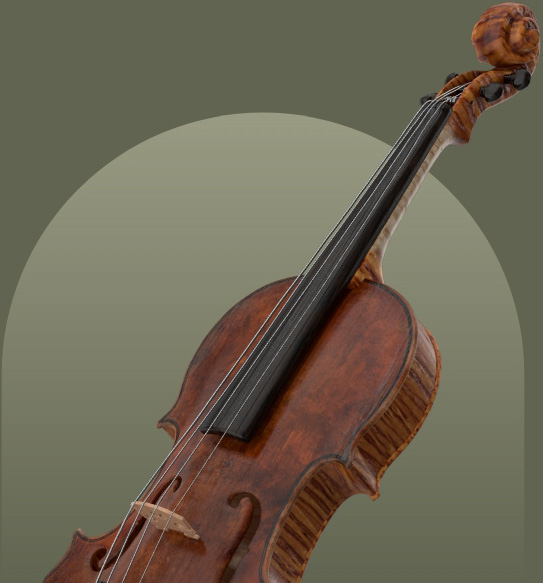
Flamersheim School
Johann Joseph Held
Flamersheim, 1823–1904
Johann Joseph Held (1823-1904) was a German luthier who began his career as a musician before becoming a self-taught violin maker. He opened a musical instrument business in Euskirchen in 1861 and later moved to Beuel in 1871. Held is noted for his collaboration with violinist Ole Bull, which led to an innovative method for achieving an evenly responsive tone in his instruments, involving the bass bar and soundpost placement. He also invented a substance for impregnating violin tops. Held produced 12-16 instruments annually, copying Italian patterns and personally performing the varnishing. His work earned him several diplomas and medals at various exhibitions.
Auction price history
Highest auction price
3 results
| Type | Details | Auction house | Sold | Price |
|---|---|---|---|---|
| Violin | Beuel, 1876 | — | November 2005 | £1,026 |
| Violin | 1880 c. | — | September 1990 | £1,815 |
| Violin | 1874 | — | November 1988 | £1,100 |
No results match those filters.
Maker Overview
Life
Johann Joseph Held (1823-1904) was born on July 17, 1823, in Flamersheim, Rheinbach (Cologne), Germany, and passed away in 1904. As the son of a musician, he was initially destined for a musical career, becoming a proficient flautist by the age of twelve. At thirteen, he began to learn the violin, which sparked his interest in violin making. His initial attempts in this art were driven by a desire to correct a flaw in his own violin. He gradually developed his skills autodidactically, eventually venturing into constructing new instruments, though he continued to earn his living as a musician., after his marriage, he moved to Euskirchen and, in 1861, opened a musical instrument shop and repair workshop there. John Dilworth also notes his presence in Euskirchen in 1861 as a flautist and violinist. In 1862, he met Ole Bull, who was taking a cure in Godesberg, and performed several repairs for him. Ole Bull returned to Held in 1878, staying as a guest for fourteen days, during which Held implemented a significant idea from the renowned violinist to achieve an evenly responsive tone across all strings of a violin. Cecie Stainer states that Held moved to his abode in Beuel, opposite Bonn (Rhine), in 1871.
Characteristics
- Self-Taught Development
- Johann Joseph Held developed his violin-making skills autodidactically, initially by repairing instruments and later by constructing new ones.
- Production Volume
- He produced between twelve and sixteen violins and violas annually, with assistance from his son and one workman, though he always performed the varnishing himself.
- Tonal Innovation
- Held adopted a method, inspired by Ole Bull, involving the oblique position of the bass bar and the placement of the soundpost, to ensure an evenly responsive tone on all strings. He remained faithful to this method for his new violins.
- Material Invention
- He invented a "Substanz zum Imprägnieren der Decke" (substance for impregnating the top plate), intended to facilitate a lighter response from the instrument.
- Pattern Copying
- Held copied Italian patterns for his instruments.
- J. J. Held. Geigenmacher in
BenelJohn Dilworth
Influence and legacy
- Mentorship: Johann Joseph Held's interest in violin making was initially sparked by his own need to repair his violin. He was largely self-taught.
- Collaboration with Ole Bull: His interaction with the celebrated violinist Ole Bull in 1862 and 1878 significantly influenced his craft, leading to the practical implementation of an idea for achieving an evenly responsive tone in violins.
- Family Continuity: His son from his second marriage was expected to become his successor in the craft.
- Awards and Recognition: Johann Joseph Held received numerous accolades for his work, including a Diploma in Vienna (1873), a medal in Düsseldorf (1880), a Diploma in Detmold (1881), silver medals in Krems and Wels (1882), a silver medal in Milan (1884), and a medal in Gorlitz (1889).
Biographies
The overview above is drawn from the following published accounts. Read them in the original:
John Dilworth+
HELD, Johann Joseph Born 1823, died 1904 Flamersheim Germany. Flautist and violinist at Euskirchen 1861. Friend of Ole Bull. Amateur violin maker. J. J. Held. Geigenmacher in / Benel
Cecie Stainer+
b. July 17, 1823, Flamersheim, Rheinbach (Cologne). When only 14 began to repair old instruments, and a few years later made new ones. In 1860 started his business in Euskirchen; moved to his present abode at Beuel vis-a-vis Bonn (Rhine), 1871.
He makes from 12 to 16 violins and violas a year, assisted by his son and one workman, but always does the varnishing himself; copies the Italian patterns.
Was awarded: Diploma, Vienna, 1873; medal, Düsseldorf, 1880; diploma, Detmold, 1881 ; silver medals at Krems and Wels, 1882; Milan. 1884; and medal, Gorlitz, 1889.
Willibald Leo Lütgendorff+
Als Sohn eines Musikers war auch er zum Musiker bestimmt. Mit zwölf
Jahren bereits ein tüchtiger Florist, sollte er von seinem 13. Jahre an das
Violinspiel erlernen. Hierdurch erwachte sein Interesse für das Geigenmachen,
und um einen Fehler seiner Geige zu verbessern, machte er die ersten Versuche
in dieser Kunst. Er bildete sich allmählich autodidactisch aus und wagte sich
schliesslich auch an den Neubau. Sein Brod verdiente er aber noch immer als
Musiker. Nach seiner Verheirathung siedelte er nach Enskirchen über und eröffnete
hier 1861 eine Musikinstrumenten-Handlung und Reparatur-Werkstatt.
Im Jahre 1862 lernte er den in Godesberg zur Kur weilenden Ole Bull kennen,
für den er mehrere Reparaturen ausführte. Im Jahre 1878 kam Ole Bull wieder
zu Held, und blieb 14 Tage bei ihm als Gast, wahrend welcher Zeit Held einen
glücklichen Gedanken des grossen Geigers practisch durchführte, um Geigen
einen auf allen Saiten gleichmässig ansprechenden Ton zu verschaffen. Die
neuen Geigen gelangen so gut, dass Held von nun an dieser Methode, die in
der schrägen Lage des Bassbalkens und der Stellung der Stimme besteht, treu
blieb. Er erfand auch eine »Substanz zum Imprägnieren der Decke«, welche
eine leichtere Ansprache bewirken soll. Sein Sohn zweiter Ehe dürfte sein Nachfolger
werden. Biographie und Bild in De Wit’s Zeitschrift 1893 No. 34.
Sell your instrument with Amati
Get started by uploading photos of your instrument for our experts to review.
Sell your instrument with Amati
Get started by uploading photos of your instrument for our experts to review.