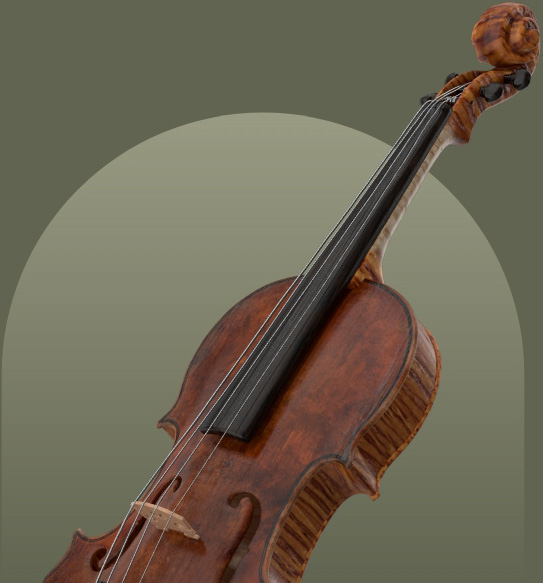
Waltenhofen School
Johann Georg Hellmer
Waltenhofen, b. 1687
Johann Georg Hellmer (1687-1770) was a prominent luthier born in Waltenhofen, Germany, who established his career in Prague as a pupil of Thomas Edlinger. Achieving prosperity and citizenship in 1724, he was known for his fine craftsmanship, producing instruments based on his own highly arched model as well as those of Klotz and Amati. His work featured excellent wood, a soft yet strong tone, and a distinctive reddish-brown or orange-brown oil varnish. Despite an initial weakness in the bass bar, easily remedied, his violins, particularly on the G-string, were highly regarded. His legacy includes instruments owned by figures such as Ludwig van Beethoven and preserved in notable collections, with his reputation leading to the use of facsimile labels by 19th-century Saxon producers.
Auction price history
Highest auction price
| Type | Details | Sold | Price |
|---|---|---|---|
| Viola | 41.2 cm 1745 | October 2002 | £3,628 |
| Violin | 1755 | November 2000 | £3,220 |
| Violin | 1760 | March 1997 | £1,610 |
| Violin | 1755 | May 1989 | £968 |
Maker Overview
Life
Johann Georg Hellmer (1687-1770) came to Prague at a young age, where he became a pupil of Thomas Edlinger and, like his teacher, achieved prosperity. He obtained citizenship in the Malá Strana (Kleinseite) district of Prague in 1724 and owned a house at Neuhofgasse No. 458 (Novodvorská ul.). He was married twice, his second marriage being to Maria Barbara Schmid on July 1, 1738. It is known that Ludwig van Beethoven owned a violin made by Hellmer from the year 1737. A theorbo repaired by him in 1755 is located in Vienna's Art History Collection of the Imperial House (Kunsth. Samml. v. A. H. Kaiserhauses), inventory number 4041. A violin from 1753 by him is found in the collegiate church (Stiftskirche) in Braunau, Bohemia. The Benedictine Abbey of St. Margaret (Bened.-Stift St. Margareth) near Prague possesses a violin from the 1720s, and Prince Lobkowitz of Raudnitz owns a violin from 1751.
Characteristics
- Models
- He worked both after his own beautiful, highly arched model and after models by Klotz and Amati.
- Workmanship
- His work is exceptionally clean in form, utilizing mostly excellent wood, which contributes to a soft, noble, yet strong tone.
- Varnish
- , he used a reddish-brown oil varnish with a yellow ground lacquer. John Dilworth notes that Hellmer used a pale yellow varnish prior to approximately 1740, later introducing an orange-brown oil varnish.
- Scroll
- Instruments often feature a diminutive scroll.
- Bass Bar
- His instruments, like those of all older masters, initially had a bass bar that was considered too weak. However, as this flaw can be easily remedied by a repairer, his violins, particularly on the G-string, produce an unsurpassed sound.
- Branding
- He sometimes branded his instruments in the chin of the scroll.
- Instrument Types
- He made several violas, and his cellos are considered his most successful instruments.
- Georges Hellemer
pragensis me fecit
anno domini 1720John Dilworth - Joannes Georgius Helmer
Pragae. 1761John Dilworth - Joannes Giorgius Hellmer
Pragensis me fecit 1742John Dilworth
Influence and legacy
- Mentorship: Johann Georg Hellmer was a pupil of Thomas Edlinger in Prague.
- Peer Comparison: His work is considered very close in quality to that of his fellow student, J. U. Eberle.
- Notable Owners: Ludwig van Beethoven owned one of his violins from 1737.
- Museum & Collection Presence: His instruments are preserved in significant collections, including a repaired theorbo in Vienna's Art History Collection of the Imperial House, a violin in the collegiate church in Braunau, and instruments in the Benedictine Abbey of St. Margaret near Prague and the collection of Prince Lobkowitz of Raudnitz.
- Imitation: Facsimile labels bearing his name were used by Saxon factory producers in the 19th century, indicating his lasting reputation.
Biographies
The overview above is drawn from the following published accounts. Read them in the original:
John Dilworth+
HELLMER, Johann Georg Born 1687 Waltenhofen Germany, Worked circa. 1720-1770 Prague Czech Republic. Pupil of Thomas Edlinger. Fine workmanship on Amati- and Klotz-derived model with diminutive scroll. Fine materials and pale yellow varnish prior to c.1740; later introduced an orange-brown oil varnish. Sometimes branded in the chin of the scroll. Several violas. Cellos most successful. Facsimile labels used by Saxon factory producers in the 19th century. Beethoven owned one of his instruments. Georges Hellemer / pragensis me fecit / anno domini 1720 Joannes Georgius Helmer / Pragae. 1761 Joannes Giorgius Hellmer / Pragensis me fecit 1742
Willibald Leo Lütgendorff+
Er kam in jungen Jahren nach Prag, wo er ein Schüler von Thomas Edlinger
wurde und es ebenfalls, wie sein Lehrer, zu Wohlstand brachte. Er erlangte
1724 das Bürgerrecht auf der Kleinseite und hatte ein eigenes Haus in der
Neuhofgasse No. 458 (Novodvorská ul.). Er war zweimal verheirathet, in 2. Ehe
mit Maria Barbara Schmid, die er am 1. Juli 1738 geheirathet hat. Er arbeitete
sowohl nach einem eigenen, schönen, hochgewölbten Modell als auch nach Klotz
u. A. und kommt seinem Mitschüler J. U. Eberle sehr nahe. Seine Arbeit ist
ungemein sauber nach der Form, das Holz meist vortrefflich und der Ton weich,
edel und doch stark. Er verwendete einen rothbraunen Öllack mit gelbem
Grundlack. Seine Instrumente hatten — wie die aller älteren Meister — einen
zu schwachen Bassbalken. Da diesem Fehler von einem Reparateur leicht abgeholfen
werden kann, klingen seine Geigen, gerade auf der G-Saite, unübertrefflich.
Es ist bekannt, dass Beethoven eine von ihm gemachte Geige aus dem
Jahre 1737 besass. Eine von ihm 1755 reparirte Theorbe in Wien, Kunsth.
Samml. v. A. H. Kaiserhauses. Inv.-No. 4041. Auf dem Chor der Stiftskirche
in Braunau (Böhmen) befindet sich von ihm eine Geige aus dem Jahre 1753.
Eine Geige aus den zwanziger Jahren des 18. Jahrhundert von ihm besitzt das
Bened.-Stift St. Margareth bei Prag, eine Geige von 1751 fürst Lobkowitz auf
Raudnitz.
Sell your instrument with Amati
Get started by uploading photos of your instrument for our experts to review.
Sell your instrument with Amati
Get started by uploading photos of your instrument for our experts to review.