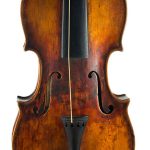
Henry Lockey Hill
London, 1774–1835
Henry Lockey Hill (1774-1835) was a highly esteemed British luthier, son of Lockey Hill and grandson of Joseph Hill. He trained under his father and uncle, Joseph (II), and worked for John Betts, where he famously created templates of the Stradivari 'King Frederick' cello, which became his primary model. He succeeded his father's business in Southwark and later established 'L. Hill & Sons' at 7 Brandon Row. Henry Lockey Hill was pivotal in the Hill family's shift from Stainer and Amati models to the Stradivari style, producing instruments of exceptional workmanship and tone, including violins, violas, and violoncellos. His legacy was continued by his son, William Ebsworth Hill, contributing significantly to the renowned firm 'W. E. Hill & Sons'.
Auction Price History
Highest auction price
10 results
| Type | Details | Auction house | Sold | Price |
|---|---|---|---|---|
| Violin | Lot 115 | Bonhams | October 2014 | £2 |
| Cello | 74.0 cm London, early 19th C. Attributed to | — | November 2011 | £9,774 |
| Cello | 73.8 cm London, 1810 c. | — | June 2010 | £14,400 |
| Cello | 73.8 cm 1800 c. (restorations) | — | March 2009 | £6,240 |
| Violin | 35.2 cm 1760 c. Ascribed to | — | December 2008 | £3,595 |
| Cello | 73.6 cm 1810 c. Attributed to | — | November 2008 | £7,200 |
| Viola | 38.9 cm Ondon, 1830 c. | — | October 2008 | £6,435 |
| Cello | 73.2 cm 1770 c. Attributed to | — | June 2008 | £15,600 |
| Violin | London, 1820 c. | — | June 2005 | £6,330 |
| Violin | 1820 c. | — | January 2005 | £2,868 |
No results match those filters.
Maker Overview
Life
Henry Lockey Hill (1774-1835) was born in 1774 and died in 1835 in London, UK. He was the son of Lockey Hill and the grandson of Joseph Hill. Henry Lockey Hill was a pupil of his uncle, Joseph (II), and also of his father. He worked for John Betts from approximately 1806 to 1810. During this period, he created templates of the Stradivari 'King Frederick' cello, which he subsequently adopted as his primary model. This particular cello was sent by Friedrich Wilhelm III of Prussia to John Betts in 1810 for sale in England. In 1810, Henry Lockey Hill succeeded his father's business in Southwark. By 1826, he had established his own firm at 7 Brandon Row, operating under the name 'L. Hill & Sons'. He later became a partner with his brothers in his father's firm, and his exceptional work significantly contributed to establishing the 'Hill' name as one of Britain's most prominent in instrument making. He is recognized as the first member of the Hill family to fully embrace the style and principles of Stradivari, distinguishing his work from the often coarser Stainer and Amati models produced by his father. His son, William Ebsworth Hill, continued this high standard of craftsmanship, which became a hallmark of the renowned firm 'W. E. Hill & Sons'. Henry Lockey Hill had four sons: Henry (who died in 1856) was a distinguished viola player, Joseph (who died in 1837) was also a maker, and William Ebsworth became a celebrated maker.
Characteristics
- Workmanship
- Henry Lockey Hill was a very fine maker, known for his excellent workmanship and magnificent tone.
- Models
- He was the first in the Hill family to transition from using Stainer and Amati models to adopting the Stradivari model. He made templates of the Stradivari 'King Frederick' cello and used it as his primary model.
- Cello Copies
- His copies of the Stradivari cello were considered perfect in all aspects except for the varnish and purfling. The varnish, while of excellent quality and a close imitation, was not comparable to Stradivari's. The purfling was carefully inlaid but differed in its manner from the original, particularly in the mitring at the corners.
- Varnish
- He frequently employed a light-colored varnish that was perfectly transparent and very elastic. A viola he made featured a pinkish tint of varnish, thinly applied and nicely polished.
- Violin Characteristics
- A violin by him, made on an Amati model with a slab back of beautiful figure, possessed a dulcet tone. The varnish color resembled the brownish-purple tint of birch tree bark in autumn.
- Viola Characteristics
- He produced a viola on a modified Amati model, characterized by a widened waist and not overly pronounced arching. This instrument yielded a large and deep tone on the lower strings, and clear and incisive notes on the upper ones. The scroll was crafted in the Italian style, free and easy, and the sound-holes were clean and graceful.
- L. Hill and Sons
Manufacturers of violin, violoncello
Tenors, Double-Bass
No. 7. Brandon Row
Newington Causeway Henry Lockey Hill
Maker. London.
Kent Street. Boro’John Dilworth
Influence and legacy
- Mentorship: Henry Lockey Hill was a pupil of his uncle, Joseph (II), and also received training from his father, Lockey Hill.
- Professional Experience: He worked for John Betts, where he likely became acquainted with the Stradivari model.
- Potential Influence: He is thought to have been influenced by Fendt.
- Family Reputation: His exceptional work played a significant role in establishing the 'Hill' name as one of the most distinguished in British instrument making.
- Succession: His son, William Ebsworth Hill, continued his high standard of craftsmanship, which became the defining characteristic of the renowned firm 'W. E. Hill & Sons'.
- Historical Significance: His instruments were of such high quality that forgers would sometimes replace his labels with those of more favored makers, such as Italian masters or Stradivari.
- Preservation: The patterns he created from the Stradivari violoncello were preserved by the firm.
Biographies
The overview above is drawn from the following published accounts. Read them in the original:
John Dilworth+
HILL, Henry Lockey Born 1774, died 1835 London UK. Son of Lockey Hill, below. Pupil of his uncle, Joseph (II). Worked for John Betts c.1806-1810, during which time he made templates of the Stradivari ‘King Frederick’ cello, which he subsequently used as his model. Succeeded to his father’s business in Southwark 1810, and established at 7 Brandon Row by 1826 as ‘L. Hill & Sons’. Very fine maker, the first of the Hill family to fully absorb the style and principles of Stradivari as distinct from the sometimes coarse Stainer and Amati work produced by his father. His son, William Ebsworth, below, maintained this high level of craftsmanship which became the distinction of the firm ‘W. E. Hill & Sons’. L. Hill and Sons / Manufacturers of violin, violoncello / Tenors, Double-Bass / No. 7. Brandon Row / Newington Causeway Henry Lockey Hill / Maker. London. / Kent Street. Boro’ [BVMA]
William Meredith Morris+
He was the son of Lockey Hill, the grandson of Joseph Hill, and the father of the world-renowned William Ebsworth Hill. He was a pupil of his father, and he worked for some time with John Betts. Later he became partner with his brothers in his father’s firm, and contributed largely by his excellent work to make the name of ” Hill ” one of the greatest fiddle names in all Britain. The workmanship and tone are magnificent — sufficiently so to furnish the forger with an excuse to extract the label (if there were one) and inserting another bearing a more favoured name. I have seen more than one Lockey Hill violoncello in this country carrying an Italian “passport.” A renowned ‘cello player uses at the present moment a Henry Lockey Hill instrument with a Stradivari label. It is of the same measurements as the Strad ‘cello sent by Friedrich Wilhelm III. of Prussia to John Betts in 1810, to be sold in this country. In all respects it is a perfect copy, except as regards the varnish and the purfling. The varnish, although of excellent quality, and a close imitation, is not to be compared with that of Stradivari. The purfling is care- fully inlaid, but not in the manner of the original. Any one examining the mitring at the corners will perceive the difference. Careful analysis and comparison of this specimen with other Henry Lockey Hill violoncellos reveal the identity of style. Some years ago I saw a violin by this maker, made on the Amati model, with a slab back of beautiful figure, which had a dulcet tone. The colour of the varnish resembled the brownish-purple tint of the bark of the birch tree in autumn. Hill frequently used a light-coloured varnish, which is perfectly transparent and very elastic. I have seen only one of his violas, which was on a modified Amati model, with a widened waist, and not over-pronounced arching. The tone was large and deep on the lower strings, and clear and incisive on the upper ones. The scroll was in the Italian style, free and easy, and the sound-holes ” clean ” and graceful. The varnish on this instrument was of a pinkish tint, laid on thinly and nicely polished. Altogether the work of Hill is exceedingly fine, and it is a great pity there is not more of it.
Cecie Stainer+
Son of Lockey Hill ; grandson of Joseph Hill ; b. 1774 ; d. Aug., 1835. Worked for some time with John Betts, was probably still with him when he took patterns (still preserved by the firm) of a Stradivari violoncello, sent by Friedrich Wilhelm III. of Prussia to John Betts in 1810, to be sold in England.
He was an excellent workman, and some violins, violas, and violoncellos of his are exceptionally good instruments. Of his four sons, one Henry (d. 1856) was a fine viola player, one Joseph (d. 1837) and William Ebsworth were both makers.
Willibald Leo Lütgendorff+
Sohn und Schüler von Lockey H. »L. Hill of the Borough«. Er arbeitete
eine Zeit lang bei John Betts, durch den er wahrscheinlich das Stradivari-Modell
kennen lernte. Er ist als besonders tüchtiger Geigenmacher bekannt und stand wahrscheinlich auch zu Fendt in Beziehung, der ihn beeinflusste. Er gilt als der Erste
in der Familie Hill, der von Stainer und Amati zu Stradivari
überging.
Sell your instrument with Amati
Get started by uploading photos of your instrument for our experts to review.
Sell your instrument with Amati
Get started by uploading photos of your instrument for our experts to review.