
Netherlands School
Hendrik Jacobs
Amsterdam, Holland, c.1629–1704
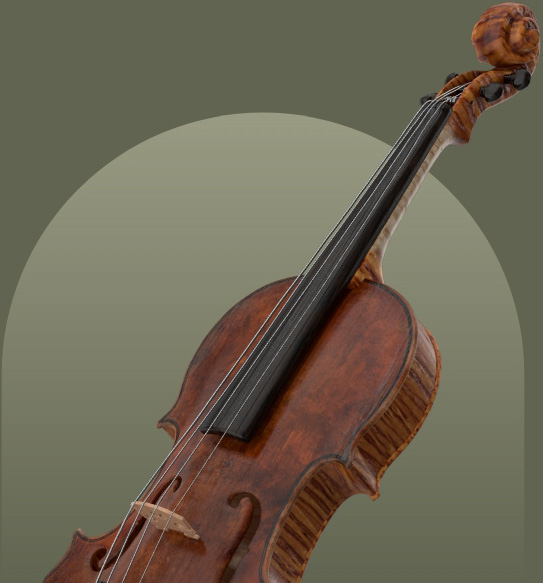
Hendrik Jacobs (circa 1629-1704) was a renowned Dutch violin maker from Amsterdam, known for his highly refined and skillful instruments. Initially, his work was strongly influenced by Nicola Amati, whose large patterns he copied so faithfully that his violins were often mistaken for genuine Italian instruments. Later in his career, his stepson and pupil, Pieter Rombouts, increasingly influenced the workshop's output, introducing Stainer-like characteristics. Jacobs is particularly noted for his use of broad whalebone purfling and a distinctive red-brown varnish. His instruments are now rare and highly valued.
Auction price history
Highest auction price
| Type | Details | Sold | Price |
|---|---|---|---|
| Violin | 35.6 cm Amsterdam, 1694 | October 2011 | £13,750 |
| Violin | 35.7 cm Amsterdam, 1690 c. | March 2011 | £18,750 |
| Violin | 35.7 cm Amsterdam, 1693 [Ascribed to & probably by] | April 2010 | £18,854 |
| Violin | 35.6 cm Amsterdam, 1695 c. | October 2008 | £10,272 |
| Violin | 35.6 cm Amsterdam, 1680 c. [Probably by] | April 2008 | £29,378 |
| Violin | 35.7 cm Amsterdam, 1699 | November 2006 | £14,400 |
| Violin | 1700 c. | May 2003 | £8,750 |
| Violin | 169- | June 1999 | £9,430 |
| Violin | 1690 | May 1999 | £7,035 |
| Violin | 1710 | March 1999 | £14,950 |
| Violin | 1690 | November 1998 | £17,250 |
| Violin | 1700 c. | April 1998 | £18,400 |
| Violin | 1702 | November 1995 | £10,350 |
| Violin | 1714 | June 1990 | £8,580 |
| Cello | 1690 c. | November 1988 | £9,900 |
| Violin | 1690 c. | March 1986 | £4,620 |
| Violin | 1692 | December 1983 | £3,080 |
Maker Overview
Life
Hendrik Jacobs (circa 1629-1704) is thought to have shared his early training with Cornelius Kleynman under Kleynman's step-father Francis Lupo in Amsterdam, Netherlands. Sources contain conflicting information regarding his training; some legends, suggest he learned in Cremona and was even the step-brother of the last Amati, likely due to his excellent ability to imitate Nic. Amati's work. Up to approximately 1670, his work was extraordinarily Amatisé, and throughout his life, it remained extremely refined and skillful. After this preliminary period, his instruments became more original in form and method. After 1685, the hand of his stepson, pupil, and successor, Pieter Rombouts, became increasingly dominant in his workshop. Rombouts seems to have used the Jacobs label for up to ten years after his master's death. A typical label reads: "Hendrik Jacobs me fecit / in Amsterdam, 1690".
Characteristics
- Models
- He made a great number of good violins, altos, and violoncellos. He copied the large pattern of Nicola Amati so faithfully that his violins are often taken for genuine Italian instruments.
- Characteristics
- His instruments are generally slightly over-sized.
- Materials
- The wood is carefully chosen.
- Varnish
- He used a darker coloured red-brown varnish of good quality. George Hart describes his varnish as "excellent varnish, of a deep red, very transparent; full of character, but wanting in finish." Later works carry a particularly thick rich red varnish of Venetian quality.
- Purfling
- He used quite broad whalebone purfling. Willibald Leo Lütgendorff suggests Jacobsz is considered the first to use whalebone for inlays, leading to any instrument with whalebone purfling being colloquially referred to as a "Hendrik Jacobs." George Hart notes the purfling as "embedded."
- Scrolls & Soundholes
- Jacob's own scrolls are perhaps a little weak in character but well cut. Cecie Stainer notes that the scroll and sound-holes are not very well cut. After 1685, the influence of Pieter Rombouts brought even broader whalebone purfling and soundholes with extended curving lower wings imitated from Stainer, whose work was becoming increasingly popular. Rombouts pursued the Stainer manner with a prolonged last turn around the eye on scrolls.
- Tone
- The tone is described as sweet, but not very powerful.
- Hendrik Jacobs me fecit
in Amsterdam, 1690John Dilworth
Influence and legacy
- Training: He is thought to have shared his early training with Cornelius Kleynman under Kleynman's step-father Francis Lupo.
- Mentorship: Pieter Rombouts was his stepson, pupil, and successor.
- Stylistic Influences: His early work was extraordinarily Amatisé, copying the large pattern of Nicola Amati. Later, his stepson Pieter Rombouts introduced elements imitated from Stainer, such as soundholes with extended curving lower wings and scrolls with a prolonged last turn around the eye.
- Rarity & Value: His works are now quite rare and highly priced. Even the Selhof'sche Verzeichniss (1759) listed only two violins by him.
- Attribution Challenges: Most of the cellos attributed to Jacobs are probably the work of Pieter Rombouts in the later period, and Rombouts seems to have used the Jacobs label for up to ten years after his master's death.
- Notable Instruments: A beautiful violin from the Snoeck collection is located in Berlin.
Biographies
The overview above is drawn from the following published accounts. Read them in the original:
John Dilworth+
JACOBS, Hendrik Born circa. 1629, died 1704 Amsterdam Netherlands. Thought to have shared his early training with Cornelius Kleynman under Kleynman’s step-father Francis Lupo. Up to c.1670 his work is extraordinarily Amatisé, and throughout his life is extremely refined and skilful. After this preliminary period the instruments become more original in form and method. They are generally slightly over-sized, with darker coloured red-brown varnish, and use quite broad whalebone purfling. After 1685 the hand of his stepson, pupil, and successor Pieter Rombouts becomes increasingly dominant. The signs of this are even broader whalebone purfling and soundholes with extended curving lower wings imitated from Stainer, whose work was becoming increasingly popular. Jacob’s own scrolls are perhaps a little weak in character but well cut, while Rombouts pursued the Stainer manner with a prolonged last turn around the eye. Last works carry a particularly thick rich red varnish of Venetian quality. Most of the cellos attributed to Jacobs are probably the work of Rombouts in this period. Rombouts seems to have used the Jacobs label for up to ten years after his master’s death. Hendrik Jacobs me fecit / in Amsterdam, 1690
George Hart+
Probably a son of [Peeter Jacobs]. Excellent varnish, of a deep red, very transparent ; full of character, but wanting in finish. Purfling embedded.
Cecie Stainer+
A maker in Amsterdam about 1690-1740. He made a great number of good violins, altos, and violoncellos; he copied the large pattern of Nicola Amati so faithfully that his violins are often taken for genuine Italian instruments; the wood is carefully chosen ; the red-brown varnish of good quality ; the scroll and the sound-holes are not very well cut; the purfling is of whalebone; the tone sweet, but not very powerful.
Willibald Leo Lütgendorff+
Wohl der berühmteste holländische Geigenmacher, dessen Geschichte von
einem ganzen Sagenkranz umwoben ist. So soll er in Cremona gelernt haben
und sogar der Stiefbruder des letzten Amati gewesen sein. Entstanden sind
diese Sagen wohl dadurch, dass er Nic. Amati vortrefflich nachzuahmen verstand.
Sein Lack ist rothbraun. Jacobsz gilt als der Erste, der Fischbein zu
den Einlagen verwendete, wesshalb Händler auch jede mit Fischbein eingelegte
Geige kurzweg als eine »Hendrik Jacobs« bezeichnen. Seine Arbeiten kommen
jetzt ziemlich selten vor und stehen hoch im Preis, durften aber auch früher nicht häufig gewesen sein, denn selbst das Selhof’sche Verzeichniss (1759) führt nur zwei Geigen von ihm auf. Eine hübsche Violine befindet sich aus der Sammlung Snoeck in Berlin.
Sell your instrument with Amati
Get started by uploading photos of your instrument for our experts to review.
Sell your instrument with Amati
Get started by uploading photos of your instrument for our experts to review.
Working in Amsterdam at the same time
Cornelius Kleynman 1626–1686
David Kleynman 1664–1698
Dirck Gerritsz b. 1586
Harmanos Boumeester 1656–1678
Huybert Gerritsz 1658–1725
Jan van Cortenhout worked 1700–1750
Margareta Boumeester worked 1700