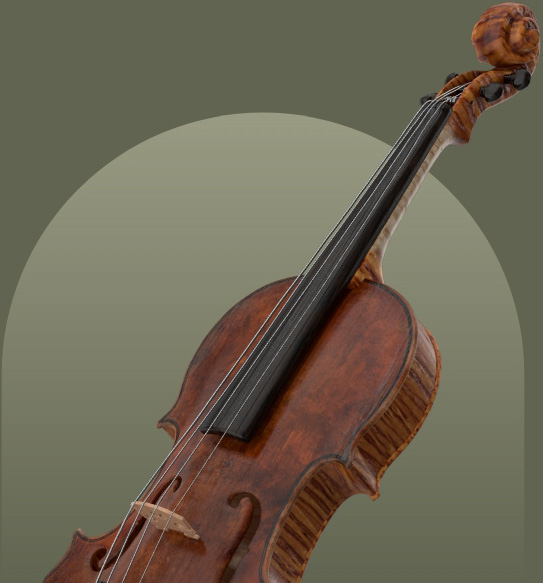
Henry (II) Jay
London, worked 1740–1776
Henry (II) Jay (circa 1740-1776) was a London luthier, likely a pupil of Peter Wamsley, who operated workshops in Long Acre and later Windmill Street. He was particularly known for his finely crafted dancing master's pochettes or kits, often built on a high arched Stainer model, which were praised for their clear and sweet tone and fetched significant prices. Jay also produced violoncellos, with his work frequently sold through firms like Longman & Co. His instruments were characterized by neat workmanship and the use of various varnishes, including a good red-brown type.
Auction Price History
Highest auction price
10 results
| Type | Details | Auction house | Sold | Price |
|---|---|---|---|---|
| Cello | 74.9 cm 1767 | — | October 2010 | £4,600 |
| Violin | 1754 | — | November 2002 | £1,100 |
| Violin | 17-- | — | September 1991 | £440 |
| Violin | 1766 | — | November 1990 | £880 |
| Violin | 1750 c. | — | March 1988 | £385 |
| Cello | 17-- | — | November 1987 | £4,950 |
| Cello | 1760 c. | — | June 1987 | £5,280 |
| Violin | 17-- | — | July 1985 | £1,430 |
| Cello | 1750 c. | — | September 1980 | £2,970 |
| Violin | 1771 | — | March 1980 | £684 |
No results match those filters.
Maker Overview
Life
Henry (II) Jay (circa 1740-1776) worked in London, UK., there was no known connection with the earlier Henry Jaye. He was probably a pupil of Peter Wamsley. Jay established independently in Long Acre, Covent Garden from 1740 and later in Windmill Street, Piccadilly from approximately 1766. Much of his work was sold through various firms including Longman & Co., later Longman Lukey & Co., and Longman & Broderip.
Characteristics
- Model
- He typically produced London trade work using a high arched Stainer model.
- Workmanship
- His craftsmanship was fine and very neat, with neatly finished work.
- Varnish
- He occasionally used a good red-brown varnish, though mostly a thin brittle dark golden-brown recipe. William Meredith Morris noted the varnish was of good quality, and Cecie Stainer described it as a red-brown colour. Willibald Leo Lütgendorff also mentioned a good reddish-brown varnish.
- Instruments
- He made a large number of dancing master's pochettes or kits, for which he was best known. He also made many violoncellos, often for Longman and Broderip.
- Tone
- The tone of his kits was described as clear and sweet.
- Pricing
- He received £5 for each kit, a sum which William Meredith Morris noted was equivalent to nearly £10 today, and Cecie Stainer considered a very large sum for the period.
- Made by Henry Jay
in Long Acre, 1742John Dilworth - Made by Henry Jay
in Windmill Street
near Piccadilly; London. 1768John Dilworth
Influence and legacy
- Training: He was probably a pupil of Peter Wamsley.
- Style: He worked well after Italian models.
- Family Connections: Sources contain conflicting information regarding his family connections. John Dilworth states there was 'No known connection with the earlier Henry Jaye', while Cecie Stainer notes he 'is supposed to have been related to Thomas Jay', and Willibald Leo Lütgendorff suggests he was 'Wahrscheinlich der Sohn von Thomas Jay' (probably the son of Thomas Jay).
- Reputation: His good pocket violins (kits) were highly priced even during his lifetime.
Biographies
The overview above is drawn from the following published accounts. Read them in the original:
John Dilworth+
JAY, Henry (II) Worked circa. 1740-1776 London UK. No known connection with the earlier Henry Jaye. Probably a pupil of Peter Wamsley. Established independently in Long Acre, Covent Garden from 1740 and in Windmill Street, Piccadilly from c.1766. Typical London trade work of the period using a high arched Stainer model. Fine craftsmanship, occasionally with a good red-brown varnish, mostly with a thin brittle dark golden-brown recipe. Made a large number of dancing master’s pochettes or kits. Much of his work was sold through Longman & Co., later Longman Lukey & Co., and Longman & Broderip, whose various brands are found beneath the back button. Sometimes signed under the fingerboard beneath the varnish: ‘H. Jay’. Made by Henry Jay / in Long Acre, 1742 Made by Henry Jay / in Windmill Street / near Piccadilly; London. 1768
William Meredith Morris+
A maker of “Kits” chiefly. The workmanship is very neat, and the varnish of good quality. The tone of one of these ” Kits” which I saw a few years since was clear and sweet. Jay is said to have received £5 for each ” Kit ” that he sold — a sum which is equivalent to nearly £10 to-day. This is hardly credible, seeing that Banks and Duke got only £6 for their best violins.
Jay made many violoncellos for Longman and Broderip.
The label in the ” Kit ” which I saw and tried read : —
MADE BY HENRY JAY, INSTRUMENT MAKER, IN LONG ACRE, LONDON, 1750
Cecie Stainer+
Worked in London about 1746-68. He was best known for the small violins or ” kits ” that he made, which were used by dancing-masters ; the varnish was a red-brown colour, the work was neatly finished, and he received £5 for each one—a very large sum for those days.
He also made some violoncellos, often signed on the back ” Longman and Broderip.” Two labels are known : ” Made by Henry Jay in Long Acre, London, 1746,” and ” Made by Henry Jay in Windmill Street, near Piccadilly, London, 1768.” He is supposed to have been related to Thomas Jay.
Willibald Leo Lütgendorff+
Wahrscheinlich der Sohn von Thomas Jay. Zeichnet sich durch saubere
Arbeit und guten röthlich-braunen Lack aus. Er arbeitete gut nach italienischen
Mustern, oft für die Firma Longman & Broderip, und war besonders durch seine
guten Taschengeigen bekannt, die schon zu seinen Lebzeiten hoch im Preise
standen. Seine Zettel sind, soweit bis jetzt bekannt ist, nur geschrieben.
Sell your instrument with Amati
Get started by uploading photos of your instrument for our experts to review.
Sell your instrument with Amati
Get started by uploading photos of your instrument for our experts to review.