
London School
John Johnson
London, worked 1740–1762
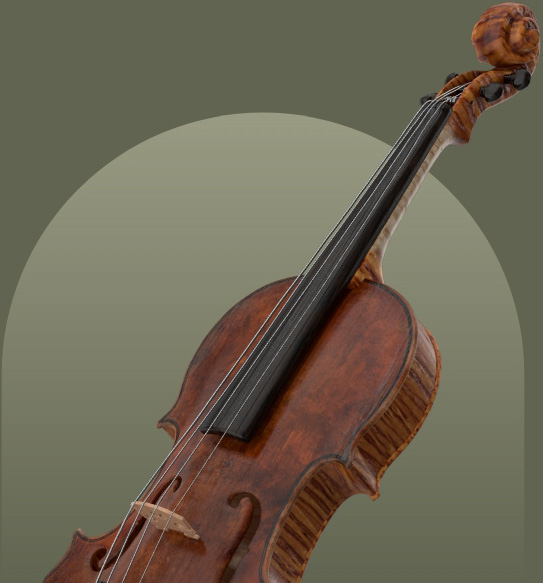
John Johnson (b. c.1719, Worked circa. 1740-1762) was a prominent 18th-century London instrument maker and music seller. Apprenticed to Daniel Wright, he took over the business in 1740, establishing a significant music shop at the 'Harp and Crown' in Cheapside and another in Covent Garden. His violins, typically crafted on the Stainer model, are characterized by a full arch, dark brown varnish, and often painted purfling, and are noted for their clear and penetrating tone. Johnson's extensive business included selling instruments and accessories, and publishing music. His enterprise continued under the management of his widow, Ruth, after his passing.
Auction price history
Highest auction price
| Type | Details | Sold | Price |
|---|---|---|---|
| Violin | October 2011 | £4,125 | |
| Violin | 35.8 cm London, 1756 c. | October 2011 | £4,125 |
| Violin | 35.7 cm London, 1750 | March 2011 | £4,000 |
| Violin | 35.5 cm London 1758 [Attributed to] | June 2010 | £1,200 |
| Violin | 35.6 cm London, 1760 (later head) | March 2010 | £575 |
| Violin | 35.8 cm 1760 c. | May 2007 | £3,456 |
| Violin | 35.7 cm 1750 c. | June 2006 | £840 |
| Violin | London, 1753 | October 2005 | £1,507 |
| Violin | London, 1770 c. | July 2005 | £2,400 |
| Cello | London, 1770 c. [Attributed to] | May 2005 | £9,600 |
| Violin | London, 1759 | March 2005 | £2,160 |
| Cello | May 2004 | £1,658 | |
| Violin | 1770 c. | February 2004 | £2,390 |
| Violin | 1764 | November 2002 | £1,057 |
| Violin | 1754 | March 2002 | £5,760 |
| Violin | 1750 | July 2000 | £3,120 |
| Violin | 1764 | June 2000 | £3,220 |
| Violin | 1759 | November 1999 | £3,200 |
| Violin | 1750 c. | March 1997 | £1,610 |
| Violin | 1759 | November 1996 | £2,439 |
| Violin | 1759 | July 1992 | £3,520 |
| Violin | 1750 c. | September 1991 | £2,090 |
| Violin | 1757 | June 1991 | £1,100 |
| Violin | 1759 | April 1991 | £4,400 |
| Violin | 1790 c. | March 1990 | £2,310 |
| Violin | 1760 c. | September 1989 | £825 |
| Viola | 39.5 cm 1763 | June 1985 | £1,364 |
Maker Overview
Life
John Johnson (b. c.1719, Worked circa. 1740-1762) was an English instrument maker and music seller who worked in London. He was apprenticed to Daniel Wright from 1732 and subsequently succeeded to Wright's business in 1740. Johnson moved his stock to new workshops at the 'Harp and Crown' in Cheapside and also opened additional premises in York Street, Covent Garden in The Brompton's Book of Violin & Bow Makers. Like many 18th-century English makers, Johnson ran an extensive music shop, offering a wide range of instruments and accessories, and also engaged in music publishing himself.'s The Violin, Johnson was a "Music and Musical Instrument seller" in Cheapside. Hart further recounts an anecdote from "The Professional Life of Dibdin," where Dibdin was introduced to "old Johnson," who kept a "capital music-shop in Cheapside." Dibdin found the task of tuning harpsichords, which Johnson assigned him, to be a "mere mechanical employment" and not to his taste. Johnson was also reluctant to print Dibdin's songs that had not yet been performed at theatres or Vauxhall. His shop continued to operate after his death, managed by his widow, Ruth.
Characteristics
- Model & Characteristics
- Johnson's violins are described as typical London work, generally following the Stainer model. William Meredith Morris, in British Violin Makers, also notes his "Average work, on the Stainer model." Willibald Leo Lütgendorff, in Die Geigen- und Lautenmacher vom Mittelalter bis zur Gegenwart, observes that the few known violins by him imitate the Stainer model and possess many valuable qualities.
- Construction & Varnish
- Instruments feature a full arch and dark brown varnish, though one violin mentioned by William Meredith Morris had a very high arch and thin, dry, yellow varnish. They are generally well executed and made with fine materials.
- Purfling
- Instruments often exhibit painted purfling.
- Signature
- Johnson's instruments are typically signed internally on the top plate in pencil.
- Tone
- William Meredith Morris notes that the tone, "although not large, is clear and penetrating."
- Labels
- Several labels are documented:
- "Sold by John Johnson, Cheapside, London" (undated).
- Sold by John Johnson
Cheapside
London Made and sold by John Johnson
at the \Harp and Crown\ in Cheapside
17 London 53John Dilworth
Influence and legacy
- Apprenticeship: John Johnson was apprenticed to Daniel Wright from 1732.
- Succession: He succeeded to Daniel Wright's business in 1740.
- Employment: Johnson employed craftsmen in his shop, "probably including David Furber amongst others,".
- Business Continuity: After John Johnson's death, his shop continued to be managed by his widow, Ruth.
Biographies
The overview above is drawn from the following published accounts. Read them in the original:
John Dilworth+
JOHNSON, John b. c.1719, Worked circa. 1740-1762 Cheapside, London UK. Apprenticed to Daniel Wright from 1732, and succeeded to his business 1740. Moved his stock to new workshops at the ‘Harp and Crown’ in Cheapside, and opened additional premises in York Street, Covent Garden. His shop continued after his death managed by his widow Ruth. Like many 18th century English makers Johnson ran an extensive music shop, offering all instruments and accessories, as well as publishing music himself. Employed craftsmen in the shop, probably including David Furber amongst others. Violins are typical London work on Stainer model; full arch and dark brown varnish, though well executed and with fine materials. Often with painted purfling. Signed internally on the top plate in pencil. Sold by John Johnson / Cheapside / London Made and sold by John Johnson / at the \Harp and Crown\ in Cheapside / 17 London 53
George Hart+
The Violins bearing his label are dated from Cheapside. Johnson was a Music and Musical Instrument seller. In ” The Professional Life of Dibdin,” written by himself, we have the following reference to this City music seller : ” My brother introduced me to old Johnson, who at that time kept a capital music-shop in Cheapside. I soon, however, grew tired of an attendance on him. He set me down to tune Harpsichords, a mere mechanical employment, not at all to my taste.” “I saw plainly that I might have screwed up Harpsichords in old Johnson’s shop to all eternity, without advancing my fortune; and as to the songs and sonatas that I brought him for sale, they had not been performed at the theatres nor Vauxhall, nor any other place, and Johnson would not print them.” ” The Thompsons, however, of St. Paul’s Churchyard, published six ballads for me, which sold at three-halfpence a-piece, and for the copyright of which they generously gave me three guineas.” Though we may not feel disposed to apply the term generous to a payment of half-a-guinea for a Dibdin ballad, yet in all probability we are indebted to the Thompsons for this particular recognition of merit. Happily true genius, when in straits, generally finds relief. Were it otherwise, and had the Thompsons been as deaf to Dibdin as John Johnson appears to have been, ” Tom Bowling,” ” Poor Jack,” and many other compositions of sterling merit, might never have been written.
William Meredith Morris+
Average work, on the Stainer model. The tone, although not large, is clear and penetrating. A very high-arched violin, with thin, dry, yellow varnish bore the following label : —
MADE BY JOHN JOHNSON. CHEAPSIDE, 17 LONDON 55
Cecie Stainer+
A maker in London, 1750-60. He followed the Stainer pattern. Two labels, one undated: ” Sold by John Johnson, Cheapside, London”; the other, ” Made and sold by John Johnson at the ‘ Harp and Crown ‘ in Cheapside, 17 London, 53 ” ; a similar label was dated 1759.
Willibald Leo Lütgendorff+
Die wenigen bekannt gewordenen Geigen von ihm sind dem Stainermodell
nachgeahmt und haben manche schätzenswerthe Eigenschaft.
Sell your instrument with Amati
Get started by uploading photos of your instrument for our experts to review.
Sell your instrument with Amati
Get started by uploading photos of your instrument for our experts to review.
Working in London at the same time
Alexander Kennedy worked 1730–1785
David Furber 1720–1787
Edmund Aireton 1720–1807
Edward (II) Lewis worked 1700–1742
Edward Dickenson worked 1750–1790
Edward Heesom worked 1745–1753