
Italy School
Giovanni Paolo Maggini
Botticino, Brescia, 1580–1632
Assistant of Gasparo da Salò from c.1595. Established independently from c.1610 in the Contrada del Palazzo Vecchio del Podesta. In 1621-1622 moved to the Bombaserie in San Agata where the family remained until his death from the plague. An extremely important figure in the early history of the viol\u{2026} — John Dilworth
Auction price history
Highest auction price
| Type | Details | Sold | Price |
|---|---|---|---|
| Violin | 35.7 cm Brescia, 1620 c. | December 2011 | £31,704 |
| Bass | 101.9 cm Brescia, 1610 c. | May 2011 | £112,893 |
| Violin | 36.9 cm Brescia, Early 17th C. (the head later) | April 2010 | £74,632 |
| Violin | 35.2 cm Italy [Ascribed to] | October 2008 | £33,650 |
| Viola | 39.9 cm [Ascribed to] | November 2006 | £33,600 |
| Violin | Brescia, 1620 c. | February 2005 | £33,600 |
| Violin | [Ascribed to] | March 2004 | £4,800 |
| Violin | 1620 | October 2000 | £37,550 |
| Violin | 1610 | November 1996 | £103,500 |
| Violin | 16-- | March 1996 | £27,600 |
| Violin | 16-- | November 1995 | £10,925 |
| Violin | 1620 c. | March 1992 | £25,300 |
| Violin | 16-- | April 1991 | £28,600 |
| Violin | March 1989 | £7,700 | |
| Violin | 16-- | June 1988 | £10,450 |
| Violin | 1600 c. | November 1987 | £17,600 |
| Violin | 1620 c. | November 1987 | £10,450 |
| Violin | 1600 c. | April 1987 | £30,800 |
| Violin | 1604 | April 1987 | £11,000 |
| Viola | 42.9 cm 1600-10 | November 1984 | £129,600 |
| Violin | 16-- | November 1980 | £6,050 |
Maker Overview
Life
Giovanni Paolo Maggini (1580-1632) was born in 1580 in Botticino, near Brescia, Italy, the son of Zovan or Giovanni Maggini and Giulia, and grandson of Ser Bertolino de Maggini (born around 1493) from Botticino di sera. His parents likely moved from the countryside to Brescia. in The Brompton's Book of Violin & Bow Makers, Maggini served as an assistant to Gasparo da Salò from approximately 1595. Willibald Leo Lütgendorff's Die Geigen- und Lautenmacher vom Mittelalter bis zur Gegenwart and Cecie Stainer's A Dictionary of Violin Makers corroborate this, stating he was apprenticed to Gasparo da Salò, remaining until his 21st year, as evidenced by a legal document from 1602 signed by both master and "garzone." However, George Hart, in The Violin, notes that while Maggini is usually counted as Gasparo's pupil, there is no authority for this statement beyond the similarity of form in their respective instruments.
Characteristics
- Importance
- Giovanni Paolo Maggini is considered an extremely important figure in the early history of the violin.
- Production Volume
- He produced significantly more violins than his master, Gasparo da Salò.
- Violas
- He crafted several smaller contralto-sized violas, which many consider to be among the best violas ever made for performance.
- Rarity
- His cellos and other instruments are considerably rarer.
- Violin Characteristics
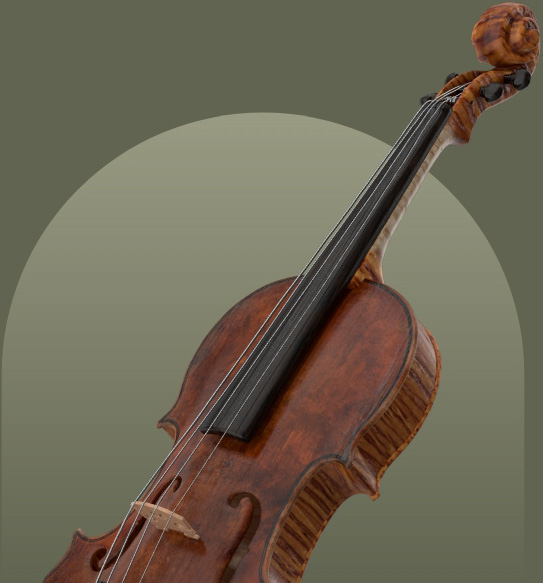
- His violins are typically large, often oversized, with full arching and a modeling style described as hasty yet deft. The large dimensions necessitated relatively low sides, though their height at the neck-end was comparable to Amati and some Stradivari instruments, while being about one-sixteenth of an inch lower at the tail-pin end. This design achieved a great volume of full and mellow tone.
- Purfling and Ornamentation
- Nearly all his instruments are double-purfled, though three violins and one viola are known with a single line. One fine violin features double purfling on the belly but only imitated purfling (drawn with pencil or ink) on the back. Instruments are often ornamented with additional purfling arabesques on the back.
- Sound Holes
- The sound holes are long, with the upper and lower circles of equal size. In his violas, they are placed higher than in violins, being short, wide, very upright, and undercut on the inner edge.
- Scrolls
- Scrolls were initially crude but evolved towards a more Cremonese definition by the end of his career.
- Varnish
- He used a beautiful varnish of a dark oxidized golden-brown. The varnish is consistently of remarkably fine quality, varying in color from a clear brown, similar to Gasparo's, to a more brilliant, transparent golden hue.
- Chronology
- His labels are never dated, making the chronology of his work largely speculative. Dendrochronology has revealed that some previously verified examples fall outside his known lifespan, suggesting his workshop continued after his death under unidentified successors.
- Early Period (First Period)
- During his early independent years, Maggini closely adhered to his teacher's models, often exhibiting inaccuracy in workmanship and less selectivity in wood choice. Sound holes displayed the serpentine line common in old violas, and he frequently inlaid his violins richly with ivory and mother-of-pearl. Characteristics included a heavy model, short blunted corners, and carelessly inlaid purfling. The head, while possessing character, was often carelessly worked, asymmetrical, with a deeply and unevenly cut face and irregular fluting. Maple wood was commonly used, often slab-cut, including for bellies, forming a link between viol and violin construction; he later adopted straight-grain cutting. Sound holes were undercut or beveled on their inside edges, similar to viols. Ornamentation sometimes included inlaid purfling, a "clover-leaf" device at the top and bottom of the back, or an elaborate design on the center of the back (the latter two never appearing on the same instrument unless a forgery).
- Middle Period (Second Period)
- In this phase, the influence of Gasparo da Salò was less pronounced, showing significant improvements in construction and workmanship. The arching was slightly higher than in his earlier or later work, typically associated with a distinct raised border. Purfling was executed with greater precision, and the sound holes, while retaining their original character, displayed more graceful curves and better cutting. The head also became more symmetrical. Wood quality was very fine, seldom slab-cut, and never for the bellies. The "Dumas" viola and violins are notable examples from this period.
- Late Period (Third Period)
- This period may have been influenced by the beautiful instruments of Antonio and Girolamo Amati, demonstrating greater accuracy and a more refined form. The purfling was distinct and finely executed, and the sound holes were well-cut and carefully finished. The arching was less pronounced, and the edges were lighter, contributing to a more graceful appearance. Scroll curves were symmetrical, and the fluting at the back of the head was less hollowed and beautifully done. Stronger corner-blocks and linings were employed internally, and thicknesses were more accurately calculated.
- Violoncellos
- His violoncellos followed a similar pattern, featuring rather high sound holes and comparatively low sides.
- Known Instruments
- The total amount of work produced by Maggini was comparatively small, with approximately fifty of his instruments believed to be extant. Only seven or eight violas, two violoncellos, and one double-bass are known, the latter being of very small size and poor workmanship. He likely also made some viols.
Influence and legacy
- Mentorship: Giovanni Paolo Maggini served as an assistant or apprentice to Gasparo da Salò from approximately 1595, as documented by a legal agreement from 1602. However, George Hart notes that the claim of him being Gasparo's pupil lacks direct authority beyond stylistic similarities in their instruments.
- Influence on Stradivari: His large, often oversized, violins with their full arching and deft modeling are considered an inspiration for Antonio Stradivari's "long pattern" instruments, produced between approximately 1690 and 1700. Stradivari is believed to have learned significantly from Maggini in the construction of both violins and violoncellos, with the latter sharing almost identical proportions.
- Influence on Guarneri: Maggini's work also exerted a strong influence on Giuseppe Guarneri del Gesù.
- Historical Significance: Giovanni Paolo Maggini is recognized as an extremely important figure in the early history of the violin.
- Market Trends: While his violas have consistently been highly sought after, the fashion for his large, dark-sounding violins reached its peak in the late 19th century.
- Imitations and Forgeries: Due to his distinctive style and the variety of his work, Maggini's instruments have been frequently imitated and forged. Unscrupulous dealers have often relabeled many 17th and 18th-century instruments, made in good faith by makers continuing the Brescian rather than the Cremonese tradition, as Maggini's work.
- Notable Players: The renowned Belgian violinist De Beriot consistently played a magnificent Maggini violin, which later sold for £600 and is now part of the Collection of Prince de Caraman-Chimay. The violinist Leonard also highly praised and used an instrument of his make.
- Family Continuity: Despite claims, there is no evidence that his son Pietro or Pietro Santo became a violin maker, as his son Pietro died in infancy and his only surviving son, Carlo Francesco, became a silk merchant. No instruments are known to have been made by any other Maggini than Giovanni Paolo.
Biographies
The overview above is drawn from the following published accounts. Read them in the original:
John Dilworth+
MAGGINI, Giovanni Paolo Born 1580 Botticino, nr Brescia, died 1632 Brescia Italy. Assistant of Gasparo da Salò from c.1595. Established independently from c.1610 in the Contrada del Palazzo Vecchio del Podesta. In 1621-1622 moved to the Bombaserie in San Agata where the family remained until his death from the plague. An extremely important figure in the early history of the violin. A memorial to him was erected in Brescia in 1907. Made far more violins than his master Gasparo and also made several smaller contralto sized violas which for many are the best violas for performance ever made. Cellos and other instruments are rarer. His large, often very oversized, violins are full arched but in the hasty but deft modelling are seen as influential not only on Guarneri del Gesù but also the inspiration for Stradivari’s ‘long pattern’ instruments of c.1690-1700. Frequently double-purfled and often ornamented with additional purfling arabesques on the back, the sound holes are long, with the upper and lower circles of equal size. Scrolls initially are crude but develop towards a more Cremonese definition towards the end of his career. Beautiful varnish of a dark oxidised golden-brown. Labels are never dated, so the chronology of his work is largely speculative. Dendrochronology has shown that some previously verified examples fall outside his known lifespan, implying that his workshop was in fact continued after his death by so far unidentified successors. While his violas have always been sought after, the fashion for his large dark sounding violins reached an apogee in the late 19th century. Maggini’s work has been often imitated and forged by makers taking advantage of the distinctive style and variety of his work. A great number of instruments made in good faith in the 17th and 18th century by makers continuing the Brescian rather than Cremonese tradition have been relabelled by unscrupulous dealers. Gio. Paolo Maggini in Brescia Paolo Maggini in Brescia
George Hart+
This famous maker followed Gasparo da Salo, and is usually counted as his pupil. There is no authority for this statement beyond the similarity of form to be traced in their respective instruments. No Italian maker is more frequently mistaken than Maggini. Any instrument having ornamentation on the back in the shape of purfled scroll-work is at once said to be by Paolo Maggini. Barak Norman, the old English maker, thus comes in for a large share of Maggini’s patronage, as also a vast number of early German makers, who adopted similar devices; to the real connoisseur, however, there is no difficulty in distinguishing the work. A more pardonable error is the confusing of Gasparo da Salo and Maggini, which is of frequent occurrence. The Double Basses of these two makers have much in common to the eye of the not deeply versed examiner. Maggini, however, was not so successful as his compeer in the selection of the form of his instruments In them we miss the harmony of outline belonging to those of Gasparo, particularly as relates to his Double Basses. Gasparo’s Violins are less harmonious in design, and evince his unsettled views as to the form they should take; a perfectly natural circumstance, when the infantile state of the Violin in his day is considered. The outline of Maggini is broad, but lacks the classic symmetry of the rare old Brescian maker. The form is flat, and the means which he adopted in order to obtain a full and telling tone were very complete. The sides are frequently shallow, and in accordance with the outline. With others who followed him, he evidently recognized the necessity of reducing the height of the sides in proportion to the dimensions of the instrument. The sound-hole is long and pointed, and admirably set in the instrument. The scroll is primitive, but boldly cut, and clearly marks an onward step from the somewhat crude production of Gasparo, the back of which is not grooved, or but slightly. Maggini’s varnish is of brown or yellow colour, and of good quality. The instruments covered with the brown varnish are often without any device on their backs, and seldom have two rows of purfling. De Beriot, the famous Belgian Violinist, used one of Maggini’s Violins, and, in consequence, their value was much increased. Leonard has one of this make, which is highly spoken of.
Cecie Stainer+
Son of Zovan or Giovanni Maggini and his wife Giulia; grandson of Ser Bertolino or Bartolommeo de Maggini of Botticino, a little village on the hills not far from Brescia; b. 1580 ; d. before or in 1632, as in a schedule presented in that year by his son Carlo he uses the words “filius quondam Johannis Pauli.” It is possible that he died of the plague that in 1632 raged in Brescia.
His parents left Botticino and settled in Brescia. Gio: Paolo was apprenticed to Gasparo da Salo, according to a legal document, dated 1602, signed by both Gasparo and Maggini, the latter calling himself “garzone” In the first period of Maggini’s work one finds much that is characteristic of the work of Gasparo ; there is the same heavy model, short blunted corners, and purfling carelessly inlaid. The head, although showing a great deal of character, is also carelessly worked, one side often differing from the other, and the face very deeply and unevenly cut, while the fluting of the back of the head is also irregular. The wood is generally maple, and is frequently cut on the slab; the wood of the bellies being also cut on the slab forms an interesting link between the viol and the violin ; afterwards he adopted the method of cutting the wood with the straight way of the grain. In the sound-holes he undercut or bevelled their inside edges like those of a viol occasionally he ornamented his violins similarly to viols, with inlaid purfling, or the “clover-leaf” device at top and bottom of the back, or with an elaborate design on the centre of the back ; the two latter ornamentations are never to be found on the same instrument, unless it is a forgery.
In the second period of his work the influence of Gasparo is not so marked; there is a great improvement in the construction and work of the instrument ; the arching is slightly higher than in his earlier or later work, and is usually associated with a pronounced raised border ; the purfling is done with more precision ; the sound-holes, though still original in character, have more graceful curves, and are better cut; so is the head, which is more symmetrical. The wood, of very fine quality, is seldom cut on the slab; and is never so cut for the bellies; the “Dumas” viola and violins are very fine specimens of this period. The beautiful instruments turned out by Antonio and Girolamo Amati may possibly have influenced the third period of his work, which shows much greater accuracy and a more beautiful form. The purfling is distinct and finely done; the sound-holes are well cut and carefully finished ; the arching is not so great, and the edges are lighter, which gives the instruments a more graceful appearance. The curves of the scroll are quite symmetrical, while the fluting at the back of the head is not so hollowed and is beautifully done. Stronger corner-blocks and linings are also used for the interior, and the thicknesses are more accurately calculated.
The varnish is always of remarkably fine quality, but varies in colour; he usually used varnish of a clear brown colour, similar to that on Gasparo’s work ; but by degrees it became more brilliant, of a transparent golden colour. Nearly all his instruments are double-purfled, but three violins and one viola are known with only one line of purfling; and also a very fine violin, which though double-purfled on the belly, has only imitated purfling on the back, the double line being drawn in with pencil or ink.
The large size of his violins makes the sides appear low, but at the neck-end their height is almost identical with that of Amati violins and some of Stradivari, though at the tail-pin end they are about one-sixteenth of an inch lower. The great length and breadth necessitated relatively low sides, and Maggini obtained exactly the right proportions for producing that great volume of tone, so full and mellow, for which his violins are famed ; their size prevented their general use, but De Beriot, the great violinist, played constantly on a magnificent specimen, which eventually was sold for £600, and is now in the Collection of Prince de Caraman-Chimay, as well as a viola and a violoncello made by Maggini.
As a rule Maggini violins are worth about £100. His violas are of very high model, the arching rises from the inner line of purfling, for the latter is, as usual, double; the border is high, and the sides are set close to the edges of the back and belly, leaving but little margin; the corners are short; the sound-holes, placed higher than in the violins, are short, wide, very upright, and undercut on the inner edge. The wood is most excellent, the varnish of very fine quality and a rich golden-brown colour; the tone is very fine. His violoncellos are made on exactly the same pattern, the sound-holes placed rather high, the sides made rather low.
Stradivari learnt much from him, both in the making of violins and of violoncellos ; the latter have almost the same proportions. Giuseppe Guarneri was another maker on whom his work exercised a strong influence. The amount of work done by Maggini was comparatively small, probably about fifty of his instruments are now existing; only seven or eight violas, two violoncellos, and one double-bass are known, the latter of very small size and of poor workmanship.
He probably made some viols as well. In England only twelve violins, six or seven violas, and one violoncello are known. The label used is; ” Gio : Paolo Maggini in Brescia.” It is never dated, a fact which often helps to expose a forgery.
Maggini married Maddalena Anna Foresto on Jan 20, 1615, and lived in the Contrada del Palazzo Vecchio del Podesta; by 1626 he had also a house and shop in Contrada delle Bombasarie. His only surviving son Carlo Francesco, became a silk merchant, and his son Pietro died in his infancy, so that there seems to be absolutely no ground for the statement that his son, Pietro, or Pietro Santo, was also a violin maker, especially as no violin, viola, or violoncello is known made by any other Maggini than the great Gio: Paolo.
Willibald Leo Lütgendorff+
Giulia (geb. 1544) und Enkel des Ser Bertolino de Maggini (geb. um 1493) aus
Botticino di sera bei Brescia. Seine Eltern waren vermuthlich Landleute, die
in die Stadt gezogen waren. Gio. Paolo’s Geburtsjahr geht auch aus einer Urkunde
von 1588 hervor, in der es von Zovan M. heisst, dass er zwei Söhne habe; der
ältere war Schuhmacher und schon verheirathet, der jüngere — unser Giovanni
Paolo — ein Knabe von sieben Jahren, der wohl bald darauf zu Gaspar da Salò
in die Lehre kam, wo er bis zu seinem 21. Lebensjahre blieb, wie aus einer
gleichfalls erhaltenen Urkunde von 1602, die Beide, der Meister und der
»Garzone« unterschrieben haben, ersichtlich ist. Am 20. Januar 1615 — damals
34jährig — heirathete er die 19jährige Maddalena Anna, Tochter des Messer
Fausto Foresto. Damals dürfte er auch das Haus in der Contrada del Palazzo
Vecchio del Podestà bezogen haben. Das ist das Wichtigste, was sich von
Maggini’s Leben ermitteln liess. Man erfährt noch, dass er sieben Kinder hatte,
von denen vier früh verstarben, und dass er um 1626 ein zweites Haus in der Contrada delle Bombasarie und mehrere Äcker etc. gekauft hat; 1632 ist
er schon gestorben. Seine Wittwe überlebte ihn bis zum 24. November 1651.
In den ersten Jahren seiner Selbstständigkeit hielt er sich ziemlich strenge an
die Modelle seines Lehrers, war häufig ungenau in der Arbeit und nicht allzu
wählerisch in Bezug auf das Holz. Die Schallöffnungen zeigen noch die bei
den alten Violen übliche Schlangenlinie; auch legte er seine Violinen allzu reich
mit Elfenbein und Perlmutter etc. ein. Später befreite er sich von dem Einflüsse
G. da Salò’s, und der Geigenbau verdankt ihm von da an gewaltige Fortschritte.
Sell your instrument with Amati
Get started by uploading photos of your instrument for our experts to review.
Sell your instrument with Amati
Get started by uploading photos of your instrument for our experts to review.
Working in Botticino at the same time
Andrea Lassigner worked 1600
Battista Doneda 1530–1610
Francesco Bertolotti 1565–1614
Gasparo Bertolotti 1540–1609
Giovita Rodiani (Rudiani) 1541–1625
Jacopo De Lafranchini worked 1614
Mathias Luchano worked 1631