
Pesaro School
Antonio Mariani
Pesaro, worked 1635–1695
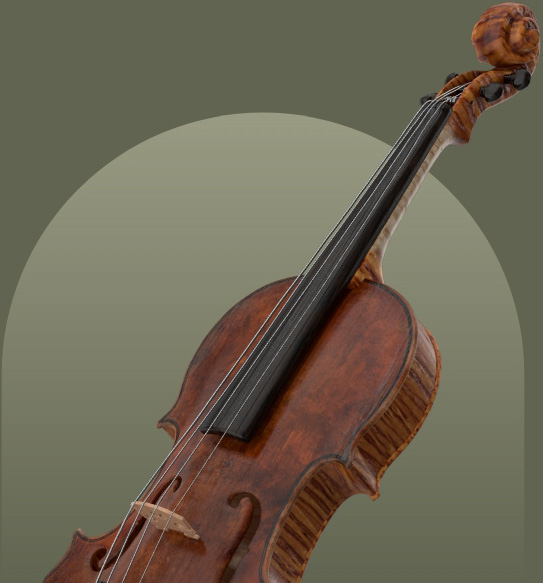
Antonio Mariani was an Italian violin maker active in Pesaro from the mid to late 17th century. His instruments are frequently compared to Brescian and Maggini styles, often featuring double purfling, but are generally characterized by a rough and unsophisticated craftsmanship, including crude inlays, unconventional scrolls, and plain materials. His production is complicated by the conversion of many instruments into 'faux Brescians,' inconsistent identification, and the use of his name on 19th-century factory instruments, with few authentic labels remaining.
Auction price history
Highest auction price
| Type | Details | Sold | Price |
|---|---|---|---|
| Violin | Bearing the remnants of an imprint of a label Antonio Mariani, Pesaro ... | May 2024 | £25,366 |
| Violin | 35.4 cm (head later) [Attributed to] | May 2011 | £6,555 |
| Violin | 35.7 cm Italy, 1750 c. [Ascribed to] | March 2011 | £22,500 |
| Violin | 35.0 cm Italy, 18th C. [Ascribed to] | October 2010 | £6,000 |
| Violin | 35.3 cm [Attributed to] | June 2008 | £9,600 |
| Cello | 75.6 cm [Attributed to] | October 2007 | £8,234 |
| Violin | 1660 c. | June 1990 | £14,300 |
| Cello | 59.4 cm 1650 c. | October 1982 | £4,853 |
| Violin | 1670 | March 1982 | £3,667 |
| Violin | 1689 | June 1980 | £6,085 |
Maker Overview
Life
Antonio Mariani (circa 1635-1695) was a violin maker active in Pesaro, Italy, with his working period generally cited as circa 1635-1695 by John Dilworth in The Brompton’s Book of Violin & Bow Makers, and about 1640 to 1700 by Cecie Stainer in A Dictionary of Violin Makers. Willibald Leo Lütgendorff, in Die Geigen- und Lautenmacher vom Mittelalter bis zur Gegenwart, notes that his period is often assumed to be nearly 100 years too early, refuting claims by Vidal, Valdrighi, and others who placed him around 1570. Lütgendorff suggests that a label date of 1619 might be a misreading of 1649. Dilworth highlights that Mariani's production is somewhat confusing, as many of his instruments have been converted into ‘faux Brescians,’ and others remain unidentified and inconsistent. Furthermore, very few of his instruments retain authentic labels, and the name 'Antonio Mariani' was also utilized for 19th-century factory instruments.
Characteristics
- Stylistic Comparisons
- Mariani's work is often compared to Brescian instruments, frequently featuring double purfling and decorative purfling designs, though John Dilworth notes no direct connection can be made. Cecie Stainer observes that his work suggests Maggini, albeit in a very rough manner, a sentiment in The Violin, who states Mariani "Worked after the manner of Maggini." Willibald Leo Lütgendorff also points out that his violins are often passed off as works by Gaspar da Salò, despite their double purfling being more reminiscent of Maggini's style.
- Decorative Elements
- The decorative inlays found on his instruments are described by Dilworth as rather crude and unimaginative.
- Scroll Characteristics
- Dilworth details that Mariani's scrolls exhibit unconventional flutings and volutes, with the central ridge broadening out to a flat triangular form at the front. Lütgendorff characterizes the scroll as "ziemlich plump" (rather clumsy).
- Model and Form
- The overall model is considered neat but unsophisticated, featuring narrow corners and similarly small wings to the soundholes.
- Material Quality
- Materials used were generally very plain. Lütgendorff describes the wood as "unschön und gewöhnlich" (unattractive and common).
- F-Holes
- Willibald Leo Lütgendorff observes that the F-holes are roughly cut with a knife ("roh mit dem Messer ausgeschnitten").
- Varnish
- His instruments typically feature a dark oxidised brown varnish, which Dilworth assesses as of good quality but not comparable to contemporary Cremonese or Brescian recipes.
- Overall Craftsmanship
- Cecie Stainer states his instruments are "not of much value" and "very rough." Lütgendorff describes his work as "recht mittelmässig" (rather mediocre).
- Antonius de Marianis
fecit Pisauri anno 1638John Dilworth - Antonius Marianus
fece in Pesaro Anno 1680John Dilworth - Antonio Mariani
in Pesaro 1673John Dilworth - Antonio Mariani
Pesaro, 1646John Dilworth - Antonio Mariani
fecit anno 1694John Dilworth
Biographies
The overview above is drawn from the following published accounts. Read them in the original:
John Dilworth+
MARIANI, Antonio Worked circa. 1635-1695 Pesaro Italy. Often compared to Brescian work frequently having double purfling and decorative purfling designs, but no direct connection can be made. The decorative inlays are rather crude and unimaginative. The scrolls having unconventional flutings and volutes. The central ridge broadens out to a flat triangular form at the front of the scroll. The model is neat but unsophisticated, with narrow corners and similarly small wings to the soundholes. Materials generally very plain. Dark oxidised brown varnish, of good quality but not approaching contemporary Cremonese or Brescian recipes. His production is a little confusing since many have been converted into ‘faux Brescians’ and others remain unidentified and inconsistent. Very few retain authentic labels. The name has also been used in 19th century factory instruments. Antonius de Marianis / fecit Pisauri anno 1638 Antonius Marianus / fece in Pesaro Anno 1680 Antonio Mariani / in Pesaro 1673 Antonio Mariani / Pesaro, 1646 Antonio Mariani / fecit anno 1694
George Hart+
Worked after the manner of Maggini.
Cecie Stainer+
A maker in Pesaro about 1640 to 1700. His instruments are not of much value; the work suggests Maggini, but is very rough ; the purfling is generally double.
Labels: “Antonio Mariani Pesaro, 1646,” found in an alto,
and ” Antonio Mariani fecit, anno 1694.”
Willibald Leo Lütgendorff+
Seine Zeit wird gewöhnlich fast um 100 Jahre zu früh angenommen; Vidal, Valdrighi u. A. setzen ihn in das Jahr 1570. Dagegen sprechen sowohl seine Geigen als auch seine Zettel. Wenn auf diesen 1619 zu lesen ist, so scheint diese Zahl aus 1649 entstanden zu sein. Übrigens ist seine Arbeit recht mittelmässig,
das Holz unschön und gewöhnlich; die F-Löcher sind roh mit dem Messer
ausgeschnitten, die Schnecke ziemlich plump. Seine Geigen werden gern für
Arbeiten Gaspar da Salò’s ausgegeben, obwohl sie wegen ihrer doppelten Einlagen
eher an Maggini’s Stil erinnern. Er verwendete verschiedene Zettel.
Sell your instrument with Amati
Get started by uploading photos of your instrument for our experts to review.
Sell your instrument with Amati
Get started by uploading photos of your instrument for our experts to review.
Family
Fabio Mariani Son
Working in Pesaro at the same time
Carlo Cortesi worked 1612
Fabio Mariani worked 1679
Gasparo Assalone worked 1695–1740
Ludovico Mariani worked 1690–1702
Steffano Forni worked 1666