
Italy School
Vincenzo Trusiano Panormo
London, Monreale, Paris, c.1734–1813
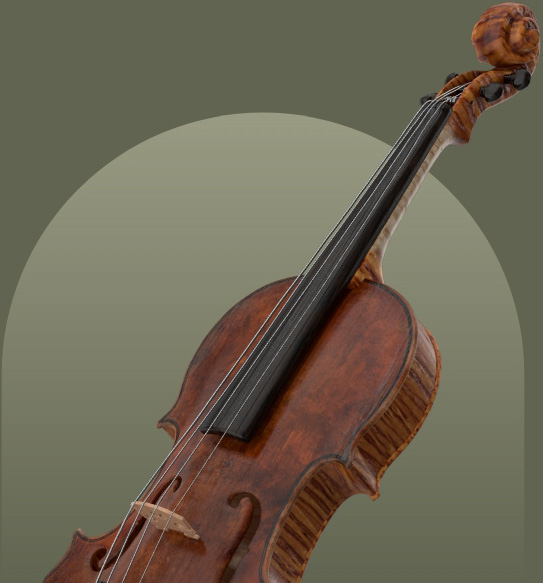
Vincenzo Trusiano Panormo (circa 1734-1813) was an influential Italian luthier, born in Monreale, Sicily, who became a pivotal figure in English violin making. The son of instrument maker Gaspare Trusiano, he adopted the name Panormo from Palermo, his original place of work. Panormo's career was marked by extensive travel, with periods spent in Rome, Naples, Marseilles, Paris, Dublin, and London, where he worked for figures like John Betts. Despite a restless temperament and often challenging working conditions, including using employer-supplied materials of varying quality, he was instrumental in shifting London makers' focus from the Stainer model to Cremonese masters like Stradivari. His craftsmanship is noted for its refinement, delicate heads, low-arched models, and well-cut sound-holes and scrolls, with a preference for golden-yellow varnish. His instruments, particularly his prized basses and sought-after cellos, are highly valued for their pure and noble tone, solidifying his legacy as one of the most successful copyists of the great Cremonese tradition.
Auction price history
Highest auction price
| Type | Details | Sold | Price |
|---|---|---|---|
| Violin | Labelled Vincent Panormo, rue de l'Arbre-Sec. Paris, 1779 | October 2024 | £70,800 |
| Violin | 35.9 cm [Attributed to] | May 2011 | £15,295 |
| Viola | 39.4 cm London, Early 19th C. [Ascribed to] | March 2011 | £14,400 |
| Violin | 36.0 cm mid-19th C. [Attributed to] | March 2011 | £6,250 |
| Violin | 35.8 cm Early 19th C. [Attributed to] | October 2010 | £11,266 |
| Violin | 35.9 cm [Probably by] | June 2010 | £13,200 |
| Cello | 73.4 cm London, 1810 c. | October 2009 | £8,750 |
| Violin | 36.2 cm [Attributed to] | October 2008 | £6,508 |
| Violin | 35.4 cm 1784 c. [Attributed to] | October 2008 | £11,005 |
| Violin | 36.2 cm [Attributed to] | May 2007 | £4,032 |
| Violin | 35.7 cm London, 1790 c. (the front probably later) | November 2006 | £28,800 |
| Violin | 35.5 cm [Attributed to] | November 2006 | £16,468 |
| Viola | 39.5 cm London, 1800 c. | November 2005 | £39,475 |
| Violin | [Attributed to] | October 2005 | £4,585 |
| Violin | Panormo, 1790 c. | November 2004 | £20,315 |
| Violin | 1780 c. | November 2003 | £19,975 |
| Violin | 1785 | October 2002 | £19,954 |
| Violin | 1762 | July 2000 | £44,200 |
| Violin | 1797 | June 2000 | £26,450 |
| Violin | 1760 c. | November 1998 | £23,000 |
| Violin | 1780 | November 1997 | £34,675 |
| Violin | 1800 c. | June 1997 | £20,700 |
| Violin | 1800 c. | March 1997 | £26,450 |
| Violin | 1880-99 | March 1997 | £24,150 |
| Violin | 1800 c. | November 1996 | £28,750 |
| Viola | 40.0 cm 1774 | November 1994 | £21,656 |
| Violin | 1810 c. | November 1994 | £19,550 |
| Violin | 1791 | November 1992 | £33,000 |
| Violin | 1790 c. | June 1992 | £25,300 |
| Violin | 1760 c. | June 1991 | £24,200 |
| Viola | 39.5 cm 1800 c. | November 1990 | £27,500 |
| Violin | 1790 c. | November 1990 | £33,000 |
| Violin | 1790 c. | June 1990 | £12,100 |
| Violin | 17-- | June 1990 | £30,800 |
| Violin | 1800 c. | March 1989 | £34,100 |
| Viola | 40.2 cm 1780-99 | November 1983 | £14,300 |
| Viola | 40.2 cm 1800 c. | November 1981 | £4,620 |
Maker Overview
Life
Vincenzo Trusiano Panormo (circa 1734-1813) was born in Monreale, Sicily, Italy, and died in London, UK., he is thought to be the son of Gaspare Trusiano, who was known as a musical instrument maker with at least one extant double bass. Vincenzo adopted the name Panormo after leaving Sicily, deriving it from the Latin name of Palermo, his original place of work. Sources contain conflicting information about his birth year; while John Dilworth states circa 1734, Cecie Stainer provides November 30, 1734, and Willibald Leo Lütgendorff notes that earlier misreadings led to a belief of 1705. He began making various kinds of musical instruments at the age of sixteen without aid. Panormo travelled widely throughout his career; his first son, François, was born in Rome in 1763, and his second son, Joseph, was born in Naples in 1767. A business named Panormo e Figli existed in Naples up to the 19th century. He worked in Marseilles before arriving in Paris before 1781. He may also have worked briefly in London and Dublin in the 1770s. By 1789, he was established in Dublin, possibly employed by Thomas Perry, and by 1791, he was in London, where he remained as an assistant to John Betts. George Hart describes Panormo as having a restless temperament, which led to continual self-imposed changes and prevented his reputation from growing steadily in one place. He often moved from city to city, hoping to find patronage, a course that Hart suggests may have robbed his work of the attention an undisturbed mind could bestow. His life was a continuous battle with adversity, often forcing him to work for bare sustenance and to satisfy daily wants by slaving at tasks that brought him little credit. He was frequently obliged to manufacture instruments for employers using materials they selected, which were often of poor quality, and to complete work within given timeframes, sometimes against his own wishes.
Characteristics
- Initial Craft
- Vincenzo Trusiano Panormo was originally a maker of woodwinds and stringed instruments in general, with several extant woodwind instruments bearing his brand. An early double bass also exists with his manuscript label 'Vincenzo Trusiano'.
- Model Evolution
- He was a hugely important figure in English violin making, transforming the habits of London makers from a loyalty to the Stainer model to a focus on Cremonese work, particularly that of Stradivari. While he had his own model, he preferred to imitate Stradivari, Guarneri, and Amati, especially the larger models.
- Workmanship
- His work is described as very refined, with a particularly delicate head, a low-arched model, and finely detailed yet subtle characteristics. His workmanship is considered lighter and more graceful than that of Lupot. The sound-holes are admirably cut, and the scroll is well carved. However, his work is also varied; his Paris work reflects local influences, being slightly heavier and 'Mirecourtian', while in London, he was likely encouraged by Betts to make closer copies of Stradivari and Amati. He sometimes omitted the hollow groove, simply rounding the edge.
- Materials
- Materials were inconsistent; sometimes very plain wood was used, and various types of purfling. Generally, he used good wood, but when working for the trade, he often had to use wood of bad quality supplied by his employers. He famously converted an old maple billiard table found in Ireland into a number of beautiful instruments.
- Varnish
- The varnish is always fine, though of different shades and textures. It is often golden-yellow, sometimes reddish, and described as a clear yellow colour.
- Instrument Specialization
- His cellos are much sought after but relatively rare. His basses are particularly prized and recognized as among the most desirable of any but the Brescians, featuring very fine modelling and arched backs. His violins, violoncellos, and double-basses are all much liked for the pure and good quality of their tone. His guitars also have a high reputation.
Influence and legacy
- Family Tradition: His father, Gaspare Trusiano, was a known musical instrument maker, indicating a family tradition in the craft.
- Mentorship: He is believed to have worked for a short time in Cremona, possibly under Bergonzi, whom he sometimes approached in style.
- Impact on London Makers: Panormo's experience was instrumental in transforming the habits of London makers, shifting their focus from the Stainer model to Cremonese work in general, and Stradivari in particular.
- Descendants: He had several sons who also became violin makers.
- Artistic Recognition: Vincenzo Trusiano Panormo is considered one of the most successful followers of Antonio Stradivari, sharing acclaim with Lupot as a copyist of the great Cremonese master. His natural gifts possessed a vitality that could not be entirely suppressed, and he bequeathed some of the finest specimens of the copyist's art.
- Market Value: His violins now achieve high prices due to their almost consistently large and noble tone. His instruments are highly regarded for their pure and good quality of tone.
- Collections: A violin made by him, dated Paris 1810, is part of the Snoeck collection.
Biographies
The overview above is drawn from the following published accounts. Read them in the original:
John Dilworth+
PANORMO, Vincenzo Trusiano Born circa. 1734 Monreale, Sicily Italy, died 1813 London UK. Thought to be the son of Gaspare Trusiano, who is known as a musical instrument maker with at least one double bass extant. Adopted the name Panormo after leaving Sicily, from the Latin name of Palermo, his original place of work. Originally a maker of woodwinds and stringed instruments in general; there are several woodwind instruments extant with his brand. An early double bass exists with his manuscript label ‘Vincenzo Trusiano’. Travelled widely: first son François born in Rome 1763; second son Joseph was born in Naples 1767. A business by the name Panormo e Figli existed in Naples up to the 19th century. Worked also in Marseilles before arriving in Paris before 1781. May also have worked briefly in London and Dublin in the 1770s. By 1789 established in Dublin, possibly employed by Thomas Perry, and by 1791 was in London where he remained as an assistant to John Betts. A hugely important figure in English violin making, his experience transformed the habits of London makers previously loyal to the Stainer model into a focus on Cremonese work in general and Stradivari in particular. Very refined work, with a particularly delicate head, low-arched model, finely detailed yet with subtleties of character. It is also very varied, with his Paris work reflecting influences there, being slightly heavier and a little Mirecourtian, with golden-yellow varnish, while in London he was probably encouraged by Betts to make closer copies of Stradivari and Amati work. Materials and varnish are likewise inconsistent: sometimes very plain wood used and various types of purfling but the varnish is always fine, though of different shades and textures. Cellos are much sought after but relatively rare. Basses are particularly prized and recognised as amongst the most desirable of any but the Brescians: very fine modelling and arched backs. His own labels are relatively rare, since a great deal would have been done for employers. Some branded beneath the saddle on the lower rib: ‘V.P.’ Vincenzo Panormo/ London 1797 Vincenzo Trusiano Panormo fecit Parisiis, anno 17.. Vincent Panormo, rue de l’Arbre-sec à Paris, 17.. Vincenzo Panormo me fece Marsiglia Vincenzo Panormo London 1791 Vincenzo Panormo di Palermo fecit anno 17.. Vincenzo Panormo dit Palermo Fecit Anno 17.. [BVMA]
Willibald Leo Lütgendorff+
Durch den Zufall, dass einige Jahreszahlen in seinen Geigen falsch gelesen
wurden, war seine Geschichte lange Zeit völlig unaufgeklärt, und da man sein
Geburtsjahr auf 1705 setzen zu müssen glaubte, so musste man aus dem einen
Manne zwei Geigenmacher machen. Dass er aus Palermo gewesen sei, nahm
man immer an, denn abgesehen davon, dass schon sein Name darauf hinweist
(der antike Name von Palermo war ????????), brachte er auf seinen Zetteln auch
gerne das Wappen von Palermo an. Er soll in Cremona gearbeitet haben —
vielleicht bei Bergonzi, dem er manchmal nahe kommt —, auch in Turin und
dürfte sich um 1750 in Paris niedergelassen haben, nachdem er vorher in Marseille
gewesen war. Im Jahre 1772 kam er zuerst nach London und ging dann
wieder nach Paris zurück, wo er von 1783—1789 in der Rue de Chartres No. 70
wohnte. Vorher und nachher war seine Werkstatt in der Rue de l’Arbre-Sec.
Von London aus unternahm er auch eine Kunstreise nach Dublin, die dadurch
bemerkenswerth wurde, dass er bei dieser Gelegenheit eine alte Billardtafel von
bestem Ahornholz fand, aus der er eine grosse Zahl trefflicher Geigen machte.
Es scheint, dass er abwechselnd in London und Paris lebte, vielleicht hatte er
sogar mit Hilfe seiner Sohne zwei Werkstätten im Gange. Er hielt sich an
seine italienischen Vorbilder, schnitzte sehr hübsche Schnecken und F-Löcher,
und wenn er auch ein eigenes Modell hatte, so ahmte er doch Stradivari und
Bergonzi etc. am liebsten nach. Er bevorzugte dabei die grösseren Modelle,
verwendete meist gutes Holz und einen hübschen gelben, manchmal röthlichen
Lack. Seine Arbeit ist gut, nur lässt er oft die Hohlkehle fehlen und rundet
einfach den Rand ab. Da der Ton fast immer gross und edel ist, erreichen seine
Violinen jetzt hohe Preise. Er hatte verschiedene Zettel und manchmal auch
einen Brandstempel im Gebrauch. Er hatte mehrere Söhne, die Geigenmacher
wurden. Eine Geige von ihm in der Sammlung Snoeck ist aus Paris 1810
datirt, mit der Adresse Rue de l’Abre sec.
George Hart+
This maker was one of the most successful followers of Antonio Stradivari. Panormo and Lupot share the palm as copyists of the great Cremonese master. Neither appears to have attempted to create a model of his own ; their sole aim was to imitate to the utmost the various patterns of Stradivari, Guarneri, and Amati, but they principally confined themselves to Stradivari. Vincenzo Panormo left Italy in early life, and settled for a short time in Paris, from which city a few of his instruments are dated. From Paris he removed to London, where he remained many years. He also visited Ireland, where he made, it is said, several beautiful instruments from an old maple billiard-table, with which he was fortunate enough to meet. He was of a restless temperament, which showed itself in continual self-imposed changes. He would not, or could not, permit his reputation to grow steadily, by residing long in one place, but as soon as fame was within his grasp, he sacrificed the work of years by removing to an entirely new field of labour. Panormo furnishes us with another example of the certain appreciation, sooner or later, of exceptional talents. No matter how trifling the circumstances under which gifted men have laboured, some time or other their genius is discovered, and acknowledged with its due award, if not of fortune, at least of fame. The peculiar circumstances under which Panormo lived would have been sufficient in the case of most men to dwarf all efforts. Unable to obtain readily that patronage to which his abilities justly entitled him, he removed from city to city, hoping to discover a resting-place, in which favour might attend his art. No doubt this was a mistaken course, and one which robbed his work of the attention which a mind undisturbed by the care of existence can bestow; nevertheless his natural gifts had a vitality that-could not entirely be suppressed. He worked and toiled for his art and for bare sustenance alternately. His life, like that of many others in the paths of literature and science, was n continued battle with adversity. Such persons are forced to satisfy daily wants by slaving at work which brings them but little credit in after time, and becomes a standard by which they are too often erroneously judged. Vincenzo Panormo was the slave of many, manufacturing Double Basses and other instruments from the material selected and purchased by his temporary employer, oft-times compelled to carry out some crotchet of the patron much against his own wishes. The wood thus forced upon him was often of the worst description ; and in addition, he was frequently obliged to complete his work within a given time. Instruments manufactured under such conditions can scarcely, it may be supposed, add to their makers’ reputation. We cannot but regret that he should have been obliged to waste himself on such poor materials. Fortunately, however, in some cases he found time to exercise his skilful powers to their full extent, and has thus bequeathed to us some of the finest specimens of the copyist’s art. His workmanship is of a lighter description than that of Lupot, and is, therefore more graceful. The sound-hole is admirably cut, and the scroll also well carved.
Cecie Stainer+
b. Nov. 30, 1734, Monreale, a village near Palermo, Sicily ; d. 1813, London. When only sixteen he began, without aid, to make various kinds of musical instruments. He went to Cremona for a short time and probably worked there under Bergonzi. About 1753 went to Paris; in 1772 made a short visit to England; 1783-89, was again living at 70, rue de Chartres, Paris, but soon after removed to London. He also worked in Ireland for a short time, and there converted a maple-wood billiard table into some very beautiful instruments.
He was a remarkably good workman, especially in his fine copies of the Stradivari pattern; his instruments were rather small, the sound-holes and scrolls well cut, the varnish a clear yellow colour, sometimes rose ; the tone is very fine. A few violoncellos made on the Stradivari pattern are generally of handsome maple-wood for the back and ribs, and have an extremely rich and powerful tone. His violins, violoncellos, and double-basses are all much liked for the pure and good quality of their tone; his guitars have a high reputation. Some of his work is poor, but he made a good many instruments for the trade, using the wood (often of bad quality) supplied by his employers, and generally had to finish these instruments within a given time.
Labels : “Vincent Panormo, rue de l’Arbre-sec a Paris, 1730 ” ; a similar label is dated 1780 ;
Sell your instrument with Amati
Get started by uploading photos of your instrument for our experts to review.
Sell your instrument with Amati
Get started by uploading photos of your instrument for our experts to review.
Working in London at the same time
(Parisse) Claude Paris worked 1770–1814
(Perrault) Perault worked 1770–1790
(Prevot) Charles Prevost worked 1775–1789
Adam Martin worked 1790–1798
Alexander Kennedy worked 1730–1785
Ambroise worked 1750–1810
And Co. Astor worked 1800–1820
Andrea Castagneri worked 1730–1762