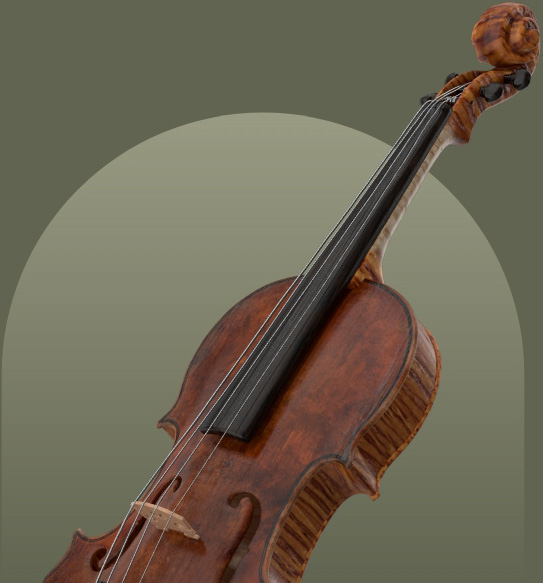
Largoward School
John Raeburn
Largoward, 1833–1910
John RAEBURN (1833-1910) was a Scottish violin maker born in Carnbee, Fifeshire. Initially a miner, he developed an interest in violin making through his father's influence as a violinist. Starting his craft in the early 1860s, he became known for producing over 100 instruments, primarily violins, often utilizing Stradivari and Guarneri models. His workmanship was refined, characterized by careful finishing and a distinctive oil varnish, though descriptions of its exact colour vary across sources. Raeburn was recognized with bronze medals at the Glasgow and Edinburgh Exhibitions and was considered the most successful maker in his family, which included his brothers Alexander and George. He was also noted for his talents as a painter and poet.
Auction price history
Highest auction price
3 results
| Type | Details | Auction house | Sold | Price |
|---|---|---|---|---|
| Violin | Bearing the maker's label, two-piece back Lot 1028 | McTear's | January 2024 | £372est. £ 400-600 |
| Violin | 1906 | — | October 1993 | £682 |
| Violin | 1897 | — | September 1991 | £1,100 |
No results match those filters.
Maker Overview
Life
John RAEBURN (1833-1910) was born on February 19, 1833, in the Parish of Carnbee, Scotland. He was the son of a miner and initially began his career in mining. His father, however, was also a skilled violinist who taught John to play the violin at an early age. This early exposure to music soon sparked his interest in violin making. Encouraged by amateurs, he began his first attempts at instrument creation, making his first violins in the early 1860s, with John Dilworth noting his work from 1856. Through diligent study and innate skill, he established himself as one of Scotland's finest violin makers. He was the eldest brother of fellow makers Alexander and George Raeburn. Beyond his primary profession, Raeburn was also a talented painter and poet. His biography can be found in The Strad and The People's Journal (August 16, 1902).
Characteristics
- Production
- John Raeburn is credited with making over 100 instruments, specifically about one hundred violins, and also repaired a large number of instruments. He worked carefully, producing only five violins per year.
- Models
- He utilized various models, primarily those of Stradivari and Guarneri, often employing a good Stradivari pattern.
- Workmanship
- His workmanship is described as being of good average merit and quite refined in style. The narrow edge and crudely managed purfling corners are noted by John Dilworth as the only elements that might betray his amateur status. His instruments were particularly well finished.
- Varnish
- Sources contain slightly differing descriptions of his varnish. He used a brown or gold-yellow oil varnish. William Meredith Morris notes he used his brother's varnish, which was of a golden orange colour. John Dilworth describes it as a fine and carefully applied red-brown oil varnish.
- Tone
- The tone of his instruments is considered good.
- John Raeburn Maker Largoward
St. Andrews
1902John Dilworth
Influence and legacy
- Early Training: John Raeburn's father, a skilled violinist, taught him to play the violin early in life, which fostered his interest in instrument making.
- Encouragement: He was encouraged by amateurs to begin his violin making endeavors.
- Family Connection: He was the eldest brother of Alexander and George Raeburn, both of whom were also violin makers.
- Awards: John Raeburn received several exhibition medals, including bronze medals at the Glasgow and Edinburgh Exhibitions.
- Reputation: He was highly regarded locally and is considered the most successful maker of his family.
Biographies
The overview above is drawn from the following published accounts. Read them in the original:
John Dilworth+
RAEBURN, John Born 1833, Worked from 1856, died 1910 Largoward, Fifeshire, Scotland UK. Eldest brother of Alexander and George Raeburn. Miner, violinist, and part-time violin maker. The most successful maker of the family, credited with over 100 instruments on various models, but often using a good Stradivari pattern. Quite refined in style, the narrow edge and crudely managed purfling corners are the only betrayal of his amateur status. Particularly well finished, with a fine and carefully applied red-brown oil varnish. Awarded bronze medals at Glasgow and Edinburgh Exhibitions. Highly regarded locally. John Raeburn Maker Largoward / St. Andrews / 1902
William Meredith Morris+
He was born in the Parish of Carnbee, Feb. 19, 1833, and is the eldest brother of the Alexander and George Raeburn previously mentioned. He has made about one hundred violins on the usual models, and also repaired a large number of instruments. The workmanship is of good average merit, and the tone good. He uses his brother’s varnish, which is of a golden orange colour.
George Hart+
Ein Grossneffe des berühmten schottischen Malers Henri Raeburn und selbst ein geschickter Maler und Dichter etc. neben seinem Berufe als Geigenmacher. Er war der Sohn eines Bergmanns und begann auch als solcher seine Laufbahn. Sein Vater war aber nebenbei ein tüchtiger Geiger und unterrichtete ihn frühzeitig im Violinspiel. So kam es bald, dass er sich für das Geigenmachen interessirte. Von Liebhabern ermuntert, wagte er seine ersten Versuche, und im Anfang der 60er Jahre machte er seine ersten Geigen. Eifriges Studium und eine angeborne Geschicklichkeit halfen ihm dabei; jetzt gilt er als einer der besten schottischen Geigenmacher und erhielt mehrere Ausstellungsmedaillen. Er benutzt verschiedene Modelle, hauptsächlich aber die des Stradivari und des Guarneri. Er arbeitet sorgfältig, macht im Jahre nur fünf Geigen und verwendet braunen oder goldgelben Öllack. Seine Biographie findet sich in »The Strad«, ferner in The People’s Journal (16. Aug. 1902) etc.
Sell your instrument with Amati
Get started by uploading photos of your instrument for our experts to review.
Sell your instrument with Amati
Get started by uploading photos of your instrument for our experts to review.