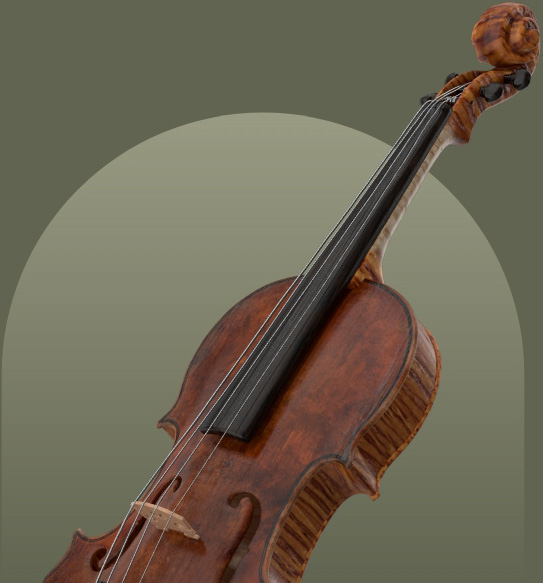
Sebastian (I) Rauch
worked 1707–1725
Sebastian (I) Rauch was a notable violin maker believed to have originated from Augsburg. After working for Schelle in Nuremberg, he established himself in Prague, gaining citizenship in 1700. He was highly esteemed for his craftsmanship, which featured original forms and a particularly beautiful yellow varnish, though sources offer conflicting descriptions of his arching. His activity in Prague is documented until around 1724-1725, with later years and locations (Hamburg, Leitmeritz) being subject to conflicting historical accounts. He had two sons, Joseph and Thomas, who also became violin makers.
Maker Overview
Life
Sebastian (I) RAUCH is believed to have originated from Augsburg and arrived in Prague after having worked previously for Schelle in Nurembergütgendorff's Die Geigen- und Lautenmacher vom Mittelalter bis zur Gegenwart. He resided in Malá Strana (Kleinseite) and obtained citizenship on September 7, 1700, having married Anna Marie, the widow of violin maker Pürtzel, on June 6 of the same year. He quickly gained considerable esteem and was a very capable master. His activity in Prague can be traced until 1724; Lütgendorff suggests he appears to have died then, unless one assumes he emigrated, for which there was no discernible reason. However, violins purportedly made by a Sebastian Rauch in Hamburg in 1725 exist, though a Sebastian Rauch cannot be documented in Hamburg. As the name Sebastian Rauch was also borne by several other violin makers, even if such documentation were found, identification with the Prague master would be difficult to establish. Cecie Stainer's A Dictionary of Violin Makers states that he is said to have worked in Hamburg around 1725 and in Leitmeritz, Bohemia, from 1742 to 1763. John Dilworth, in The Brompton's Book of Violin & Bow Makers, notes his work in Prague, Czech Republic, circa 1707-1725, and in Hamburg, Germany, from 1725. Dilworth also suggests he was probably born in Augsburg and worked for Schell in Nuremberg before establishing himself in Prague around 1707. Sources contain conflicting information regarding his later years and locations; while Lütgendorff suggests his activity in Prague ended around 1724, Stainer mentions work in Hamburg around 1725 and Leitmeritz from 1742-1763, and Dilworth indicates activity in Hamburg from 1725.
Characteristics
- Workmanship
- ütgendorff, his work was sometimes unrefined in form but always original. He frequently adopted a flatter arching than his contemporaries. His yellow varnish, however, was particularly beautiful, and he undoubtedly understood how to calculate tone excellently.
- Arching
- Cecie Stainer, however, describes his instruments as "much arched" and notes that "the work was not carefully finished." John Dilworth also describes his work as having a "high arch." Sources contain conflicting descriptions of his arching; Lütgendorff states he used a flatter arching, while Stainer and Dilworth describe his instruments as having a "much arched" or "high arch."
- Varnish
- Henri Poidras highlights his "original model which fortunately has an extremely effective yellow varnish."
- Known Instruments
- A violin from 1714 is owned by the Ossegg Abbey, and another was exhibited at the Prague ethnographic exhibition of 1895. The Prague Kreuzherrenkirche possesses a double bass from 1713. John Dilworth also mentions a double bass dated 1713 located in Prague Cathedral.
- Sebastian Rauch Lauthen- und / Geigenmacher in Pra.g / im Jahr 1710John Dilworth
- Sebastianus Rauch Pragensis / fecit Anno 1707John Dilworth
Influence and legacy
- Training: He worked for Schelle in Nuremberg before establishing his own workshop in Prague.
- Family: He had two sons, Joseph and Thomas.
Biographies
The overview above is drawn from the following published accounts. Read them in the original:
John Dilworth+
Sebastian (I) Worked circa. 1707-1725 Prague Czech Republic, Worked from 1725 Hamburg Germany. Probably born in Augsburg. Worked for Schell in Nuremberg. Established in Prague c.1707. Active in Hamburg from 1725. Good work with high arch and fine varnish. Double bass dated 1713 in Prague Cathedral. Sebastian Rauch Lauthen- und / Geigenmacher in Pra.g / im Jahr 1710 Sebastianus Rauch Pragensis / fecit Anno 1707
Cecie Stainer+
Is said to have worked in Hamburg about 1725, and in Leitmeritz, in Bohemia, 1742-63. His instruments were much arched, and the work was not carefully finished.
Willibald Leo Lütgendorff+
Er soll aus dem Augsburgischen stammen und nach Prag gekommen sein, nachdem er vorher bei Schelle in Nürnberg gearbeitet hatte. Er wohnte auf der Kleinseite, und erlangte am 7. Sept. 1700 das Bürgerrecht, nachdem er schon am 6. Juni desselben Jahres Anna Marie, die Wittwe des Geigenmachers Pürtzel, geheirathet hatte. Er kam bald zu grossem Ansehen und war ein sehr tüchtiger Meister. Er hatte zwei Söhne: Joseph und Thomas. Seine Thätigkeit lässt sich in Prag bis 1724 verfolgen; er scheint dann gestorben zu sein, wenn man nicht annehmen will, dass er ausgewandert ist, wozu er keinen erkennbaren Grund gehabt hatte. Immerhin kommen Geigen vor, die von einem Sebastian Rauch in Hamburg 1725 gefertigt sein sollen. In Hamburg aber lässt sich ein Seb. Rauch urkundlich nicht nachweisen. Da der Name Sebastian Rauch obendrein von mehreren Geigenmachern geführt wurde, konnte, selbst wenn ein solcher Nachweis gelänge, die Identität mit dem Prager Meister nicht leicht festgestellt werden. Seine Arbeit ist manchmal unschön in der Form, immerhin aber originell; auch nahm er die Wölbung häufig flacher, als seine Zeitgenossen; besonders schon ist jedoch sein gelber Lack, und den Ton verstand er zweifellos vortrefflich zu berechnen. Eine Geige von ihm aus dem Jahre 1714 besitzt das Stift Ossegg, eine andere war auf der Prager ethnographischen Ausstellung von 1895 zu sehen. Einen Contrabass von 1713 besitzt die Prager Kreuzherrenkirche.
Henri Poidras+
Prague circa. 1730. Original model which fortunately has an extremely effective yellow varnish.
Sell your instrument with Amati
Get started by uploading photos of your instrument for our experts to review.
Sell your instrument with Amati
Get started by uploading photos of your instrument for our experts to review.