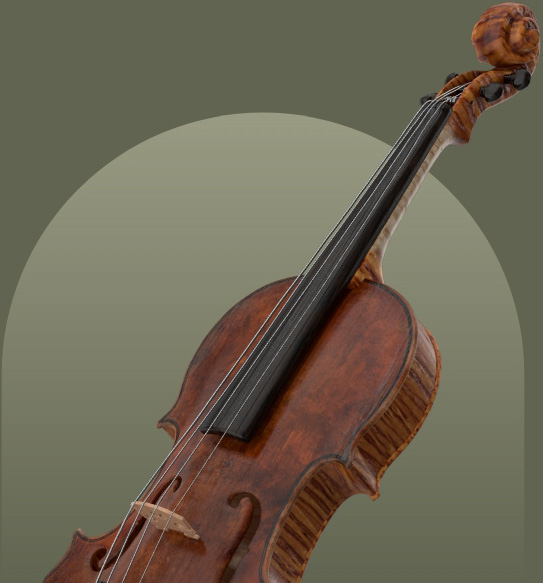
Giovanni Battista Rugeri
1653–1711
Giovanni Battista Rugeri (1653-1711) was a Cremonese luthier, the son, pupil, and assistant of Francesco Rugeri. His instruments, though few are authenticated, are recognized for their sophisticated craftsmanship within the Rugeri tradition, often featuring a deeper red or dark brown varnish. He made large-pattern violoncellos and instruments in the Amati style, which are highly valued. While primarily associated with Cremona, conflicting sources suggest he may have worked until 1723 or later and resided in Brescia for many years. He was also known as "Bononiensis" due to his Bologna citizenship and may have worked in the Amati shop.
Maker Overview
Life
Giovanni Battista RUGERI (1653-1711) was born in Cremona, the son, pupil, and assistant of Francesco Rugeri. in The Brompton's Book of Violin & Bow Makers, very few authenticated instruments bear his label. Vincenzo Lancetti states that Giovanni Battista Rugeri called himself "Bononiensis," referring to his status as a citizen of Bologna in The Violin. Sources contain conflicting information regarding his working period and location; John Dilworth indicates his death in 1711 in Cremona, while Count Cozio di Salabue and Lancetti suggest he worked until 1723 or later and lived for many years in Brescia. He appears to have worked from about the close of the seventeenth century.
Characteristics
- Workmanship
- Instruments attributed to Giovanni Battista Rugeri are described by John Dilworth as very sophisticated and beautifully made, adhering to the Rugeri tradition without significant departures in style or craftsmanship.
- Varnish
- Some of his instruments feature a deeper red varnish than is typically associated with Francesco Rugeri. Cecie Stainer notes that his violoncellos generally had dark brown varnish of good quality.
- Modeling
- George Hart observes that his instruments are of a different pattern to those of Francesco, being higher modeled.
- Violoncellos
- Cecie Stainer highlights that he made several violoncellos of a large pattern, which were rather arched and generally constructed from plain wood.
- Sound Holes & Scroll
- Cecie Stainer states that both the sound holes and the scroll on his instruments were cut wider than in Amati work. George Hart adds that the sound-holes were less elegant and the scroll heavier compared to Francesco's work.
- Pattern
- Instruments he made of a large Amati pattern are highly valued.
- Gio. Battista Rugier detto il per / fecit Cremonae Anno 16..John Dilworth
Influence and legacy
- Mentorship: Giovanni Battista Rugeri was the son, pupil, and assistant of Francesco Rugeri.
- Collaboration: He may have worked in the shop of Amati, as suggested by instruments bearing original Amati labels of his make.
- Value: His instruments possess high merits and command prices nearly equivalent to those of Francesco Rugeri's instruments.
Biographies
The overview above is drawn from the following published accounts. Read them in the original:
John Dilworth+
RUGERI, Giovanni Battista Born 1653, died 1711 Cremona Son, pupil, and assistant of Francesco Rugeri, above. Very few authenticated instruments with his label, but these seem to be very sophisticated and beautifully made in the Rugeri tradition. No particular departures in style or craftsmanship, although some with deeper red varnish than is associated with Francesco, above. Gio. Battista Rugier detto il per / fecit Cremonae Anno 16..
Cecie Stainer+
Son of Francesco Ruggeri; b. in Cremona. His work is similar to that of his father, but has not the same value he made several violoncellos of large pattern rather arched, generally of plain wood and with dark brown varnish of good quality, both the sound holes and the scroll were cut wider than in Amati work. Label,’ ‘Giacinto filio di Francesco Ruggeri detto il Per 1696 ‘ ; another was dated 1692.
George Hart+
The word Bon after his name refers to his having been a citizen of Bologna. Vincenzo Lancetti speaks of it being certain that he called himself Bononiensis. The instruments of this maker are of a different pattern to those of Francesco. They are higher modelled, the sound-holes less elegant, and the scroll heavier. They possess, however, high merits, and command prices nearly equivalent to those of the instruments of Francesco. The labels of this maker are sometimes met with printed in red ink. The instruments he made of large Amati pattern are highly valued. He appears to have worked from about the close of the seventeenth century. Count Cozio di Salabue and Lancetti speak of G. B. Ruggeri having worked down to 1723, and possibly later, and that he lived for many years in Brescia. There are some instruments bearing original Amati labels of this make, made, doubtless, when he was in the shop of Amati.
Sell your instrument with Amati
Get started by uploading photos of your instrument for our experts to review.
Sell your instrument with Amati
Get started by uploading photos of your instrument for our experts to review.