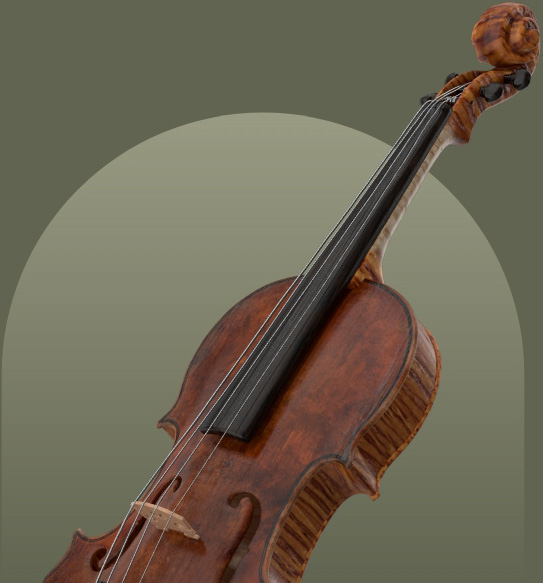
Jean-Baptiste Deshayes Salomon
Paris, Paris mid, b. 1713
Jean-Baptiste Deshayes SALOMON (1713-after 1767) was a prominent Parisian luthier and successful businessman who became Master of the violin makers' guild in 1760. Known for an extensive but inconsistent output, his instruments, particularly his violoncellos, are highly sought after despite varying quality. He crafted violins, violoncellos, Liebesgeigen, bass viols, and harps, often employing models reminiscent of Chappuy and Guersan, and using diverse varnishes. His work is preserved in notable collections, including the Paris Conservatoire.
Auction Price History
Highest auction price
32 results
| Type | Details | Auction house | Sold | Price |
|---|---|---|---|---|
| Small Violoncello | 7/8 size cello, many table restorations including bass bar and sound post cracks, worm Lot 101 | Laurent | December 2024 | £5,859est. € 2.000-3.000 |
| Violin | Labelled Salomon Luthier à St. Cecille Place de la ecole à Paris 17...; branded Salomon à Paris Lot 21 | Ingles & H. | October 2024 | £10,200est. £ 8,000-12,000 |
| Violin | 36.4 cm 1750 c. Ascribed to | — | November 2011 | £2,954 |
| Cello | 72 cm Paris, 1750 c. | — | March 2011 | £10,625 |
| Violin | 35.7 cm Paris, 1768 | — | June 2010 | £7,249 |
| Violin | 36.5 cm Paris, 1750 c. | — | April 2009 | £2,540 |
| Cello | 75.3 cm Paris, 1770 c. | — | October 2008 | £17,550 |
| Violin | 35.7 cm 1760 c. | — | June 2008 | £3,840 |
| Cello | 71.3 cm 1760 c. Attributed to | — | March 2008 | £3,360 |
| Cello | 70.5 cm 7/8 size (numerous restorations) | — | December 2007 | £3,574 |
| Cello | 75.3 cm Paris, 1770 c. | — | October 2007 | £13,704 |
| Violin | 35.6 cm Paris, 1750 c. | — | October 2007 | £8,750 |
| Violin | 35.6 cm Paris, 1760 c. | — | April 2007 | £7,278 |
| Viola | 40.7 cm Paris, 1750 c. | — | June 2006 | £7,200 |
| Violin | 35.9 cm Paris, mid-18th C. Original neck | — | May 2006 | £3,066 |
| Violin | Paris, mid-18th C. | — | November 2005 | £1,500 |
| Cello | 1760 | — | March 2002 | £8,000 |
| Violin | 1750 | — | March 2001 | £3,120 |
| Violin | 1750 c. | — | October 2000 | £2,416 |
| Violin | 1750 | — | May 2000 | £8,200 |
| Violin | 1760 | — | June 1999 | £3,450 |
| Violin | 1760 c. | — | November 1998 | £4,600 |
| Violin | 1760 c. | — | November 1998 | £2,070 |
| Violin | 1770 | — | April 1991 | £4,620 |
| Violin | 1770 c. | — | March 1991 | £418 |
| Violin | 17-- | — | March 1989 | £1,430 |
| Violin | 1770 c. | — | September 1988 | £2,420 |
| Cello | 1754 | — | November 1986 | £6,600 |
| Violin | 17-- | — | November 1983 | £990 |
| Cello | 175- | — | November 1983 | £2,200 |
| Cello | 1749 | — | September 1983 | £2,520 |
| Cello | 17-- | — | June 1983 | £3,520 |
No results match those filters.
Maker Overview
Life
Jean-Baptiste Deshayes SALOMON (1713-after 1767) was born in Rheims in 1713 and died after 1767 in Paris, France. He is believed to have arrived in Paris from Rheims around the late 1730s. In 1748, he married Barbe Deshaies, the widow of J. Ouvrard, and subsequently adopted the name 'Jean-Baptiste Deshayes'. Following his marriage, he worked in the former Ouvrard shop located in the place de l'École. He was appointed Master of the violin makers' guild in 1760, a testament to the esteem in which his colleagues held him. Salomon was a highly successful businessman and dealer in various musical instruments. His widow continued the business after his death, with Namy directing the shop from 1772, initially at the Place de l'École, and later moving it to the Quai de la Mégisserie, where it operated until 1789.
Characteristics
- Workmanship
- Jean-Baptiste Deshayes SALOMON's production was extensive but inconsistent, leading to instruments of varying quality, from very good to mediocre. Many instruments bearing his name are presumed to have been constructed by various outworkers.
- Models
- Recognizable models in his oeuvre include those reminiscent of Chappuy and Guersan. His work style is noted to be similar to Chappuy's.
- Varnish
- The varnish he employed ranged from a softer red-brown to a hard pale golden-brown. Other descriptions include yellow-brown spirit varnish, similar to Guersan's, and simply yellow varnish.
- Construction
- He often used available wood for the tops of his instruments, and the backs were typically kept quite flat.
- Instruments
- While he made violins, his violoncellos are generally considered better, with some exhibiting excellent wood and fine tone. He also crafted Liebesgeigen (viola d'amore) with beautifully carved heads, bass viols, and was praised as a harp maker. His 'cellos are particularly sought after when they reach the appropriate size.
- Branding & Labels
- Instruments were frequently branded below the back button with 'Salomon' or 'Salomon à Paris'. Various labels were used, including "Salomon / de Paris, 1740", "Salomon / 1742", "Salomon Luthier a Ste Cecille / Place de l'ecole a Paris, 1741", "Parisiis apud Salomonem ad insign. / Sta Caecilia Scholae Palatio / 1754", and "Salomon / Maître Luthier à Paris, Rue / l'Arbre-sec à Ste Cecille".
- Frequently branded below back button: ‘Salomon’ or ‘Salomon à Paris’ Du Salomon
de Paris, 1740John Dilworth - Salomon
1742John Dilworth - Salomon Luthier a Ste Cecille
Place de l’ecole a Paris, 1741John Dilworth - Parisiis apud Salomonem ad insign.
Sta Caecilia Scholae Palatio
1754John Dilworth - Salomon
Maître Luthier à Paris, Rue
l’Arbre-sec à Ste CecilleJohn Dilworth
Influence and legacy
- Contemporaries: His work is noted to be similar in pattern to that of his contemporary, Louis Guersan.
- Stylistic Influences: His work reminds observers of Chappuy's style, while his yellow-brown spirit varnish is more akin to Guersan's.
- Collections: A Liebesgeige (viola d'amore) with a finely carved head by Salomon is preserved in the Paris Conservatoire Collection (No. 156). A similar instrument is held by the Conservatorium in Brussels, and a violin from the Snoeck collection (No. 530) is in Berlin.
- Demand: Despite the variability in his output, instruments by Jean-Baptiste Deshayes SALOMON are much in demand, with his 'cellos being particularly sought after.
Biographies
The overview above is drawn from the following published accounts. Read them in the original:
John Dilworth+
SALOMON, Jean-Baptiste Deshayes Born 1713 Rheims, d. after 1767 Paris France. Established in Paris on the rue de Grenelle Saint Honoré at the sign ‘Sainte-Cécile’. Married Barbe Deshaies, the widow of J. Ouvrard in 1748. Thereafter adopted the name ‘Jean-Baptiste Deshayes’, and worked in the old Ouvrard shop in place de l’École. Appointed Master of the violin makers guild 1760. Highly successful businessman and dealer in all sorts of musical instruments. Many instruments bearing his name are presumed to be constructed by various outworkers. Chappuy and Guersan models are recognisable, and there is little consistency over his entire oeuvre. Varnish of softer red-brown to hard pale golden-brown. Frequently branded below back button: ‘Salomon’ or ‘Salomon à Paris’ Du Salomon / de Paris, 1740 Salomon / 1742 Salomon Luthier a Ste Cecille / Place de l’ecole a Paris, 1741 Parisiis apud Salomonem ad insign. / Sta Caecilia Scholae Palatio / 1754 Salomon / Maître Luthier à Paris, Rue / l’Arbre-sec à Ste Cecille
Cecie Stainer+
Worked in Rheims till about 1747, and then in Paris at the place de l’Ecole; later he settled in the rue de l’Arbre-sec (about 1769). He died before 1772, for in that year Namy is mentioned as working for the widowed Madame Salomon. He made few violins, but they show good work, and are on a similar pattern to those of Louis Guersan, his contemporary; they have yellow-brown varnish. A viola d’amore of his is in the Paris Conservatoire Collection; he also made good bass viols. A few of his violoncellos are of excellent wood and have a fine tone, but in others the varnish is hard and the tone poor. Labels: ” Salomon, luthier, a Ste Cecile, place de l’Ecole a Paris, 1751, ‘ and “Parisiis apud Salomonem ad insigne Sta Caecilia Scolie Palatio, 1752.” He also sometimes branded his instruments with ” Salomon a Paris.” His widow continued the business for some time after his death, moving about 1788 to quai de la Megisserie.
Willibald Leo Lütgendorff+
Er soll aus Reims um das Ende der dreissiger Jahre des 18. Jahrh. nach Paris gekommen sein und war vermuthlich ein Sohn oder Bruder des in Reims thätigen Salomon. Er führte das Ladenschild »–À Ste Cecille«, wohnte erst Rue de l’arbre sec und dann Place de l’École, wo seine Wittwe von 1772 an das Geschäft unter Namy’s Leitung fortführte. Sie verlegte dasselbe später nach dem Quai de la Mégisserie und behielt es bis 1789. Salomon war ein ziemlich talentvoller Geigenmacher, den auch seine Collegen schätzten, die ihn 1760 zum geschworenen Zunftmeister erwählten. Seine Arbeit erinnert an die Chappuy’s, sein gelbbrauner Spirituslack dagegen mehr an Guersan. Das Holz zu den Decken hat er genommen, wie er es gerade hatte; den Boden hielt er ziemlich flach; so giebt es recht gute, aber auch sehr mittelmässige Violinen von ihm. Besser sind seine Violoncelli und seine Liebesgeigen. Eine solche mit hübsch geschnitztem Köpfchen besitzt das Pariser Conservatorium (No. 156), eine ähnliche das Conservatorium in Brüssel, eine Violine Berlin aus der Sammlung Snoeck (No. 530). Auch als Harfenmacher wurde er gelobt. Er gebrauchte verschiedene Zettel:
Henri Poidras+
Paris 1730-1772. This maker, whose production has been as great as it has been unequal, is much in demand. The material used is generally good, and the varnish, yellow. Branded near the button, apart from the label. His ‘cellos are particularly sought after when they reach the size. He has left some very nice quintoles with carved heads.
Sell your instrument with Amati
Get started by uploading photos of your instrument for our experts to review.
Sell your instrument with Amati
Get started by uploading photos of your instrument for our experts to review.