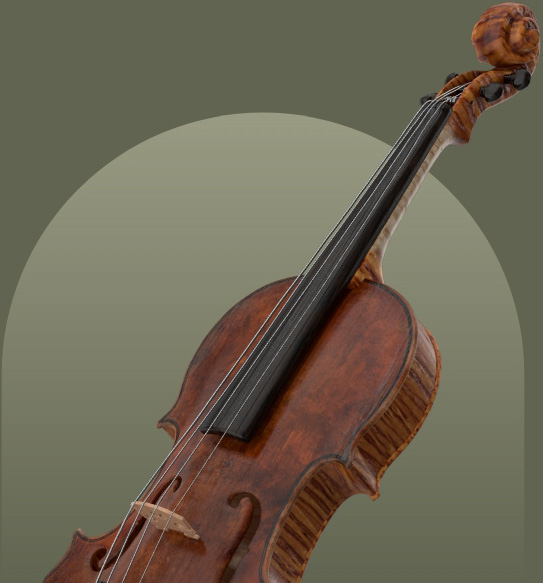
Sebastian Schelle
worked 1700–1750
Sebastian Schelle (circa 1700-1750) was a highly regarded lute and violin maker from Nuremberg, Germany, and a pupil of Matthias Hummel. His instruments, known for their fine craftsmanship, often followed the Stainer model for violins and featured distinctive soundholes and a thin, golden-brown varnish. Schelle's work was celebrated across Europe for its excellent proportions, sound projection, and the use of high-quality, seasoned woods. His instruments are rare and are preserved in notable collections such as the Paris Conservatoire and the Germanische Museum in Nuremberg.
Maker Overview
Life
Sebastian SCHELLE (circa 1700-1750) was a prominent lute and violin maker who worked in Nuremberg, Germany. He is noted as a pupil of Matthias Hummel and is considered the most significant Nuremberg lute and violin maker of his era. According to a quote from Baron in Willibald Leo Lütgendorff's Die Geigen- und Lautenmacher vom Mittelalter bis zur Gegenwart, M. Hummel was Schelle's teacher, and Schelle profited so much from him that his work became highly regarded in Italy, France, Upper and Lower Germany, and other cultivated parts of Europe. Baron further states that Schelle's lutes were often so well made that masters who acquired them at a reasonable price sometimes had the good fortune to resell them to connoisseurs and enthusiasts after playing them in. A violin in London, held by Withers, bears a written label reading "Sebastianus Schelle Cremona 1701", which, if authentic, suggests he may have worked in Cremona during his journeyman years.
Characteristics
- Workmanship
- Sebastian Schelle's instruments are characterized by very fine work.
- Models
- He often followed the Stainer model for violins. John Dilworth notes that Hamma illustrates a beautiful Rogeri-like cello by Schelle.
- Design Elements
- His soundholes feature rounded wings and graceful points extending into the circles. The cello head is described as having characteristically German sloping shoulders.
- Varnish
- Instruments typically exhibit a thin, golden-brown varnish that is not fully transparent.
- Construction Philosophy
- instruments are of medium size, suitable for most players, and possess beautiful and accurate proportions in their construction and string setup. They are described as flat, broad-grained, elongated, and capable of projecting sound far.
- Materials
- Schelle maintained a large stock of rare, dry, and beautiful wood, which was ideally suited for instrument making.
- Sebastian Schelle
Lauten und Geigenmacher
in Niirnberg. Hummels
Erben An. 1744John Dilworth
Influence and legacy
- Mentorship: Sebastian Schelle was a pupil of Matthias Hummel, a significant influence on his development as a luthier.
- Museum Holdings: An instrument dated 1727 is part of the Paris Conservatoire Collection. The Städtische Museum Carolino-Augusteum in Salzburg holds a work from 1719. The Germanische Museum in Nuremberg possesses a lute from 1744.
- Repairs: Several instruments repaired by Schelle are housed in the royal collection of old musical instruments in Berlin.
Biographies
The overview above is drawn from the following published accounts. Read them in the original:
John Dilworth+
SCHELLE, Sebastian Worked circa. 1700-1750 Nuremberg Germany. Pupil of Matthias Hummel Schelle. Very fine work. Stainer model. Soundholes with rounded wings and graceful points into the circles. Quite rare, possibly many having been falsely re-labelled. Hamma shows a beautiful Rogeri-like cello; head with characteristically German sloping shoulders. Thin golden-brown varnish, not fully transparent. Sebastian Schelle / Lauten und Geigenmacher / in Niirnberg. Hummels / Erben An. 1744
Cecie Stainer+
A maker of lutes in Nuremberg in 1727. One with that date is in the Paris Conservatoire Collection.
Willibald Leo Lütgendorff+
Schüler von Math. Hummel und der bedeutendste Nürnberger Lauten- und Geigenmacher seiner Zeit. Baron sagt von ihm in seiner Untersuchung des Instruments der Lauten (S. 97): »M. Hummel ist ein Lehrmeister des . . . .Schelle gewesen, welcher bey ihm so viel gutes profitirt, dass er sich mit seiner bewährten Arbeit so wohl in Italien, Frankreich, Ober- und Nieder Teutschland und andern cultivirten Theilen von Europa schon sehr signalisiret hat. Seine Lauten sind öffters so wohl gerathen, dass diejenigen Meister, welche sie von ihm um einen billigen Preiss bekommen, schon bissweilen das Glück gehabt haben, wenn sie dieselben vorhero ein wenig ausgespielt, an Kenner und Liebhaber theils vor hundert theils vor sechtzig biss siebentzig Reichsthaler wieder anzubringen. Seine Instrumente sind von mittelmässigen Stock, fast vor Jedermanns Faust, haben eine schöne und accurate Proportion am Gebäude und Saitenlage, sind flach, breitspänicht, länglicht und werffen den Thon weit in die Ferne. Er hat einen grossen Vorrath von allerley raren, trucknen und schönen Holtze, das sich zu Instrumenten am besten schickt und kann man sich seiner mit guten Success bedienen.« — Eine Arbeit von ihm besitzt das städtische Museum Carolino-Augusteum in Salzburg (von 1719), eine theorbirte Laute (von 1727) das Museum des Pariser Conservatoriums (No. 218), eine Laute von 1744 das Germanische Museum in Nürnberg. In der kgl. Sammlung alter Musikinstrumente in Berlin sind mehrere Instrumente, die er reparirt hat. In London bei Withers befindet sich eine hochgewölbte Violine von ihm mit dem geschriebenen Zettel: »Sebastianus Schelle Cremona 1701«. Wenn der Zettel echt ist, hätte man anzunehmen, dass er in seinen Wanderjahren in Cremona gearbeitet habe, was nicht gerade unglaubwürdig erscheint.
Sell your instrument with Amati
Get started by uploading photos of your instrument for our experts to review.
Sell your instrument with Amati
Get started by uploading photos of your instrument for our experts to review.