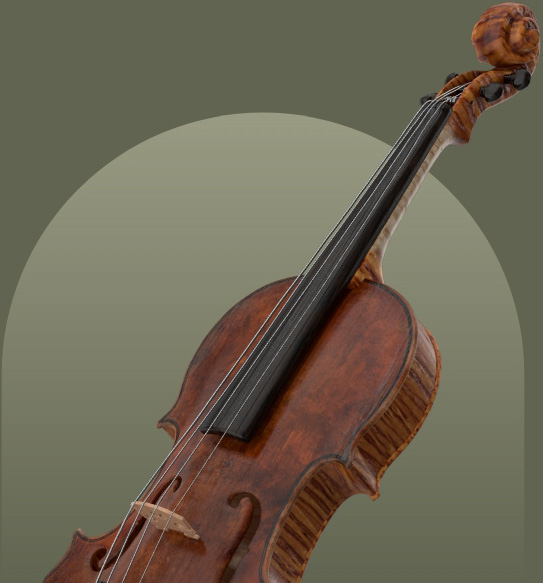
John Simpson
worked 1735–1794
John SIMPSON (circa 1735-1794) was a prominent London musical instrument merchant who operated a significant business from 1735, taking over John Hare's establishment in 1741. His firm, known variously as Messers Simpson or J. & J. Simpson, produced instruments often described as common London trade work, frequently based on Stainer patterns and sometimes signed internally by other makers like Lockey Hill sr. These instruments often featured a German style, orange-yellow varnish, and were sometimes branded 'Simpson'.
Auction price history
Highest auction price
| Type | Details | Sold | Price |
|---|---|---|---|
| Violin | 35.5 cm 1790 | November 2008 | £2,280 |
| Violin | 1788 | October 1993 | £1,265 |
| Violin | 1780-95 | April 1991 | £2,860 |
| Violin | 1790 c. | September 1989 | £1,980 |
| Violin | 1780-99 | November 1987 | £825 |
| Violin | 1788 | June 1983 | £385 |
| Violin | 17-- | November 1982 | £118 |
Maker Overview
Life
John SIMPSON (circa 1735-1794) was an important figure in the London musical trade during the 18th century. He established his business at 15 Sweeting's Alley from 1735 and took over the business of John Hare in 1741. The firm was known as Messers Simpson, or J. & J. Simpson from 1767, and was located at 14 Sweeting's Alley in 1798. John Simpson worked in association with his brother James, although the number of generations involved in the 19th century is not clear. John is identified as the first individual and presumed to be the senior partner., he is presumed to be a merchant rather than a maker himself.
Characteristics
- Production Method
- Instruments bearing the Simpson label were often factory-made, and are generally considered common London trade work of the period, frequently based on Stainer patterns in various qualities.
- Associated Makers
- Instruments with the joint label have been found signed internally by Lockey Hill sr., Henry Jay, Robert Thompson, R. Duke jr., and John Barrett.
- Stylistic Characteristics
- The instruments often exhibit a German style, with a thin and poor scroll, ordinary f-holes, and a lack of purfling.
- Varnish
- Henri Poidras notes an orange-yellow varnish, while Willibald Leo Lütgendorff describes it as dark orange-yellow.
- Branding
- Some instruments are branded below the back button with 'Simpson'.
- J. and J. Simpson
Musical Instrument Makers
at the Bass-Viol and Flute
in Sweeting’s Alley
opposite the East door of the Royal Exchange
London. John Simpson
Musical Instrument Makers
at the Bass-Viol and Flute
in Sweeting’s Alley
opposite the East door of the Royal Exchange
London. John Simpson
Musical Instrument Maker
at ye Bass viol & Flute in Sweeting Alley opposite ye
East Door of ye Royal Exchange London
(from the late Mrs Hares in Cornhill) Sold by John Simpson at
The Viola & Flute in
Swithin’s Alley near
The Royal Exchange London
1735John Dilworth
Influence and legacy
- Notable Instruments: A four-string Alt-Viola di Gamba attributed to them is owned by C. Claudius in Malmö.
Biographies
The overview above is drawn from the following published accounts. Read them in the original:
John Dilworth+
SIMPSON, John Worked circa. 1735-1794 London UK. An important business in the London musical trade in the 18th century. Presumed to be a merchant rather than a maker himself. Established at 15 Sweeting’s Alley from 1735. Took over the business of John Hare 1741. Known as Messers Simpson, or J. & J. Simpson from 1767, and found at 14 Sweeting’s Alley in 1798. Worked in association with his brother James, above, although it is not clear how many generations were involved in the 19th century. Most labels refer to either ‘J. and J. Simpson’, ‘James and Sons’, or John Simpson alone, but John is the first to be identified individually in documents and supposed therefore to be the senior. Instruments with the joint label have been found signed internally by Lockey Hill sr., Henry Jay, Robert Thompson, R. Duke jr., and John Barrett; these are generally common London trade work of the period based on Stainer patterns in various qualities. Some branded below the back button: ‘Simpson’ . Printed labels: J. and J. Simpson / Musical Instrument Makers / at the Bass-Viol and Flute / in Sweeting’s Alley / opposite the East door of the Royal Exchange / London. John Simpson / Musical Instrument Makers / at the Bass-Viol and Flute / in Sweeting’s Alley / opposite the East door of the Royal Exchange/ London. John Simpson / Musical Instrument Maker / at ye Bass viol & Flute in Sweeting Alley opposite ye / East Door of ye Royal Exchange London / (from the late Mrs Hares in Cornhill) Sold by John Simpson at / The Viola & Flute in / Swithin’s Alley near / The Royal Exchange London / 1735 [Hill Archive, BVMA]
Willibald Leo Lütgendorff+
Ursprünglich führte er sein Geschäft allein, später zusammen mit seinem Sohne J(ames?). Es ist fraglich, ob die Geigen, die ihren Zettel tragen und meist sehr fabrikmässig hergestellt sind, wirklich von ihnen gemacht wurden. In der Arbeit sind ihre Geigen gut und erinnern an deutschen Stil; die Schnecke ist dünn und armselig, die F-Löcher gewöhnlich, die Einlage fehlt und der Lack ist dunkelorangegelb. Sie hiessen James und John, wie aber der Vater und wie der Sohn ? Eine viersaitige Alt-Viola di Gamba von ihnen besitzt C. Claudius in Malmö.
Henri Poidras+
London circa 1700. Instruments after the German style. Orange-yellow varnish.
Sell your instrument with Amati
Get started by uploading photos of your instrument for our experts to review.
Sell your instrument with Amati
Get started by uploading photos of your instrument for our experts to review.