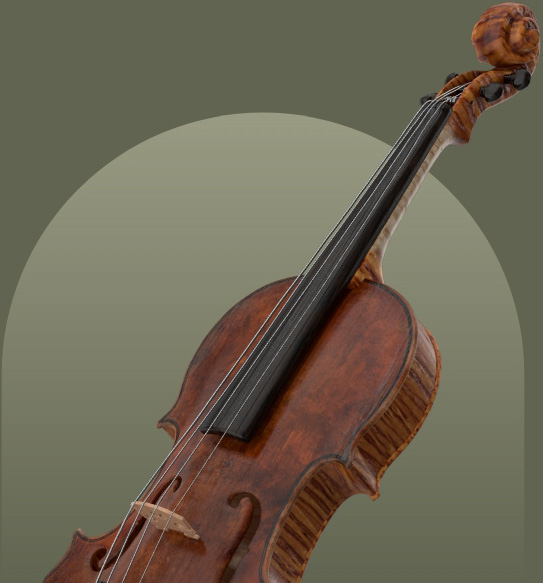
Leo (II) Sir
1883–1915
Leo (II) SIR (1883-1915) was a French luthier, son and pupil of Leo Sir (I), whose promising career was tragically cut short by World War I. Known for his individual model influenced by Amati and Stradivari, and a distinctive rich red oil varnish, he received awards at Liège and Bordeaux. He also established the Ecole Bordelaise and collaborated with his father on innovative instruments.
Maker Overview
Life
Leo (II) SIR (1883-1915) was born in 1883 in Bordeaux, France. He was the son and pupil of Leo Sir (I), and tragically died in 1915 in Rennes, France, as a casualty of World War I. In 1913, he assisted his father in the construction of a notable double-quintet (dixtuor).
Characteristics
- Model
- His personal model was described as original and individual, drawing inspiration from both Amati and Stradivari, positioning itself uniquely between these two masters. Henri Poidras specifically noted that while his model was highly individual, its outline remained consistent with that of Stradivarius.
- Varnish
- He employed a rich, soft-textured red-brown varnish applied over an amber ground. This varnish is also characterized as a vivid red oil varnish on an ambered background, consistently praised for its fine quality and generous substance.
- Varnish Characteristics
- Willibald Leo Lütgendorff observed a particular characteristic of his gold-red oil varnish, noting its tendency to penetrate the wood.
- L. Sir
Marmonde 1912
No..John Dilworth
Influence and legacy
- Mentorship: His foundational training in violin making was provided by his father, Leo Sir (I), under whom he served as both son and pupil.
- Further Training: He further honed and perfected his skills through dedicated study with C. Brugère (Charles Brugere) between 1901 and 1902.
- School: He was instrumental in establishing the Ecole Bordelaise, located in Marmande.
- Awards: His exceptional craftsmanship was recognized with medals at Liège in 1905 and a Grand Prix at Bordeaux in 1907.
- Death: His promising career was tragically cut short by his death in 1915, a direct consequence of World War I.
Biographies
The overview above is drawn from the following published accounts. Read them in the original:
John Dilworth+
SIR, Leo (II) Born 1883 Bordeaux, died 1915 Rennes France. Son and pupil of Leo Sir (I), above. Studied with C. Brugère. Assisted his father in the construction of a double-quintet (dixtuor) 1913. Personal model based on Amati and Stradivari with rich soft-textured red-brown varnish over an amber ground. Medals awarded at Liège 1905 and Bordeaux 1907. Established the Ecole Bordelaise at Marmande. Died in World War I. Manuscript label: L. Sir / Marmonde 1912 / No..
Willibald Leo Lütgendorff+
Sein Vater Léon S. betrieb das Geigenmachen aus Liebhaberei mit grossem Eifer und schönen Erfolgen und konnte daher seinem Sohne die ersten Anleitungen geben. Von 1901—1902 arbeitete Léo Sir zu seiner letzten Ausbildung bei Brugère. Er gilt als sehr talentvoll und ist jetzt im Geschäfte seiner Mutter, die früher in Langon ansässig war, thätig. Sein Modell ist originell und steht zwischen Stradivari und Amati, doch erklärt er selbst, dass er dasselbe, wenn es ihm nöthig scheinen sollte, noch verändern wurde. Sein besonderes Augenmerk verwendet er auf einen schönen Öllack. Er ist dabei auch zu günstigen Resaltaten gekommen, wenn auch sein Lack (von goldrother Farbe) noch den Fehler hat, in das Holz einzudringen.
Henri Poidras+
Son of Leo Sir (I), born at Bordeaux in 1883, died in 1915 at Rennes, as a result of the war. Apprenticed to his father, he perfected himself with Charles Brugere. Collaborated with his father in the making of the double string quintet or dixtuor which was presented by the composer Hyard at a concert given at the seat of the Societe” Positiviste in December 1913, and by M. Emmanuel at the Conservatoire. His very individual model is only that of Stradivarius in outline. His vivid red oil varnish on an ambered back-ground is of fine quality and the substance is generous. Grand Prix, Bordeaux Exhibition, 1907.
Sell your instrument with Amati
Get started by uploading photos of your instrument for our experts to review.
Sell your instrument with Amati
Get started by uploading photos of your instrument for our experts to review.