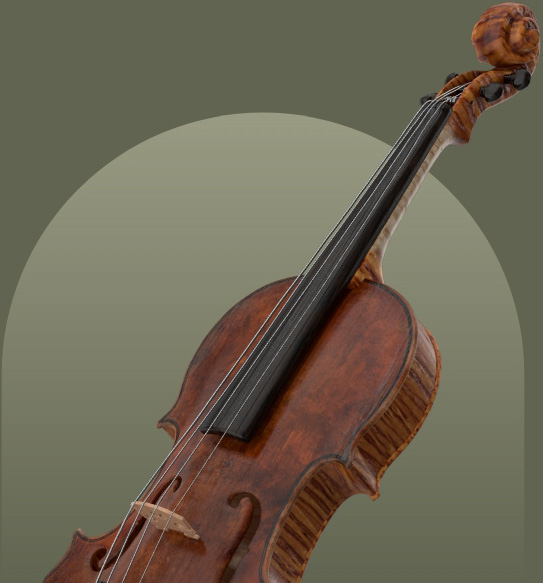
Thomas Smith
Lakewood, London, c.1725–1789
Thomas Smith (circa 1725-1789) was a prominent English luthier, pupil and successor to Peter Wamsley at the 'Harp and Hautboy' in Piccadilly, London. He was known for his cellos and violas, often made on the Stainer model, and took over court appointments to King George III and the Duke of York. His instruments are noted for their strong wood and less fragile construction, though opinions on his varnish and tone quality vary among historians.
Auction Price History
Highest auction price
38 results
| Type | Details | Auction house | Sold | Price |
|---|---|---|---|---|
| Violin | Lot 55 | Bonhams | May 2014 | £3,500 |
| Cello | 73.5 cm London, 1770 c. | — | March 2011 | £10,800 |
| Cello | 73.3 cm London, 1765 | — | October 2010 | £7,200 |
| Viola | 42.9 cm Lakewood, 1951 | — | October 2009 | £2,781 |
| Cello | 73.6 cm London, 1765 | — | October 2009 | £24,098 |
| Cello | 75.0 cm London, 1790 c. Attributed to | — | March 2009 | £7,440 |
| Violin | 35.7 cm 18th C. | — | November 2006 | £1,823 |
| Violin | London, late-18th C. | — | May 2005 | £3,053 |
| Cello | London, 1780 c. Attributed to | — | November 2004 | £5,975 |
| Violin | London | — | October 2004 | £1,750 |
| Cello | London, 1780 | — | March 2004 | £14,400 |
| Cello | London, 1769 | — | March 2004 | £11,950 |
| Cello | 1778 | — | May 2003 | £4,460 |
| Cello | 1780 | — | March 2002 | £4,250 |
| Cello | 1759 | — | May 2001 | £13,262 |
| Viola | 39.5 cm 1801 | — | November 2000 | £5,400 |
| Cello | 1773 | — | March 2000 | £17,250 |
| Viola | 38.8 cm 1783 | — | February 2000 | £1,000 |
| Cello | 1757 | — | November 1999 | £6,325 |
| Violin Bow | Ivory 61 g. Open frog, baroque style | — | November 1999 | £2,185 |
| Cello | 1770 | — | June 1996 | £10,925 |
| Cello | 17-- | — | June 1996 | £3,220 |
| Cello | 1760 | — | June 1995 | £4,255 |
| Cello | 1782 | — | December 1994 | £5,897 |
| Cello | 1764 | — | November 1994 | £6,325 |
| Cello | 1766 | — | June 1993 | £3,910 |
| Cello | 17-- | — | July 1992 | £4,950 |
| Cello | 1770 c. | — | April 1992 | £1,650 |
| Violin | 1763 | — | September 1991 | £440 |
| Violin | 1750 c. | — | April 1991 | £1,760 |
| Violin | 1783 | — | March 1991 | £2,640 |
| Violin | 1790 c. | — | November 1989 | £990 |
| Violin | 17-- | — | April 1987 | £495 |
| Violin | 1750 c. | — | April 1985 | £605 |
| Violin | 1772 | — | April 1983 | £748 |
| Violin | 17-- | — | January 1982 | £231 |
| Violin | 1774 | — | November 1981 | £315 |
| Violin | 1756 | — | November 1980 | £880 |
No results match those filters.
Maker Overview
Life
Thomas SMITH (circa 1725-1789) was born around 1725 and died in 1789 in London, UK. He was the son of William Smith, a music engraver who worked for P. Wamsley. Thomas became Wamsley's pupil, assistant, and successor at the 'Harp and Hautboy' in Piccadilly. He moved to 6 High Street Marylebone in 1782. Smith was responsible for most of the work emanating from the shop after Wamsley's retirement in 1741, even though the business remained in the hands of Wamsley's wife. Smith finally took over in 1751 and used all the same labels and trade cards with only the name altered. He took over the court appointments to King George III and the Duke of York.
Characteristics
- Workmanship
- His work is described by John Dilworth as a little less refined than Wamsley's, perhaps 'the better for it, being more strongly wooded and less fragile'. Willibald Leo Lütgendorff states that his work is good but not outstanding.
- Model
- He consistently used the Stainer model, which Willibald Leo Lütgendorff compares to the manner of John Johnson.
- Varnish
- John Dilworth describes his varnish as golden-yellow. Cecie Stainer and William Meredith Morris describe it as 'rather poor, of a brownish-yellow colour' or 'dirty amber, or brownish-yellow colour'. Henri Poidras notes a dark yellow varnish, and Willibald Leo Lütgendorff describes it as lean, of a weak brownish-yellow color.
- Instruments
- He produced several alto violas and many cellos, which are considered very effective and desirable instruments. He often used local maple with a narrow flame, and his violas almost invariably featured one-piece fronts. Cecie Stainer states that his violoncellos were much liked in England, with some having a powerful tone, though she questioned its quality. William Meredith Morris, however, found the tone of the violoncellos he tried to be 'hard, rasping'. Willibald Leo Lütgendorff describes the tone as appealing but not great.
- Signature
- His signature appears in several instruments bearing the labels of other contemporary English makers.
- Made by Thomas Smith
at the harp and hautboy in Pickadilly,
London, 1759John Dilworth - T. Smith 1756John Dilworth
- Made by Thos Smith at the harp and
Hautboy in Pickadilly London 1783
now no.6 High Street, St. MaryleboneJohn Dilworth
Influence and legacy
- Family: He was the son of William Smith, a music engraver.
- Mentorship: He was a pupil of P. Wamsley, and later his assistant and successor.
- Pupils: John Norris was a pupil of his.
- Market Value: In 1799, his instruments sold for £5 5s. up to £8. More recently, two realized £30 and £40 each.
- Museum Holdings: A bow in the Ashmolean Museum, Oxford, branded 'T.Smith', is identical to those bearing the Wamsley brand and is one of the earliest known to feature an adjustable frog.
- Family Continuity: Willibald Leo Lütgendorff suggests he may have had a son named John.
Biographies
The overview above is drawn from the following published accounts. Read them in the original:
John Dilworth+
SMITH, Thomas Born circa. 1725, died 1789 London UK. Son of William Smith, a music engraver who worked for P. Wamsley. Thomas became Wamsley’s pupil, assistant, and successor at the ‘Harp and Hautboy’ in Piccadilly. Moved to 6 High Street Marylebone 1782. Smith was responsible for most of the work emanating from the shop after Wamsley’s retirement 1741, even though the business remained in the hands of Wamsley’s wife. Smith finally took over in 1751 and used all the same labels and trade cards with only the name altered. He took over the court appointments to King George III and the Duke of York. His work is a little less refined than Wamsley’s, perhaps the better for it, being more strongly wooded and less fragile. The Stainer model is consistent. Golden-yellow varnish. He produced several alto violas and many cellos which are very effective and desirable instruments. Often used local maple with a narrow flame; violas almost invariably with one-piece fronts. His signature appears in several instruments bearing the labels of other contemporary English makers. A bow in the Ashmolean Museum, Oxford branded ‘T.Smith’ is identical to those bearing the Wamsley brand and one of the earliest known to feature an adjustable frog. Made by Thomas Smith / at the harp and hautboy in Pickadilly, / London, 1759 T. Smith 1756 Made by Thos Smith at the harp and / Hautboy in Pickadilly London 1783 / now no.6 High Street, St. Marylebone [BVMA]
Cecie Stainer+
A maker in London about 1740-90. Pupil and successor of Peter Wamsley. He had a great reputation as a maker of violoncellos, his instruments are much liked in England; they are made on the Stainer model, and some have a powerful tone, though not of very good quality ; the varnish is rather poor, of a brownish-yellow colour; in 1799 they sold for £5 5s. up to £8; more recently two realised £30 and ; £40 each. It is doubtful if he ever made any violins and tenors. John Norris was a pupil of his. Label: ” Made by Thos. Smith at the harp and hautboy in Pickadilly, London, 1756 ” ; similar labels were used until 1766.
William Meredith Morris+
He was a pupil and successor of Peter Wamsley. Some writers have bestowed great praise on his violoncellos, but I am inclined to think that they have never drawn a bow across their strings. Those which I tried had a hard, rasping tone that set one’s teeth on edge. The workmanship is not bad, although the varnish is rather poor stuff, of a dirty amber, or brownish-yellow colour. He used various labels.
George Hart+
Pupil of Peter Wamsley, and his successor at the Harp and Hautboy.
Willibald Leo Lütgendorff+
Schüler von Peter Wamsley, an dessen Arbeiten seine Instrumente auch in den Umrissen erinnern; nur sind sie stärker im Holz und sind, wenigstens in England, geschätzt. Ob er jemals Violinen gemacht hat, ist mindestens zweifelhaft; dagegen giebt es viele grössere Geigen von ihm. Er ahmte das Stainer- Modell nach, etwa in der Art John Johnson’s. Die Arbeit ist gut, aber nicht hervorragend, der Ton ansprechend, aber nicht gross und der Lack mager, von schwacher, braungelber’Farbe. Seine Zettel gleichen so sehr denen von Wamsley, dass Sandys und Forster annehmen, er sei auch der Geschäftsnachfolger seines Meisters gewesen. Er soll einen Sohn Namens John gehabt haben.
Henri Poidras+
London circa 1750. Pupil of P. Wamsley. Stainer model. Dark yellow varnish.
Sell your instrument with Amati
Get started by uploading photos of your instrument for our experts to review.
Sell your instrument with Amati
Get started by uploading photos of your instrument for our experts to review.