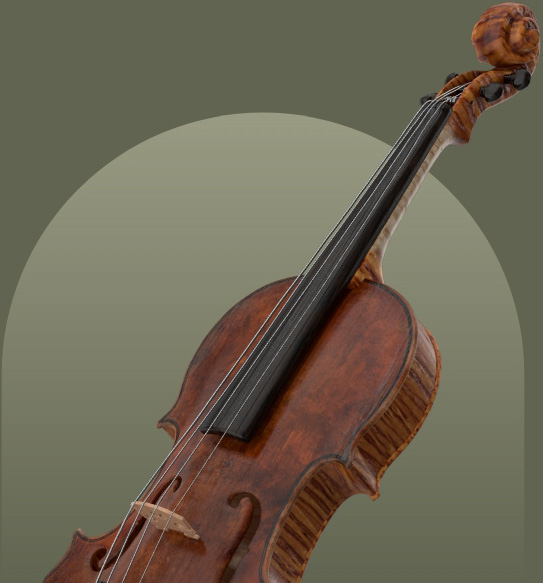
Modena School
Angelo Soliani
Modena, c.1752–1810
Angelo Soliani (1752-1810) was a respected violin maker based in Modena, Italy, originally from Mantua. His craftsmanship is noted for its beauty and care, often drawing inspiration from the patterns of J. B. Guadagnini II, particularly in the flat arching of his models, though some higher-arched instruments exist. Soliani utilized fine woods, crafted tasteful sound-holes, and produced instruments with small, pretty scrolls and delicate purfling. His instruments are recognized for their wonderful yellow, orange, or reddish varnishes and possess powerful, clear tone qualities. He marked his instruments with both labels and an internal 'shining sun' brand.
Auction price history
Highest auction price
4 results
| Type | Details | Auction house | Sold | Price |
|---|---|---|---|---|
| Violin | Labelled Pietro Bagatelli in Padua Fecit Anno 1753 Lot 160 | Ingles & H. | March 2024 | £28,800est. £ 12,000-18,000 |
| Violin | 1791 | — | July 2003 | £26,400 |
| Violin | 1791 | — | June 1994 | £25,300 |
| Violin | 1812 | — | April 1987 | £7,700 |
No results match those filters.
Maker Overview
Life
Angelo SOLIANI (1752-1810) was a violin maker who worked in Modena, Italy. He was born in 1752 and passed away around 1810. Karel Jalovec notes that Soliani came to Modena from Mantua. His work is described as good by Willibald Leo Lütgendorff and sometimes recalls the style of Guadagnini. Karel Jalovec further elaborates that Soliani worked in a beautiful manner and with much care, often following the pattern of J. B. Guadagnini II of Turin. His instruments are considered rare and valuable by Karel Jalovec.
Characteristics
- Model
- Angelo Soliani's instruments often featured a rather flat model, recalling Guadagnini with a low arch. However, Karel Jalovec mentions that there are also works with a higher arching, and John Dilworth specifies some high-arched instruments on a narrower pattern.
- Materials
- He utilized fine wood and fine materials, respectively.
- Sound-holes
- The sound-holes were tastefully cut in the fashion of Guadagnini.
- Scroll
- His scrolls featured projecting inner windings, and John Dilworth characterizes them as small and pretty.
- Purfling
- John Dilworth notes the presence of delicate purfling on his instruments.
- Varnish
- Soliani's varnish was fine and effective, often yellow or orange. Karel Jalovec describes it as wonderful, with hues of yellow, light brown, or orange-red. John Dilworth mentions a golden-orange varnish, while Willibald Leo Lütgendorff refers to an amber-yellow or orange-red lacquer.
- Tone Qualities
- The instruments possess powerful and clear tone qualities, which were greatly appreciated by artists, as reported by Henri Poidras. Willibald Leo Lütgendorff adds that his violins are good, bright-sounding orchestral instruments.
- Markings
- Angelo Soliani's instruments were both branded and labelled. Karel Jalovec states that he used to brand a mark showing the sun emitting beams of light in the centre of the back (inside). John Dilworth confirms this, noting an internal 'shining sun' motif. Willibald Leo Lütgendorff also mentions the use of a brand mark in addition to his label. An example label reads: 'Angelus Soliani fecit / in Mutinae, 1789', as cited by John Dilworth.
- Angelus Soliani fecit
in Mutinae, 1789John Dilworth
Influence and legacy
- Style: His style often recalled that of Guadagnini. Karel Jalovec specifically states that he worked on the pattern of J. B. Guadagnini II of Turin and cut sound-holes in the fashion of Guadagnini.
- Value: Angelo Soliani's instruments are considered rare and valuable, with Karel Jalovec noting a price of 80,000 Kc.
Biographies
The overview above is drawn from the following published accounts. Read them in the original:
John Dilworth+
SOLIANI, Angelo Born 1752, d.c.1810 Modena Italy. Style recalling Guadagnini with low arch. Some high-arched instruments on a narrower pattern. Fine materials and golden-orange varnish. Small pretty scroll and delicate purfling. Branded internally with a ‘shining sun’ motif. Angelus Soliani fecit / in Mutinae, 1789
Cecie Stainer+
A maker in Modena, 1752 1810.
Willibald Leo Lütgendorff+
Zuerst soll er in Mantua ansässig gewesen sein. Seine Arbeit ist gut und erinnert manchmal an Guadagnini; er hat ein flaches Modell, einen bernsteingelben oder orangerothen Lack. Seine Geigen sind gute, hellklingende Orchesterinstrumente. Ausser seinem Zettel verwendet er auch eine Brandmarke.
Henri Poidras+
Good make, rather flat model. Fine and effective yellow or orange varnish. Powerful and clear tone qualities causing them to be greatly appreciated by artists. Branded as well as labelled.
Karel Jalovec+
Modena. 1752 — 1810. Came to Modena from Mantua. Worked in a beautiful manner and with much care on the pattern of J. B. Guadagnini II of Turin. His instruments which are rare and valuable, have a flat arching, there are, however, works with a higher arching as well. Fine wood, sound-holes tastefully cut in the fashion of Guadagnini, scroll with projecting inner windings, wonderful varnish of a yellow, light brown or orange-red hue. In the centre of the back (inside) he used to brand a mark showing the sun emitting beams of light. Price 80.000 Kc.
Sell your instrument with Amati
Get started by uploading photos of your instrument for our experts to review.
Sell your instrument with Amati
Get started by uploading photos of your instrument for our experts to review.