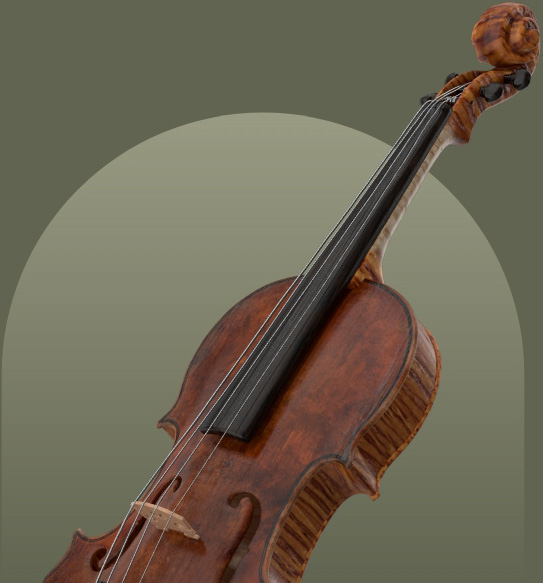
Lorenzo Storioni
Cremona, 1744–1816
Early life spent in Contrada Confettoria (present-day via Robolotti) where the family were neighbours and associates of the Rugeri family including Francesco (II) and Carlo (II), sons of Vincenzo. Active as a violin maker from 1768, he is acknowledged in the diaries of Count Cozio di Salabue in 1775\u{2026} — John Dilworth
Auction Price History
Highest auction price
38 results
| Type | Details | Auction house | Sold | Price |
|---|---|---|---|---|
| Viola | Labelled Laurentius Storioni fecit, Cremonae 1773 Lot 51 | Tarisio | November 2024 | £103,688est. $ 100,000-150,000 |
| Violin | Unlabelled Lot 45 | Ingles & H. | October 2024 | £54,000est. £ 50,000-70,000 |
| Violin | Illustrated in The Late Cremonese Violin Makers by Dmitry Gindin, pp. 297-415 Lot 198 | Ingles & H. | October 2024 | £312,000est. £ 250,000-350,000 |
| Violin | 34.8 cm 1800 c. Attributed to | — | November 2011 | £17,292 |
| Violin | 35.8 cm late 18th C. (possibly composit, back altered) | — | July 2011 | £11,017 |
| Violin | 35.6 cm Italy , 1800 c. | — | October 2010 | £21,250 |
| Violin | 35.4 cm Ascribed to | — | April 2010 | £34,959 |
| Violin | 35.7 cm 19th C. Attributed to | — | May 2009 | £5,047 |
| Violin | 35.4 cm Cremona, 1790 c. | — | March 2009 | £57,600 |
| Violin | 35.8 cm Attributed to | — | March 2009 | £17,500 |
| Violin | 35.5 cm Italy, 18th C. Ascribed to | — | March 2009 | £37,250 |
| Viola | 39.2 cm Cremona, 1783 c. | — | October 2007 | £71,394 |
| Violin | 35.4 cm Attributed to and possibly by | — | May 2007 | £23,043 |
| Violin | 35.5 cm Cremona, 1768 c. | — | May 2007 | £77,769 |
| Violin | 35.5 cm 1780 c. Attributed to | — | March 2007 | £6,325 |
| Violin | 35.3 cm Cremona, 1796 c. | — | March 2007 | £102,884 |
| Viola | 39.1 cm Cremona, 1789 c. | — | October 2006 | £64,686 |
| Viola | 39.1 cm Cremona, 1800 c. Probably by | — | July 2006 | £28,800 |
| Violin | 35.2 cm Ascribed to | — | May 2006 | £44,455 |
| Violin | Cremona, 1790 c. | — | May 2005 | £72,000 |
| Violin | Cremona, 1776 | — | May 2005 | £113,015 |
| Violin | Attributed to | — | November 2004 | £31,070 |
| Violin | 1783 | — | October 2002 | £99,330 |
| Violin | 1793 | — | March 2002 | £60,950 |
| Violin | 1792 | — | November 2001 | £75,887 |
| Violin | 1770 | — | March 2001 | £44,650 |
| Violin | 1790 | — | March 1999 | £43,300 |
| Viola | 38.9 cm 1789 | — | June 1995 | £43,700 |
| Viola | 39.4 cm 1749 | — | November 1994 | £54,300 |
| Violin | 1780 | — | November 1994 | £31,050 |
| Violin | 1794 | — | March 1994 | £154,000 |
| Violin | 1780 | — | November 1991 | £24,200 |
| Viola | 40.8 cm 1750-99 | — | June 1990 | £37,400 |
| Violin | 1770 | — | March 1990 | £41,800 |
| Viola | 40.8 cm 1750-99 | — | November 1988 | £38,500 |
| Viola | 40.6 cm 1770 | — | September 1987 | £34,100 |
| Violin | 1789 | — | January 1984 | £4,400 |
| Violin | 1786 | — | April 1981 | £8,049 |
No results match those filters.
Maker Overview
Life
Lorenzo Storioni (1744-1816), though sources contain conflicting information regarding his life dates, with some stating 1751-1801 or 1751-1799, was born in Cremona, Italy. His early life was spent in Contrada Confettoria, now via Robolotti, where his family were neighbors and associates of the Rugeri family, including Francesco (II) and Carlo (II), sons of Vincenzo. He became active as a violin maker from 1768 and was acknowledged in the diaries of Count Cozio di Salabue in 1775. A viola d'amore made to Stradivari's designs, labeled and branded by Storioni, indicates he had access to the Stradivari shop before its tools and relics were purchased by Cozio and removed in 1776. Between 1782 and 1786, he took on G. Rota as an apprentice. By 1787, Storioni was established in Casa Bolzesi, Contrada Coltellai, where Nicola Bergonzi joined him in 1790. He moved to Casa Sterlini in 1795 and to Sant'Agostino in 1797. From 1802, Storioni made several departures from Cremona, being absent in 1802 and again from 1804 to 1809. During this period, at least one instrument is labeled from 'Flumio,' understood to mean Fiume (now Rijeka, Croatia). He returned to Cremona in 1810, settling in Contrada Sepciana (now via Anguissola), but no known instruments are dated later than 1804, or 1795. G. B. Ceruti reportedly took advantage of Storioni's absence to establish himself as the leading maker in Cremona in the early 19th century. Willibald Leo Lütgendorff rightly refers to him as the last great Cremonese maker, though his works also show the undeniable decline of the Cremona school.
Characteristics
- Models
- Lorenzo Storioni often worked freely on a large model, producing variations on Guarneri del Gesu, and his mature work frequently took cues from Guarneri models as much as from the late Bergonzis.
- Varnish
- Sources describe his varnish inconsistently; John Dilworth notes a harder plain yellow varnish that lacked the quality of the classical Cremonese period. Karel Jalovec states his best varnish was red-brown, while yellow and dark brown varnishes were drier and less supple. Henri Poidras mentions yellow varnish, sometimes red, lacking softness. George Hart describes it as not of the Cremonese description but partaking of the Neapolitan character. Cecie Stainer notes it as very dry, of a deep yellow color with a reddish tinge.
- Wood
- The quality of wood used by Storioni was inconsistent; the maple often displayed a wild and rooty figure, and the spruce had a bland and winding grain, seeming to be locally sourced. Despite this, George Hart notes that the material he used was invariably good in terms of acoustical properties, though not handsome.
- Archings
- His archings are sometimes described as a little pinched but invariably low and very effective.
- Scrolls
- John Dilworth notes scrolls as a weakness throughout Storioni's career. Henri Poidras states the scroll is "completely devoid of charm," George Hart describes it as stiff, and Cecie Stainer notes it "has not much finish." However, Karel Jalovec states that the scrolls are "beautifully cut."
- Sound-holes
- Storioni experimented a great deal with the position of the sound-holes, placing them in all sorts of ways, scarcely twice alike, and sometimes in very odd places. Karel Jalovec describes them as "beautifully cut."
- Edges & Purfling
- Karel Jalovec notes the edges and purfling were finished with delicate taste. Henri Poidras describes narrow purfling near the edges. George Hart states the purfling is unusually narrow and roughly worked, a sentiment, who calls it "roughly done."
- Workmanship
- John Dilworth notes that Storioni's work lacks the vitality of the classical Cremonese period, with his early instruments being a little clumsy. Henri Poidras describes his make as original but lacking finish. George Hart observes an almost total absence of refinement, a vigorous outline without thought of symmetrical appearance, and notes that his instruments were built from the blocks rather than on a mould, resulting in a less graceful appearance. Cecie Stainer adds that the work is not finished with much delicacy.
- Branding & Labels
- Storioni sometimes branded his instruments in the pegbox with 'L.S.' or 'S.' Examples of his labels include "Laurentius Storioni fecit / Cremonae. 1793," "Laurentius Storioni Cremonensis / fecit Anno 17..," "Laurentius Storioni restauravit / Cremonae 1780," and "Lorenzi Storioni fecit anno 1786. Cremona." Cecie Stainer notes he did not begin to sign them until 1776.
- Instruments
- He made several violas and a few short-patterned cellos. George Hart notes he did not appear to have made many tenors or violoncellos, with the latter being rarely met with. Cecie Stainer states no tenors are known.
- Tone
- His instruments are noted for their outstanding rich tone, described as very noble, and possessing great powers. Cecie Stainer characterizes the tone as full, rich, and silvery.
- Sometimes branded in the pegbox: ‘L.S.’ or ‘S’ Laurentius Storioni fecit
Cremonae. 1793John Dilworth - Laurentius Storioni Cremonensis
fecit Anno 17..John Dilworth - Laurentius Storioni restauravit
Cremonae 1780John Dilworth - Lorenzi Storioni fecit anno 1786John Dilworth
Influence and legacy
- Mentorship: Lorenzo Storioni took on G. Rota as an apprentice between 1782 and 1786.
- Tradition: He maintained the traditions of his more significant predecessors, but Willibald Leo Lütgendorff suggests he also contributed to the potential loss of the "secret of the varnish" by primarily using the red-brown varnish of the Neapolitans.
- Models: Storioni was heavily influenced by Guarneri models, particularly Guarneri del Gesu, and also by the late Bergonzis. George Hart notes that Storioni made Giuseppe Guarneri del Gesu his idol, incorporating salient points of Guarneri's work into his own models.
- Reputation: Lorenzo Storioni is considered the last great Cremonese maker, though his works also show the decline of the Cremona school. His instruments are highly valued, particularly in Italy, and are rising in value.
- Notable Users: The renowned violinist M. Vieuxtemps played on a Storioni violin for many years, preferring it to all other violins he knew. This instrument now belongs to Mr. Proctor.
- Valuation: Violins from his prime period, which falls between 1775 and 1795, were valued up to 4000 Marks.
Biographies
The overview above is drawn from the following published accounts. Read them in the original:
John Dilworth+
STORIONI, Lorenzo Born 1744, died 1816 Cremona Italy. Early life spent in Contrada Confettoria (present-day via Robolotti) where the family were neighbours and associates of the Rugeri family including Francesco (II) and Carlo (II), sons of Vincenzo. Active as a violin maker from 1768, he is acknowledged in the diaries of Count Cozio di Salabue in 1775. A viola d’amore made to Stradivari’s designs by Storioni, labelled and branded by him, demonstrates that he had access to the Stradivari shop before the tools and relics were purchased by Cozio and removed in 1776. Between 1782 and 1786 he took on G. Rota as an apprentice and by 1787 was established in Casa Bolzesi, Contrada Coltellai. In 1790 he was joined at this address by Nicola Bergonzi, still an active maker. Storioni moved to Casa Sterlini in 1795, and in 1797 to Sant’Agostino. From 1802 he made several departures from Cremona. He was away in 1802, present the following year, and absent again1804-1809. During this period there is at least one instrument labelled from ‘Flumio’ which is taken to mean Fiume (now Rijeka, Croatia). In 1810 he returned to Cremona, settling in Contrada Sepciana (now via Anguissola), but there are no known instruments dated later than 1804. It would seem that G. B. Ceruti took advantage of his absence to establish himself as the leading maker in Cremona in the early 19th century. Storioni’s work lacks the vitality of the classical period in Cremona, in most part because his harder plain yellow varnish is not of the same quality. His early instruments are a little clumsy and scrolls are a weakness thoughout his career. But his mature work is full of interest, often taking a cue from Guarneri models as much as from the late Bergonzis. The quality of wood is inconsistent: the maple often of a wild and rooty figure and the spruce of bland and winding grain seeming to be locally sourced. The archings are sometimes a little pinched, but invariably low and very effective. Several violas extant and a few short-patterned cellos. Sometimes branded in the pegbox: ‘L.S.’ or ‘S’ Laurentius Storioni fecit / Cremonae. 1793 Laurentius Storioni Cremonensis / fecit Anno 17.. Laurentius Storioni restauravit / Cremonae 1780 Lorenzi Storioni fecit anno 1786. Cremona [Gindin]
Cecie Stainer+
b. 1751, Cremona; d. there, 1799. Worked at 3, Contrada Coltellai. He was one of the latest, if not the last, of the celebrated makers of Cremona, and his instruments, though of great merit, show signs of decadence in the art. They are often taken for the work of Guarneri del Gesu, whose pattern he imitated with great ability. His violins are handsome in appearance, slightly arched, the wood of the belly very fine, that of the back rather plain; the varnish is very dry, of a deep yellow colour, with a reddish tinge; the tone is full, rich, and silvery ; the sound-holes are very seldom cut in two instruments alike, the work is not finished with much delicacy ; the narrow purfling is roughly done, and the scroll has not much finish. His violins are highly thought of in Italy, and are rising in value; for many years Vieuxtemps played on a very beautiful one. He did not begin to sign them till 1776, and none are known after 1795. No tenors are known, but his violoncellos, which are rare, have a powerful tone. Labels: ” Laurentius Storioni fecit Cremonae, 1789,” and “Laurentius Storioni restauravit Cremona, 1780.’
George Hart+
The last of the old makers who evinced any powers of originality. Although there is an almost total absence of refinement in his works, there is much that is clever, which has already caused these instruments to be valued very highly. He appears to have made Giuseppe Guarneri del Gesu his idol. Although his instruments cannot be considered as copies, yet there is evidence of his having made use of the salient points belonging to Guarneri, which he fitted, as it were, to his own model. He had much of the disregard of mere appearance which Guarneri so often displayed, and seems to have been guided by similar fancies. His freak was to place his sound-holes in all sorts of ways, scarcely twice alike. His outline is always vigorous, but without thought of symmetrical appearance. There is not an instrument of his make that could have been made upon a mould— they were built from the blocks, and the result, as may be expected, is not graceful. M. Vieuxtemps, some years ago, possessed himself of a Storioni Violin, now belonging to Mr. Proctor, and, having carefully regulated it, succeeded in bringing forth its great powers. His hearers were so delighted that attention was speedily directed to this neglected maker. These instruments are highly thought of in Italy. The varnish is not of the Cremonese description, but partakes of the Neapolitan character. The purfling is unusually narrow, and roughly worked; the scroll is stiff, and the absence of finish is observable. The material he used was invariably good in point of acoustical properties, though not handsome. Storioni does not appear to have made many Tenors or Violoncellos— the latter are rarely met with. Storioni died in 1799. He lived at the house No. 3, Contrada Coltellai, which was afterwards occupied by G. B. Ceruti.
Willibald Leo Lütgendorff+
Er wird mit Recht als der letzte grosse Cremoneser bezeichnet, wenn man auch in seinen Werken unverkennbar den Niedergang der Schule von Cremona erkennt. Er pflegte noch die Überlieferungen seiner bedeutenderen Vorgänger hat aber sicher dadurch mit dazu beigetragen, dass das »Geheimniss des Lacks« verloren gehen konnte, dass er den rothbraunen Lack der Neapolitaner vorzugsweise anwendete. Er scheint ausserdem vielerlei Versuche angestellt zu haben. Daher ist er in der Arbeit wie in der Wahl des Holzes sehr ungleich, und die F-Löcher brachte er mitunter an den sonderbarsten Stellen an. Er bevorzugte ein grosses, an Guarneri erinnerndes Modell und erzielte fast immer einen sehr edlen Ton. Desshalb spielte z. B. auch Vieuxtemps Jahre lang auf einer »Storioni«, die er allen ihm bekannten Geigen vorzog. Geigen aus seiner Blüthezeit, die in die Jahre 1775—1795 fällt, werden jetzt bis 4000 M bewerthet. Er war recht fleissig und wohnte in der Via Coltellai No.3 beim Dominicusplatz.
Henri Poidras+
Original make lacking finish. Excellent instruments of the Guarnerius del Gesu model. Yellow varnish, sometimes red, lacking softness. Narrow purfling near edges. The scroll is completely devoid of charm. On the whole the work of this maker has a certain individuality and the influence of his noted predecessors can well be traced, but he is nevertheless the starting point of the downfall of the great Cremonese School.
Karel Jalovec+
Cremona. Born 1751, died 1801. Working freely on Guarneri’s large model, he produced sort of ‘variations” on Guarneri del Gesu, as he experimented a great deal, e. g., with the position of the sound-holes. The wood he used is not always flawless, but the scrolls and sound-holes are beautifully cut, the edges and the purfling finished with delicate taste. The best varnish he used is the red- brown, whereas the yellow and dark brown varnishes are drier and less supple. The back is sometimes of a lighter shade than the belly. Best are the works he created in 1775 — 1795 which have often been fictitiously marked with Guarneri’s labels. Outstanding rich tone.
Sell your instrument with Amati
Get started by uploading photos of your instrument for our experts to review.
Sell your instrument with Amati
Get started by uploading photos of your instrument for our experts to review.